

Driving growth, creating jobs: What are the Economic Strategy Review’s 7 recommendations?
These are crafted from suggestions by businesses and workers over 60 engagements, events and company visits since August


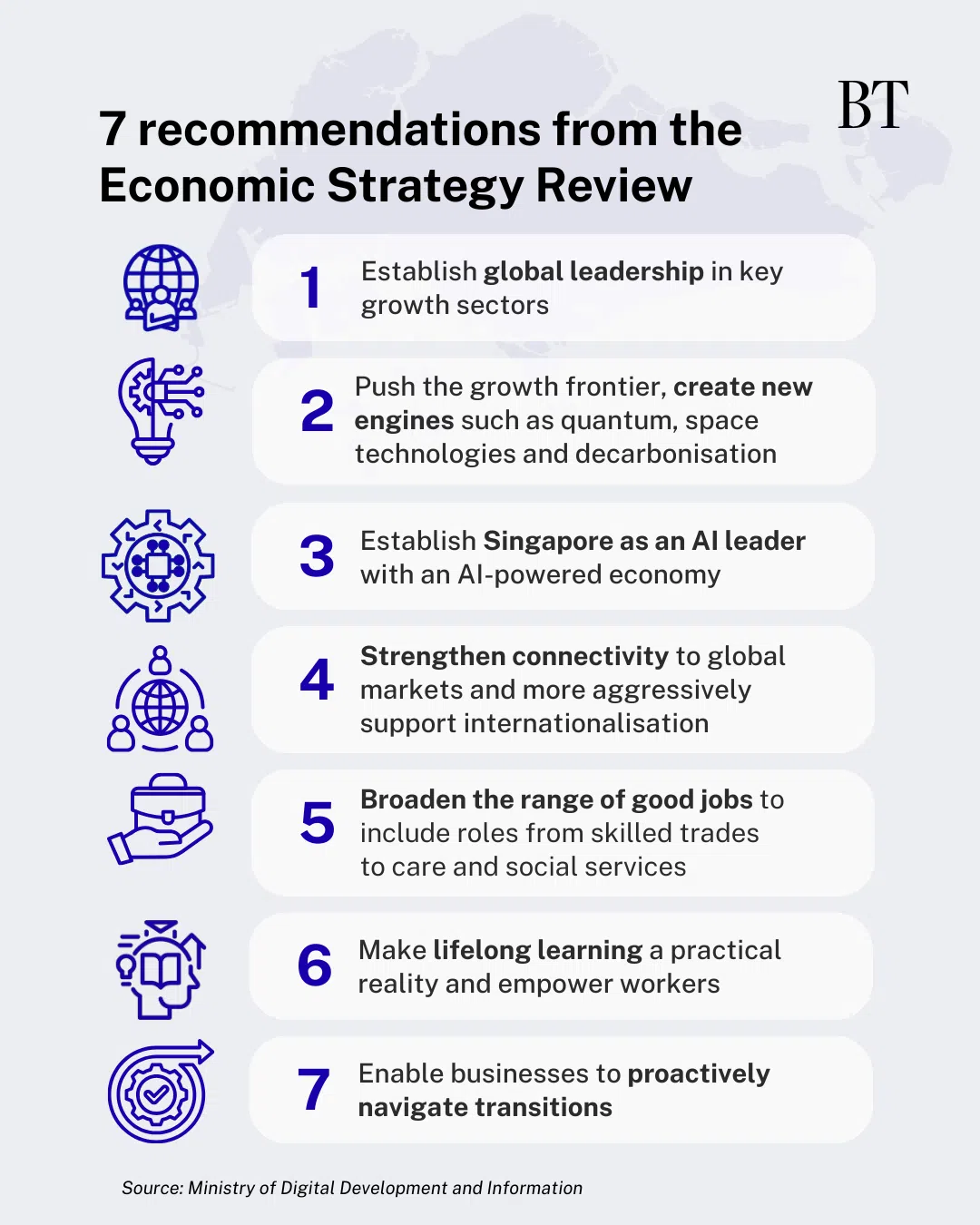
[SINGAPORE] Ahead of the upcoming Budget speech, the Economic Strategy Review (ESR) committees provided a midterm update on Thursday (Jan 29), proposing seven recommendations to drive Singapore’s economic growth and create good jobs amid the complex global environment.
Launched in August 2025 to review Singapore’s economic strategy, the ESR – chaired by Deputy Prime Minister Gan Kim Yong – comprises five committees focusing on global competitiveness, technology, entrepreneurship, human capital, and economic restructuring.
Here are their recommendations.
1. Establish global leadership in key growth sectors
Singapore should double down on its strengths, investing in artificial intelligence (AI) and automation and sustainable technologies for the advanced manufacturing industry, to stay ahead.
To stay competitive, national-level research and development resources must be used to capture global leadership in high-value industries.
Given the changing global environment and risks from emerging technologies, Singapore should leverage its trusted reputation to offer new trust technologies and services, such as cybersecurity, AI assurance and testing, inspection and certification, that will extend its lead in modern services.

2. Creating new engines to push the growth frontier
Singapore should pursue emerging technologies including quantum, decarbonisation and space technologies, which can drive breakthroughs across the economy.
In addition to attracting leading multinational corporations, Singapore should identify new globally-leading enterprises, persuade them to use Singapore as their home base and help them scale their innovations to capture value for the country.
To sustain an entrepreneurial startup ecosystem, it must also help high-potential, fast-growing startups scale regionally and globally, as well as facilitate listing exits so that they can recycle capital and expertise.


3. Establish Singapore as an AI leader with an AI-powered economy
The Republic should position itself as a choice location for companies and talent to develop, test, deploy and scale AI solutions.
To distinguish itself from other AI talent centres, it should also collaborate within government and with industry to identify problem statements and gather resources to develop and test AI solutions.
Singapore should also push for AI adoption, to drive overall productivity.
4. Strengthen connectivity to global markets and more aggressively support internationalisation
Singapore should strengthen linkages by investing in its transport hubs and networks to capture new supply chain opportunities, and deepening trade cooperation and integration with economic partners.
It should also aggressively support local companies in pursuing overseas ventures with higher risk and higher capital outlay, providing them a foothold for growth.
5. Broaden the range of good jobs
For inclusive growth and shared progress, Singapore should broaden the range of good jobs in the economy, to suit workers’ aspirations and skills.
Growth strategies will create some new roles, but new opportunities cannot be concentrated in a few sectors. Singapore should boost efforts to uplift and transform jobs in resilient sectors, with roles ranging from skilled trades to jobs in care and social services.
6. Make lifelong learning a practical reality and empower workers
With new roles created and existing roles being reshaped, skills and training models must evolve to be more agile and responsive.
Singapore will need more flexible pathways that combine training and work to develop industry skills; a national AI workforce strategy to teach AI literacy; a more nimble system that makes better use of private-sector intermediaries; and a government review to improve bridging support from skills to jobs.
It should also provide career transition support for workers affected by increased churn. This includes working with employers on earlier retrenchment notices, partnering tripartite partners and trade associations and chambers to aggregate job vacancies and facilitate job matching, and enhancing career conversion programmes and placements to support various types of workers.
7. Enable businesses to proactively navigate transitions
Beyond support for business expansion and capability building, Singapore should also enable businesses to navigate transitions and pivot to opportunities that may be more viable as the economy restructures.
These could be through support for them to better understand their business health and transform, including through restructuring, rationalising, or offshoring operations.
For more of BT’s Budget 2026 coverage, go to bt.sg/budget26
Decoding Asia newsletter: your guide to navigating Asia in a new global order. Sign up here to get Decoding Asia newsletter. Delivered to your inbox. Free.
Copyright SPH Media. All rights reserved.
TRENDING NOW
DBS remains analysts’ pick ahead of Q3 earnings after Singapore banks’ share slump

Singapore identifies 7 firms responsible for haze fires, notices issued urging action: Grace Fu

Good Class Bungalow market activity picks up pace on ‘realistic’ pricing

High Court rules against Julius Baer’s Singapore trust arm in US$50 million family trust dispute

