Economists expect no change to monetary policy in January, as December core inflation remains stable at 1.2%
Full-year core inflation for 2025 stands at 0.7%, down from 2.8% in 2024

[SINGAPORE] Economists expect the Monetary Authority of Singapore (MAS) to leave policy settings unchanged at its January review next week, with any tightening to be made in April or July at the earliest.
Still, they anticipate the official inflation forecast range to rise to 1-2 per cent on Jan 29, signalling a more hawkish stance. This would be up from a current range of 0.5-1.5 per cent for both core and headline inflation.
Singapore’s core inflation for 2025, which excludes private transport and accommodation, came in at 0.7 per cent, data from the Department of Statistics showed on Friday (Jan 23).
This was slightly above the official forecast of 0.5 per cent, but far lower than the 2.8 per cent recorded in 2024.
Meanwhile, headline inflation for the full year stood at 0.9 per cent, within the official forecast of 0.5-1 per cent, and compared with 2.4 per cent in 2024.
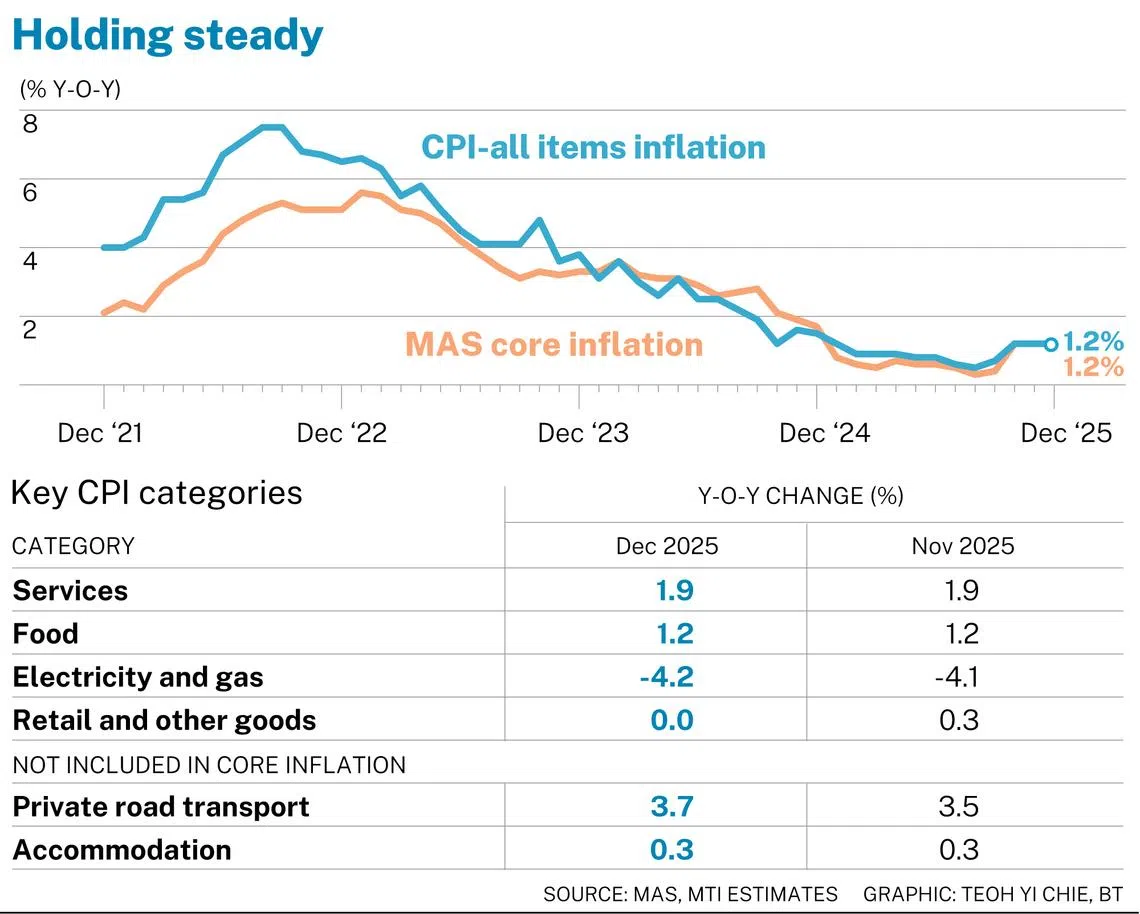
The full-year figures came alongside the release of December’s numbers, which saw both core and headline inflation hold steady at 1.2 per cent – in line with the median forecasts by economists in a Bloomberg poll.
On a month-on-month basis, the core prices rose by 0.4 per cent in December, while the all-items consumer price index (CPI) prices rose by 0.3 per cent.
The acceleration suggests that momentum “is picking up, albeit still at a moderate sequential pace”, said OCBC chief economist Selena Ling.
In a joint statement on Friday, MAS and the Ministry of Trade and Industry (MTI) noted that Singapore’s imported costs should continue to decline over the course of this year, though at a slower pace.
“While global crude oil prices are projected to fall this year, regional inflation should pick up modestly after their weak outturns last year,” they said.
On the domestic front, unit labour cost growth is expected to increase as productivity growth normalises, while private consumption demand “is likely to remain steady”.
Considering these factors, MAS and MTI project core and headline inflation in 2026 to rise from their low levels last year. The official 2026 forecast ranges will be updated on Jan 29.
“No hurry” to tighten
On account of inflation holding steady, economists see little urgency for MAS to tighten monetary policy, with settings likely to stay put on Jan 29. They expect tightening to take place in April or July instead.
Given 2025’s strong growth and the fact that inflation has bottomed and is set to rise in the coming quarters, Standard Chartered (StanChart) economists Edward Lee and Jonathan Koh said that Singapore’s current monetary policy settings may be deemed “too accommodative”.
Still, they see “no hurry” for MAS to tighten monetary policy in January amid ongoing elevated uncertainty and the absence of strong inflationary pressures.
Maybank economists Chua Hak Bin and Brian Lee pointed out that authorities remain wary about downside risks to the country’s economic outlook from tariffs and geopolitics, with MAS therefore likely to maintain policy settings on Jan 29. Rather, they believe the central bank could opt for a “slight steepening” of the S$NEER slope at its April or July meeting, should Singapore’s growth remain robust and core inflation continues to climb.
Similarly, UOB associate economist Jester Koh believes that April or July would be a “more suitable juncture” for the central bank to steepen the slope to 1 per cent per annum, from its current 0.5 per cent.
But he expects this to be a “one-off adjustment” to better align the slope with equilibrium levels, rather than the start of a series of tightening moves.
Barclays economist Brian Tan’s base case is for policy tightening to occur in July.
“We are inclined to believe the MAS will be more circumspect than most market commentators believe – and act later rather than sooner,” he said.
Beyond January’s meeting, Tan pointed out several triggers that could prompt the central bank to tighten monetary policy.
These include a broadening of gross domestic product growth from the manufacturing sector into the services sector, which MAS “would likely view as a precursor to stronger demand-pull inflation pressures”; a “visible intensification” of demand-pull inflation pressures; as well as the central bank’s growing comfort with the sustainability of the artificial intelligence boom, he explained.
Hawkish stance
At the same time, economists expect MAS to raise the official forecast ranges for both core and headline inflation on Jan 29, even if monetary policy settings stand pat.
DBS senior economist Chua Han Teng said: “This adjustment would remain consistent with overall price stability in the economy, though the accompanying rhetoric might lean slightly hawkish.”
Likewise, OCBC’s Ling said that an upgrade of the forecast ranges “would send a more hawkish signal to markets”.
Economists’ forecasts for 2026 fall within their anticipated official ranges of 1-2 per cent, with several clustered around the midpoint.
StanChart’s Lee and Koh, as well as UOB’s Koh, expect both core and headline inflation to come in at 1.5 per cent.
Barclays’ Tan likewise projects core inflation at 1.5 per cent, though he expects headline inflation to come in slightly lower at 1.3 per cent.
At the lower end are OCBC’s Ling as well as Maybank’s Chua and Lee, who are forecasting core and headline inflation to come in at 1.3 per cent and 1.4 per cent, respectively.
But Ling added that she will review her forecasts should the pace of price increases continue to pick up. “The carbon tax hikes, coupled with a tighter manpower situation, fading base effects of rebates and subsidies, may lay the foundation for inflation to incrementally rise from the current levels.”
Key CPI categories
In December, accommodation inflation stayed unchanged at 0.3 per cent, as housing rents increased at a similar rate. Food inflation was also unchanged at 1.2 per cent, as the prices of food services increased at a similar pace. Services inflation also held steady at 1.9 per cent.
Private transport inflation rose to 3.7 per cent, from 3.5 per cent in November, following a smaller decline in petrol prices.
Electricity and gas prices fell further by 4.2 per cent, compared with November’s 4.1 per cent drop, due to a larger decline in electricity prices. Prices of retail and other goods were unchanged, as higher prices for alcoholic beverages and tobacco were offset by falling prices for personal effects and furniture.