

Economists keep Singapore’s 2027 NODX forecasts unchanged despite fresh US tariffs
Exemptions, tariff structures and trade agreements will likely soften the blow, they say

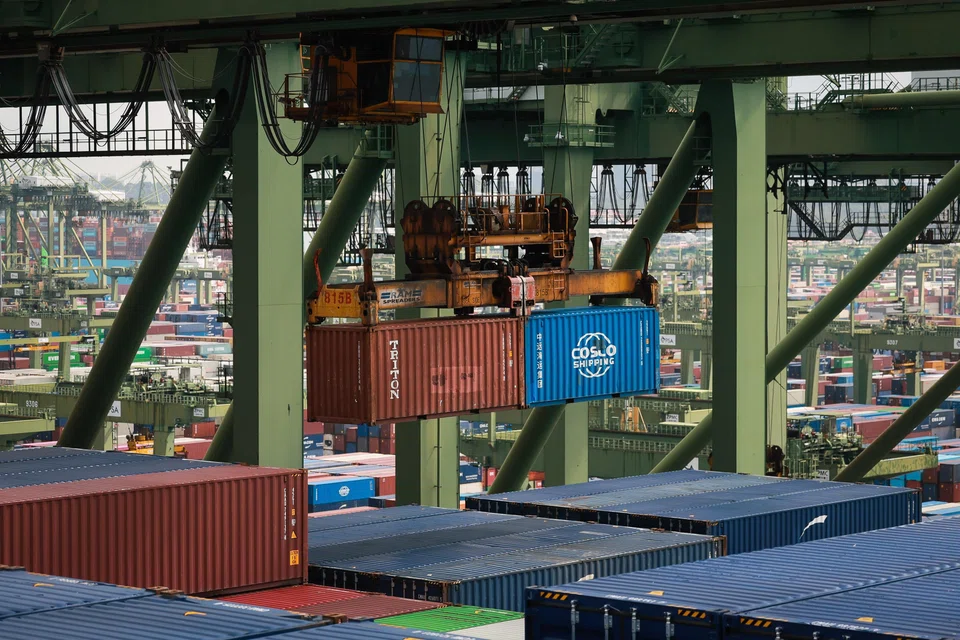
[SINGAPORE] Private sector economists are maintaining their growth projections for Singapore’s non-oil domestic exports (NODX), despite a fresh round of US Section 301 tariffs targeting structural excess industrial capacity.
Exemptions for critical sectors, together with a framework that sets a ceiling for total duties rather than stacking them, will cushion the impact, they said.
Maybank kept its growth NODX projection unchanged for 2027, with analyst Brian Lee noting that the economy-wide impact on overall exports should be small.
“There are quite a number of product exemptions to the tariffs, most notably for electronics,” said Lee, adding that the product exemption list under the fresh Section 301 overcapacity tariffs is largely similar to previous exemption lists under prior tariff frameworks.
Agreed OCBC chief economist Selena Ling: “The direct incremental tariff shock looks relatively contained, particularly given the significant product exemptions.”
The bank’s NODX expansion prediction stayed the same, at 5 to 10 per cent, accounting for some normalisation following 2026’s exceptional artificial intelligence and electronics-led performance, slower global AI capex, a semiconductor inventory correction, and softer US growth.

OCBC’s earlier estimates found that about 68 per cent of US imports from Singapore were exempt under the existing tariff framework, resulting in an effective tariff rate of around 6.1 per cent.
A DBS report from economists including Chua Han Teng and Radhika Rao echoed that continued semiconductor and pharmaceutical exemptions would help keep the downside impact to NODX to the US manageable.
Exports from the region have surged this year despite US tariffs being in place since early 2025, because of these carve-outs, highlighted Moody’s Analytics senior economist Denise Cheok. She also held off on revising her projections.
“The AI boom has seen a surge in demand for tech-related products coming out of Asean, and this is unlikely to change with these latest rounds of tariffs,” she said.
Chris Hampden, senior vice-president at supply chain consultancy Proxima, flagged that electronic assemblies and components, specialty chemicals, healthcare products and precision-engineered parts that do not qualify for an exemption could potentially be exposed.
Yet he agreed that, overall, “Singapore’s direct exposure may also be narrower than the headline suggests”.
Not stackable
Another balancing factor is that the new levy will not compound existing ones.
The proposed 20 per cent tariff cap acts as a ceiling, and does not stack on top of the existing 12.5 per cent tariff on Singapore’s exports, watchers said. This new measure would therefore potentially “top up” the current tariff rate – but would not raise the levy to 32.5 per cent.
The window also remains open for bilateral negotiation, with the tariffs only expected to take effect in early 2027.
“Importantly, this remains a proposal, with written comments due by Jan 5, 2027 and hearings beginning on Jan 25, so the final rate and exemptions could still change,” said Ling.
In fact, the United States Trade Representative’s (USTR) office has explicitly left the door open to potentially lower the levy to 10 per cent, if Singapore reaches an agreement with the US, several economists pointed out.
DBS’ team added that “looser conditions” for Singapore, compared with Vietnam – which was hit with a 35 per cent tariff cap – likely reflects ongoing active bilateral engagements and goodwill between them. They said that on top of a reciprocal trade agreement, “there is scope to conclude other negotiations that address US concerns”.
But Cheok pointed out a legal uncertainty. How the tariffs will be implemented remains unclear, given that the US and Singapore have a free trade agreement (FTA), she said.
“Even a lower 10 per cent rate under a potential Agreement on Reciprocal Trade would be in violation of the existing FTA.”
Indirect hit
Economists also flagged that the impact on trade could be indirect.
“Many multinationals run their Asian procurement, planning and supply chain functions from Singapore, and those teams will need to re-run landed-cost models across their regional sourcing footprints,” said Hampden.
Ling added: “The immediate market impact is therefore likely to be more through sentiment and uncertainty than a large mechanical hit to trade. The announcement may weigh modestly on trade and tech-sensitive equities and business confidence, but the non-stacking structure limits the incremental shock.”
A more meaningful downside risk could arise from second-round effects instead, she believes, if broader tariff actions weaken global demand, disrupt regional supply chains or investment flows, or coincide with a sharper correction in the AI capex cycle.
Decoding Asia newsletter: your guide to navigating Asia in a new global order. Sign up here to get Decoding Asia newsletter. Delivered to your inbox. Free.
Copyright SPH Media. All rights reserved.
TRENDING NOW

Nvidia halts chip shipments to 4 countries in South-east Asia, including Singapore: FT

Should Keppel swoop in to snare Mapletree Investments?

OCBC opens 100-tonne gold vaulting facility to meet growing institutional demand
‘Very disappointed’: Singapore disagrees with US tariff rationale, to seek lower levies

