

2017 labour productivity jumps to seven-year high
Singapore
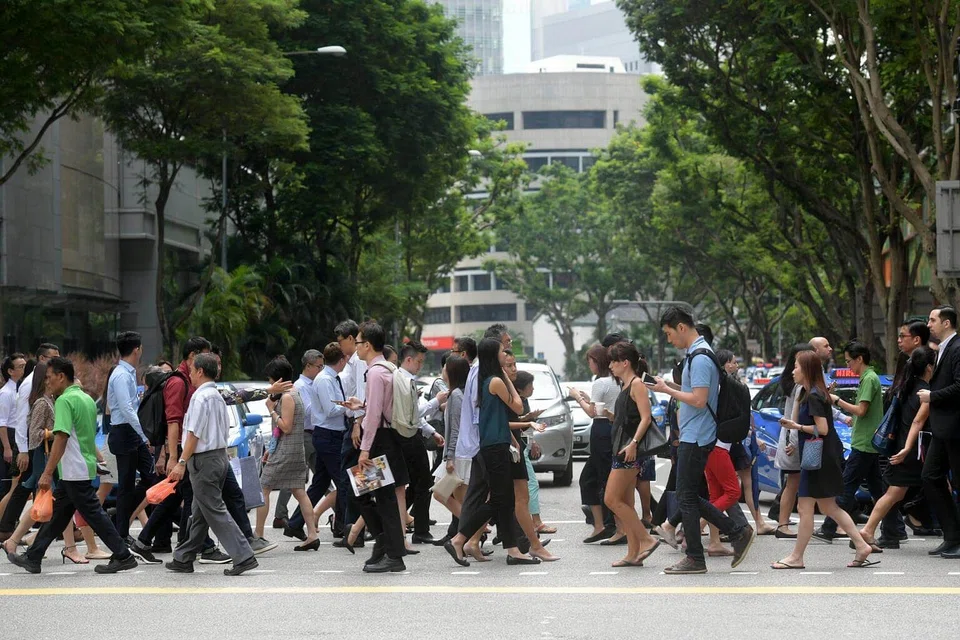
SINGAPORE'S overall labour productivity in 2017 surged to a seven-year peak - the highest recorded since it rebounded in 2010 following the Global Financial Crisis (GFC).
Labour productivity, as measured by real value-added (VA) per actual hour worked, grew by 4.5 per cent last year, improving significantly from the 1.8 per cent achieved in 2016.
In line with the cyclical upswing, this was primarily driven by productivity gains in the outward-oriented sectors such as manufacturing, wholesale trade, and finance & insurance, on the back of an uptick in the global economy, according to a report by the Ministry of Trade and Industry (MTI) released on Wednesday.
On average, more productive sectors increased their share of the total actual hours worked at the expense of less productive sectors like construction. An analysis by MTI found that there has been a gradual shift in the drivers of gross domestic product (GDP) growth over the period of 2010 to 2017, with the Singapore economy increasingly driven by productivity growth rather than employment growth.
Singapore's productivity performance in recent years also fared well compared to several other advanced economies between 2010 and 2016.
The city-state's productivity growth of 1.7 per cent per annum was higher than that of most of the economies compared, such as Italy's 0.1 per cent, the UK's 0.2 per cent and Germany's 1 per cent.
The report also found that outward-oriented sectors were the main contributors to overall productivity growth in 2017, but this was weighed down by the weaker productivity performance of domestically-oriented sectors such as food services, real estate, and administrative & support services.
Productivity in outward-oriented sectors surged by 6.7 per cent in 2017, while that in domestically-oriented services fell by 0.2 per cent.
Correspondingly, outward-oriented sectors contributed 4.2 percentage points to overall productivity growth, while domestically-oriented sectors contributed -0.5 percentage points.
External-oriented sectors saw strong productivity growth in 2017 partly due to the pickup in the external environment. More generally, firms in outward-oriented sectors are also incentivised to optimise operations and seek efficient production methods to remain competitive in the face of global competition, said the report.
It also indicated that there remains scope to raise the productivity of domestically-oriented sectors through sectoral restructuring and transformation efforts.
The report also concluded that the emphasis on life-long learning and skills training under the SkillsFuture initiative will equip workers with the necessary skills for more productive sectors.
Loh Khum Yean, Permanent Secretary for Trade & Industry, said that increasing productivity is a work in progress.
He said: "I think it's an ongoing journey for us to take structural steps and reforms needed to improve productivity, especially for the domestic-oriented sectors. This is part of the objective of the many industry transformation maps that have been launched."
READ MORE:
TRENDING NOW

Simba admits exceeding spectrum limits amid failed M1 deal; parent company Tuas’ full-year profit surges 277%

He built the Vingroup empire. Now South-east Asia’s richest man is handing some key roles to his sons
What’s on the agenda when Xi and Trump meet in Washington

Ex-execs of CW Group, Allied Tech charged with offences linked to lawyer’s S$76 million misappropriation

