AI transition must safeguard and empower workers, support firms: Ng Chee Meng
AI can raise productivity, unlock new possibilities and strengthen country’s competitiveness if used well, says labour chief

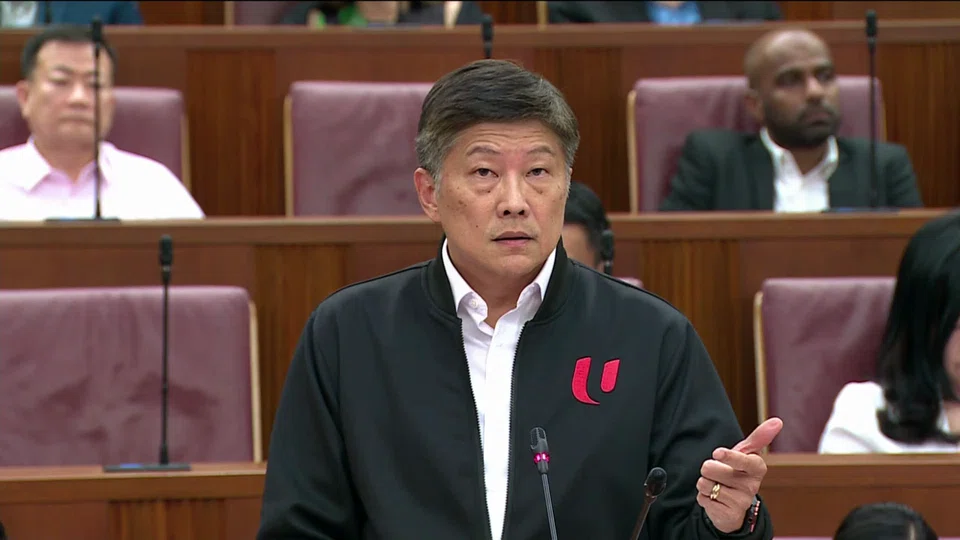
[SINGAPORE] Member of Parliament for Jalan Kayu Ng Chee Meng has called for early, proactive action to address concerns over artificial intelligence adoption, urging that workers’ interests be safeguarded and that they benefit from Singapore’s shift to an AI-enabled economy.
To that end, Ng, who is also secretary-general of the National Trades Union Congress (NTUC), outlined four key moves in his parliamentary motion on Tuesday (May 5): acting early, transforming businesses, training workers and supporting workforce transitions.
The motion is supported by Saktiandi Supaat (Bishan-Toa Payoh GRC), Yeo Wan Ling (Pasir-Ris-Punggol GRC), and Nominated MP Mark Lee, who is also the vice-chairman of the Singapore Business Federation.
Broadly, the motion calls on Parliament to recognise the transformative potential of AI in driving Singapore’s next phase of growth, while ensuring the transition is anchored in fairness, resilience and opportunity.
It also seeks to equip workers and enterprises to seize new opportunities together, and affirms that economic progress must remain inclusive, without “jobless growth”.
The motion is the first to be tabled by a labour MP in 15 years.
In 2011, then MP for Bishan-Toa Payoh GRC, Josephine Teo, tabled a motion on inclusive growth and strengthening support for workers when she was NTUC’s assistant secretary-general.
In his speech on Tuesday, Ng noted that AI is no longer just a tool. Rather, it is now “reshaping how work is done, how we serve customers and how value is created”.
Workers, he said, are understandably anxious as AI is reshaping not just entry-level roles – once the first rung of the career ladder – but also automating routine, process-heavy tasks, reducing the need for junior staff to spend long hours on data processing and standardised modelling.
SEE ALSO

Even professional, managerial and executive (PME) jobs, such as lawyers, doctors and accountants, are being reshaped by AI, he added.
“For many Singaporeans on the ground, two questions remain,” said Ng. “How can I take part in this growth and benefit from it? How will this growth translate into fair opportunities for me?”
He said that when such questions go unanswered, two extremes tend to emerge.
At one end, technology races ahead, leaving displaced workers to fend for themselves, with economists warning of lasting scars.
At the other, “fear takes hold”, prompting defensive pushback – as seen in the 2023 strikes in Hollywood by actors and writers over the use of AI.
“These are not the paths that we want for Singapore,” said Ng, adding that the motion aims to set a clear agenda for AI adoption, one that strengthens competitiveness, supports enterprises and empowers workers.
“I am sure that everyone in this House agrees – AI is not optional. Used well, it can raise productivity, unlock new possibilities, and strengthen our competitiveness,” he said.
“But every worker, who puts in the fair share of effort must be able to see where they fit in this new economy – and be supported to get there.”
“Four practical moves”
Ng outlined “four practical moves” in his speech that aim to support workers and businesses to make that transition towards an AI-enabled economy.
The first is building market intelligence and foresight.
He said that workers and enterprises need not just more information, but also “trusted intelligence, grounded in Singapore’s own labour market realities”, noting that current signals are often fragmented.
Better intelligence would help youth identify in-demand skills and support smoother school-to-work transitions, while giving workers earlier guidance on upskilling and job redesign.
The second area is enabling enterprises to transform with AI “in a way that benefits workers”.
The labour chief cited examples such as PSA and ST Engineering Land Systems, where AI adoption has been paired with workforce upgrading.
However, he noted that small and medium-sized enterprises (SMEs), which employ about 70 per cent of the workforce, often face tighter constraints.
Ng cited the Company Training Committee (CTC) initiative as one that supports such SMEs. The scheme has helped align business transformation with skills upgrading and job redesign.
He suggested that NTUC could work with the Singapore National Employers Federation (SNEF) to scale CTCs nationwide under the new Tripartite Jobs Council, extending AI-related support to more enterprises and workers.
Ng said additional resources may be needed for this new CTC approach, adding that the labour movement will work out the details with SNEF and submit funding requests when ready.
The third area focuses on enabling workers to seize new opportunities.
As AI reshapes jobs, Ng said that support must start early, including through stronger outreach to institutes of higher learning.
As for mid-career workers, he noted that 56 per cent of PMEs feel the need to upskill, citing an NTUC survey.
The labour movement’s AI-Ready SG initiative has trained more than 4,000 workers so far, with plans to scale to over one million training places over the next few years.
Ng said that unions will also expand support through the Union Training Assistance Programme to help offset the cost of selected AI tools, while working with sectoral partners to ensure training is practical and relevant to workers’ daily roles.
The final area is helping displaced workers bounce back with dignity and confidence.
While the government has introduced the SkillsFuture Jobseeker Support Scheme, NTUC is pushing to expand its coverage beyond the current S$5,000 median income threshold to better reflect the risks faced by higher-earning PMEs, said Ng.
“Adjusting coverage closer to the PME median gross income levels, would better reflect the realities of the AI-driven disruption,” he said.
Ng added that Singapore has invested much in the education and the skills of its workforce.
“As we enter the next phase of growth, we must renew our steadfast commitment to support our workers,” he said.
Parliament will debate Ng’s motion on Wednesday.
Decoding Asia newsletter: your guide to navigating Asia in a new global order. Sign up here to get Decoding Asia newsletter. Delivered to your inbox. Free.
Copyright SPH Media. All rights reserved.