Budget 2023: Upskilling is key, though CPF support for platform workers may ease near-term pain
Longer-term solution lies in equipping workers to seek career advancements, greater financial security

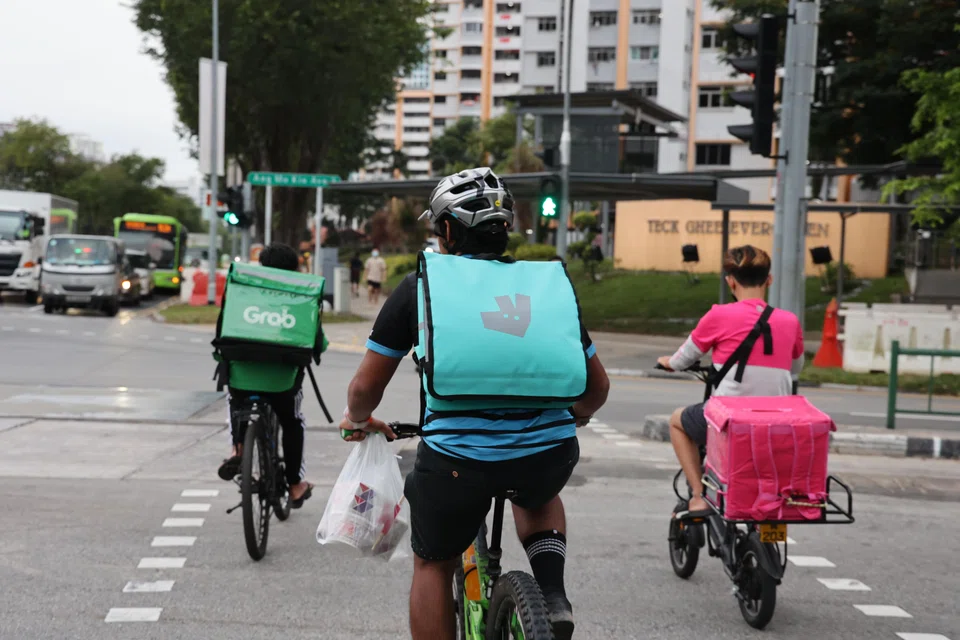
- The Platform Worker CPF Transition Support (PCTS) scheme will offset part of platform workers’ share of the year-on-year increase in CPF Ordinary and Special Account contribution rates for four years after implementation
- Singaporean platform workers earning S$2,500 or less per month, including from other employment sources, will be eligible if they are required to make CPF contributions under new rules, or opt in
A NEW support scheme announced in this year’s Budget will ease low-wage ride-hailing and delivery workers into making Central Provident Fund (CPF) contributions, with new regulations set to kick in from 2024 or later.
But the long-term solution for platform workers still lies in helping them to upskill and pursue job progression opportunities, industry observers told The Business Times.
In his Budget speech on Tuesday (Feb 14), Finance Minister Lawrence Wong unveiled a new initiative, the Platform Workers CPF Transition Support (PCTS) scheme, for platform workers earning S$2,500 or less per month, inclusive of income from other employment sources.
The PCTS scheme will offset part of platform workers’ share of the year-on-year increase in contribution rates to their CPF Ordinary and Special Accounts. It will last for the first four years from the time the new CPF rules, announced last year, kick in for platform workers.
The new rules require platform workers and companies to make CPF contributions at the same rate as employees and employers, as long as the worker is aged below 30 in the first year of implementation. The CPF contribution rates for platform workers will be stepped up over five years, until they hit the prevailing rates, which are currently at 20 per cent of wages for workers and 17 per cent for companies.
Anna Low, head of personal tax and global mobility services at KPMG, said the PCTS scheme would “help companies retain their platform workers and avoid the potential impact of reduced manpower in the platform market”.
The Singapore University of Social Sciences’ Associate Professor Walter Theseira said it would also benefit platform workers operating on very thin margins: “The fact is, for a lot of these workers, they might have very little margin between their earnings and their expenses every month. It would not be inconceivable that the margin would be close to 0 per cent. So even asking them to maybe give a (small percentage) in the first year would be quite a big deal.”
However, this is still only a short-term measure, and upskilling will be important for their economic welfare in the long run. Goh Jia Yong, partner for people advisory services at Ernst & Young Solutions, suggested that more could be done on this front.
“To encourage platform companies to invest in the upskilling and reskilling of platform workers, and enhance their capabilities to take up higher-paying jobs in the future, the criteria for training and wage subsidies can be expanded to also include platform workers,” he said.
Initiatives, such as the Career Conversion Programmes, could also be expanded to help platform workers take up career opportunities within their current platform companies, he added.
KPMG’s Low likewise said that the job-skills integrators, also announced in this year’s Budget, could focus on upgrading platform workers in particular.
Noel Goh, people and organisation rewards leader at PwC Singapore, said platform workers would need to eventually reskill or upskill, because the technology for self-driving cars would eventually catch up, making delivery or ride-hailing jobs disappear.
The Digital Platforms Industry Association, which represents Grab, foodpanda and Deliveroo, said that it “broadly” welcomed the Budget announcement. A Gojek spokesperson said that while CPF was important, extending it to platform workers would “increase costs to consumers and platforms as well impact (its) drivers’ cash flow”.