

Budget 2026: Push to support firms’ overseas expansion, scaling up of startups welcomed
The initiatives will alleviate cost pressures that businesses face, say observers
 Add BT as a preferred source

DeeperDive is a beta AI feature. Refer to full articles for the facts.
[SINGAPORE] Analysts and industry observers broadly welcomed the pro-business measures announced by Finance Minister Lawrence Wong during his Budget speech on Thursday (Feb 12). They noted that stronger support for overseas expansion and additional funding for startups could help firms grow and compete internationally.
They also said that the enhancements to grants, tax incentives, financing schemes and startup investment programmes are expected to help companies expand into new markets, diversify revenue sources and cope better with global uncertainties, while strengthening Singapore’s position as a regional business hub.
Grishma Kewada, chief executive and country manager for Singapore at trade credit insurer Coface, said that insolvency risks remain elevated globally and that the Republic is not insulated from external shocks, especially given its deep integration into global trade and supply chains.
“Many small and medium-sized enterprises (SMEs) continue to operate on compressed margins, face rising operational costs, and struggle with cash-flow pressures,” she pointed out.
Thus, initiatives to alleviate these cost pressures through enhanced grant schemes or tax rebates are timely.
“They enhance cash flow and access to financing, enabling local businesses to invest in more prudent risk management and strategic market expansion,” noted Kewada.

She added that the measures will help SMEs remain competitive and resilient, while reinforcing Singapore’s position as a trusted global trade and business hub.
Internationalisation support
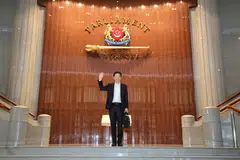
On Thursday, Wong, who is also prime minister, acknowledged the difficulties that firms – particularly smaller ones – face when going global.
In response to these, he announced a slew of measures to support firms’ internationalisation, including enhanced grant support of up to 70 per cent for SMEs and up to 50 per cent for non-SMEs under schemes that help companies expand overseas.

Other initiatives include enhancements to the Market Readiness Assistance (MRA) grant, which will support deeper expansion in existing markets and raise funding support to up to 70 per cent of eligible costs (capped at S$100,000 per company per new market) from Apr 1, 2026, until Mar 31, 2029.
The cap for automatic claims under the Double Tax Deduction for Internationalisation scheme will be raised to S$400,000, with more qualifying activities made eligible for automatic tax-deduction claims.
Currently, companies automatically enjoy a 200 per cent tax deduction for selected qualifying activities under the scheme, capped at S$150,000.
Meanwhile, the Enterprise Financing Scheme will be upgraded through higher loan limits subject to an overall exposure cap of S$50 million per borrower group.
Yong Jiahao, a partner at KPMG in Singapore, said that both the MRA and the double tax deduction schemes will help alleviate immediate cash-flow concerns which come with expanding into new markets. He added that besides making the claim for double tax deduction easier, the expanded list of qualifying activities may also allow more expenditure to qualify.
“The message is clear – businesses are being encouraged to look beyond domestic growth and take a more deliberate approach towards international expansion,” he explained.
DBS senior economist Chua Han Teng noted that with about eight in 10 SMEs planning overseas expansion this year, according to a recent DBS Business Pulse Check Survey, the enhanced internationalisation schemes will support Singapore enterprises seeking to enter new markets and diversify revenue streams.
They will also help “build resilience amid global uncertainty and a limited domestic market”, he added.
Support for startups and public listings
Separately, PM Wong also announced a S$1 billion enhancement to Startup SG Equity, to help startups scale; and a second S$1.5 billion tranche of the Anchor Fund, to anchor high-quality public listings.
This brings the total allocation for Startup SG Equity and the Anchor Fund to S$1.9 billion and S$3 billion, respectively.
Under the Startup SG Equity scheme, the government provides initial capital to catalyse and crowd in private funding for promising startups.
The government will now enhance it to catalyse growth capital in Singapore.
As for the Anchor Fund, it was set up in 2021 to attract and anchor high-quality public listings.
Associate Professor Lee Kuan-Huei, director of programmes for business, communication and design at the Singapore Institute of Technology, noted that expanding the Startup SG Equity scheme to support growth-stage companies reflects a maturing innovation ecosystem, where scaling up has become just as critical as early-stage experimentation.
“Many firms today are navigating persistent cost pressures, tighter funding conditions and the need to adapt business models quickly, which makes access to patient capital and strategic support increasingly important,” she said.
Beyond financing, added Prof Lee, growth-stage enterprises require capabilities in design, branding, digitalisation and market positioning to remain competitive as they secure the local market and expand overseas.
Therefore, strengthening support at this stage helps promising businesses move from innovation to sustainable value creation, while reinforcing Singapore’s position as a launch pad where ideas can evolve into resilient companies that contribute to the broader economy, she said.
Patrick Yeo, PwC Singapore’s markets leader, said that ramping up support to not just early-stage startups, but also growth-stage companies helps increase the probability of Singapore enterprises becoming world beaters.
“Positioning Singapore as the leading centre for growth capital can create a virtuous circle: More enterprises based here succeed and scale, in turn increasing the demand for public listings in Singapore.”
Since the Anchor Fund’s launch, there have been “encouraging signs of renewed listing activity” on the Singapore Exchange, said PM Wong in his speech.
He added: “When enterprises are ready to list, we want them to see Singapore as their listing venue of choice.”
For more of BT’s Budget 2026 coverage, go to bt.sg/budget26
Decoding Asia newsletter: your guide to navigating Asia in a new global order. Sign up here to get Decoding Asia newsletter. Delivered to your inbox. Free.
Copyright SPH Media. All rights reserved.
TRENDING NOW
‘Boring’ is the new black: The stars are aligning for a Singapore stock market revival

Near sell-out launches in March boost developer sales to 1,300 units after four slow months

China pips the US if Asean is forced to choose, but analysts warn against reading it like a sports result

Genting Singapore’s Lim Kok Thay receives S$7.5 million pay package for FY2025

