

China's Belt and Road will outgrow its teething woes: Panel

Singapore
CHINA'S flagship Belt and Road Initiative (BRI) may have hit some speed bumps at the outset, but there's no hiding from its ambitions and its progress, observers here have said.
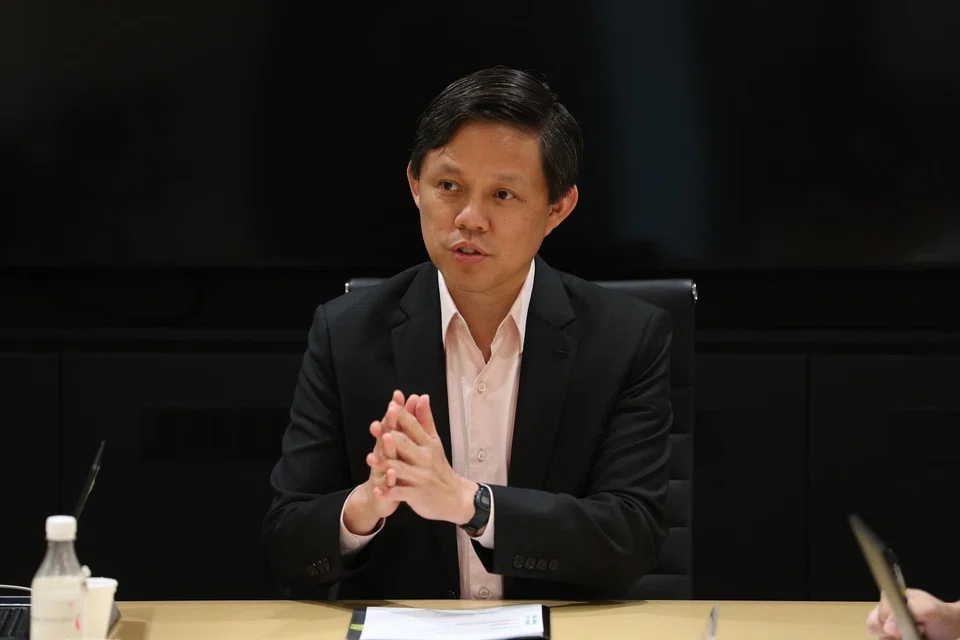
Minister for Trade and Industry Chan Chun Sing and shipping veteran Teo Siong Seng both weighed in on the rising giant at a panel after the Singapore Maritime Lecture on Monday.
The long-term trend is for economic integration between China and the rest of the world, said Mr Chan.
"That is inevitable, no matter how big the Chinese economy might be, and no matter how sophisticated it might be . . . That gives us scope for optimism, to see how we can work with the Chinese in this journey."
He added that "I think the Chinese appreciate Singapore's role" in the BRI - "not because we bring in money like them, we don't have their kind of resources, but I think we bring in a certain way of doing business", such as objective project evaluation, as well as "neutral, professional services" like loan syndication and arbitration.
Mr Chan also said that China's global plans for the BRI are to be fully expected, as "any growing economy in the history of mankind will always try to secure its supply chains and its access to markets. He pointed to the Roman and British Empires and "the American system" as examples.
"I don't think there is a question of aspirations and I don't think China should be questioned on their aspirations to build their own economic ecosystem," Mr Chan pronounced.
Mr Teo, managing director of Pacific International Lines, added: "I really think that Belt and Road is inevitable, and it's not going to be a 10- or 20-year project. It will be over even centuries, and I think we should all look at it with a very open mind."
But Mr Chan noted that "the question that has arisen recently is how the Chinese do it and if they are going through some teething problems".
He cautioned that, "in any Belt and Road project, it is not the sole responsibility of the Chinese to get it right", as project partners share that duty: "If it is only the Chinese going round to select their projects, without the local countries' input, then I think we are setting ourselves up for failure."
Mr Chan suggested that China would benefit from making sure that the selection of projects is based on market principles, with the execution to be based on market feasibility.
"I think there may be cases where, in the haste for many functionaries to clump everything under the Belt and Road Initiative, that some of them are really not based on sound financial and commercial discipline," he said.
Meanwhile, Mr Teo added that some early projects under the BRI - including those helmed by private companies - "were too aggressive".
"We also know that some of the officials in some of the policy banks were changed because some of the projects were over budget," he said, noting that China will "have to learn how to better fine-tune" the BRI.
Separately, Mr Chan reiterated Singapore's support for the maritime industry and said the Government is confident in long-term regional trade growth, even as, "short to medium term, there'll be shifts in the global trade flows, because of the shifts in the global production chains".
"For us, it's not a net positive or a net negative," he said. "We just have to be careful . . . how to position ourselves carefully in those new and shifting global production and trade flows."
The post-lecture dialogue was moderated by BW Group chairman Andreas Sohmen-Pao, who also heads the Singapore Maritime Foundation.
OCBC Bank chief executive Samuel Tsien and venture capitalist Edith Yeung, a partner at Silicon Valley's 500 Startups, were on the panel as well.
TRENDING NOW
Easy to rent out, hard to sell: Are buyers losing interest in Singapore’s one-bedroom condos?

GovTech retrenches another 38 staff in second round of layoffs
Stocks to watch: Seatrium, CapitaLand Investment, Keppel DC Reit, Suntec Reit, CLCT, TSH Resources

World’s largest offshore wind platform by Seatrium consortium on track to be completed by 2028

