Doing business without new foreign workers could become the new normal
More aggressive strategy will be needed to drive changes in sectors and companies, says Singapore National Employers Federation

Singapore
SINGAPORE has tried both the carrot and the stick to wean companies off over-reliance on foreign labour, but the novel coronavirus might just be the final straw for employers.
The Ministry of Manpower (MOM) put a de facto freeze on new work passes in mid-March - before a two-month circuit breaker shuttered many businesses - and there is no word yet on whether the halt will lift when the quasi-lockdown ends in early June.
In line with tighter entry controls, MOM stopped issuing all classes of new work passes for foreigners outside the country from March 18 onwards. Case-by-case exemptions, which are very limited, include workers deemed essential in industries such as health care, transport and waste management.
With dampened consumer demand, businesses are getting by for now. Said Joe Chen, chief commercial officer at fresh produce wholesaler Glife Technologies: "Business is down temporarily, so we have sufficient manpower at this time. But as business resumes, we will require more manpower."
But doing business without new foreign workers could become the new normal. Industry observers told The Business Times that bosses may not be ready for how working conditions must change to keep up.
Linda Teo, country manager of ManpowerGroup Singapore, believes "work will never be the same". "The disruption to companies' manpower availability . . . has shown how over-reliance on foreign workers can affect business operations."
While efforts to develop skilled local manpower have been under way for years - such as the skills frameworks in Singapore's sectoral industry transformation maps - a spokesman for the Singapore National Employers Federation (SNEF) noted that "a more aggressive strategy will be needed to drive changes in sectors and companies".
Besides lifting skilled wages and investing in technology to go manpower-lean, the SNEF believes that employers should consider hiring middle-aged locals aged 40 to 59, as well as the unemployed. These two groups would make up about 200,000 workers, by its estimates.
"Until recently, there was simply much more job creation than could be filled by locals," noted labour economist Walter Theseira, an associate professor of economics at the Singapore University of Social Sciences.
And, with the global electronics industry poised for cyclical upswing, Singapore began the year on the cusp of an economic rebound.
But it now faces a massive recession and projected layoffs in the tens of thousands. Economists believe that foreigners will bear the brunt of retrenchments, making the need for local workers even more critical.
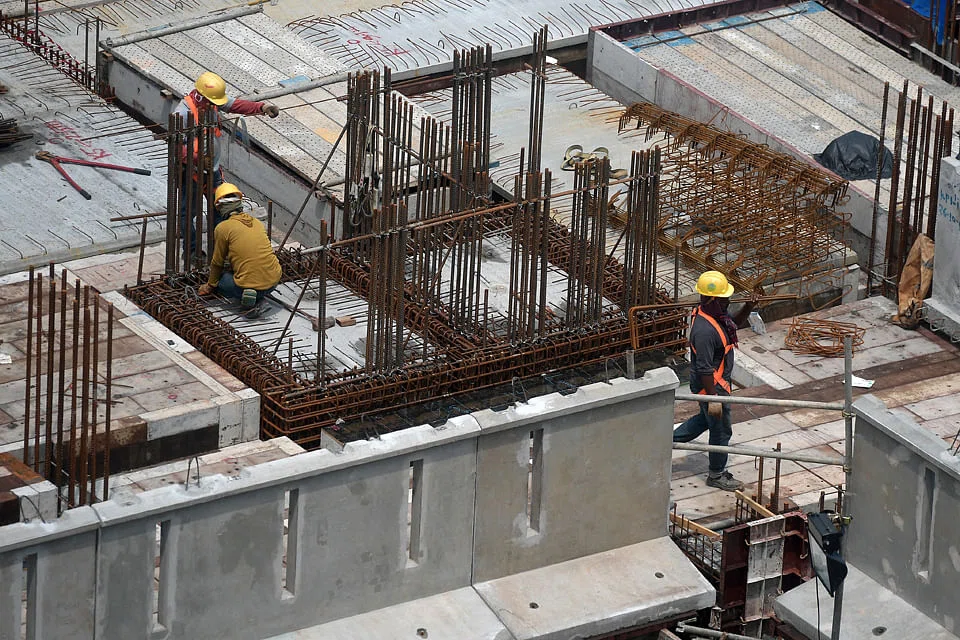
Yet there were 1.43 million foreign workers here at end-2019, with some 576,100 in the services sector. Some 341,400 worked in construction, and another 242,700 worked in manufacturing, where the workforce is split evenly between locals and migrants. The rest are domestic workers.
Many of them support functions deemed essential even during the circuit breaker, such as facilities management and waste management, as it seems that Singaporeans do not want to do these jobs.
For instance, Jean Yip Group takes in no more than 50 local trainees a year, because of a lack of interest.
Combined with a tighter foreign worker quota, this manpower crunch has stymied the beauty and hairdressing group's expansion plans in the last few years, said group operations and marketing director Dawn Yip.
"If it's so easy to replace, all (of us) would have done it already, because this policy of reducing foreign labour has been in place already," she added.
To be sure, hiring foreign workers is not always the cheap fix that some assume. Upscale hairdresser Casey Salon used to employ some half a dozen Malaysians because they came with higher industry qualifications, but it has switched to an all-local staff.
Pointing to the foreign worker levy system, business director Paul Chua told BT that employing foreigners could cost the same, if not more, than locals. As restrictions tightened over the years, "we started to gradually lean less on foreign workers and instead focus on our in-house training to upskill our highly experienced team of eight Singaporeans", he said.
Now with the pandemic, National Development Minister Lawrence Wong has warned that tougher virus safety rules for foreign workers will raise construction costs.
Tonny Loh, senior client partner in advisory at consultancy Korn Ferry, also observed that employers may have to fork out more for foreign labour, "either as direct costs in more stringent employment conditions or through a higher levy".
Prof Theseira said: "When there is a labour crunch and a job is essential, the market adjusts to compensate - by raising wages or improving working conditions to make the job more desirable." Tighter foreign worker quotas for food and beverage services were evened out by more recruitment of older locals, for instance.
"Again, it may not be an ideal job for all Singaporeans, but it can become better for many," he noted.
Yet a bump in wages - though crucial - will not be enough to woo locals, observers said. Neither will pay raises work, if productivity is not boosted.
While ManpowerGroup's Ms Teo noted that tweaks to wages and working hours could attract local workers, she warned: "The short-term fix by increasing wages without any real rise in productivity is not a viable long-term solution. Employers will need to dive deeper into the core human resources issues . . . such as career progression and recognition."
Mr Loh also called on businesses to ramp up digitalisation - which would free up workers for higher-skilled, higher-value tasks.
"Generally, it is not sustainable for companies to simply raise wages to attract locals especially if their business models and jobs do not change in the short term," he said.
"Companies seek to pay appropriately, according to the value of the job. Once the jobs are elevated, wages will naturally go up and they will become more attractive to locals."
Using technology to make up for a shortfall in workers is another solution that is being keenly pursued.
Fong's Engineering and Manufacturing, where 55 per cent of staff are foreigners, plans to invest in Industrial 4.0 robotics, automation and even artificial intelligence (AI) for its production and backend operations, over the next three years.
Grand Venture Technology, which makes high-precision parts, is also embracing emerging technologies, such as the Internet of Things and AI, to transition to smart manufacturing.
Indeed, the Singapore Manufacturing Federation (SMF) found in a recent poll that about 75 per cent of members have tapped digital tools during the circuit-breaker period.
But those companies use information technology solutions in areas such as finance, human resources and inventory, SMF president Douglas Foo said. Nearly seven in 10 respondents still said their reliance on foreign labour will stay unchanged, since "even with digitalisation, manpower is still likely required across a wide range of functions".
Mr Loh said: "In the short term, sectors which traditionally rely heavily on foreign workers, such as construction, process and some manufacturing industries, would still require foreign workers to continue operations once economic activity picks up."
Other jobs may simply disappear from Singapore's economy. Said Prof Theseira: "A business which says it can't adapt - what that really means is that the job is not producing enough value that it expects to be able to cover costs and make a reasonable profit."
Corporate uniform supplier Esta - which employs three seamstresses from China, who earn between S$1,800 and S$2,300 a month each - faces just that problem.
Business owner Esther Tay, who complained of a dearth of local seamstresses, also frets that her small business does not have the resources for industrial-scale automation.
"If we cannot get the foreign workers, then we will also think of closing down the workshop and working with overseas factories," she said. "But that will be another challenge, in terms of not being able to meet our clients' deadline expectations."
At the end of the day, Prof Theseira said: "Wages adjust, working conditions adjust, jobs adjust. One or more of these will happen."
READ MORE: Who will do the dirty, intensive jobs that Singaporeans shun?