
Economists hold 2026 Singapore growth forecasts despite strong 2025 finish

This year’s risks include trade policy uncertainty, geopolitical tensions and manufacturing normalisation

Summarise
Low Youjin
Published Fri, Jan 2, 2026 · 06:22 PM
    • The Republic’s economy expanded 4.8% year on year in 2025, while Q4 GDP growth came in at 5.7%, advance estimates from MTI showed.
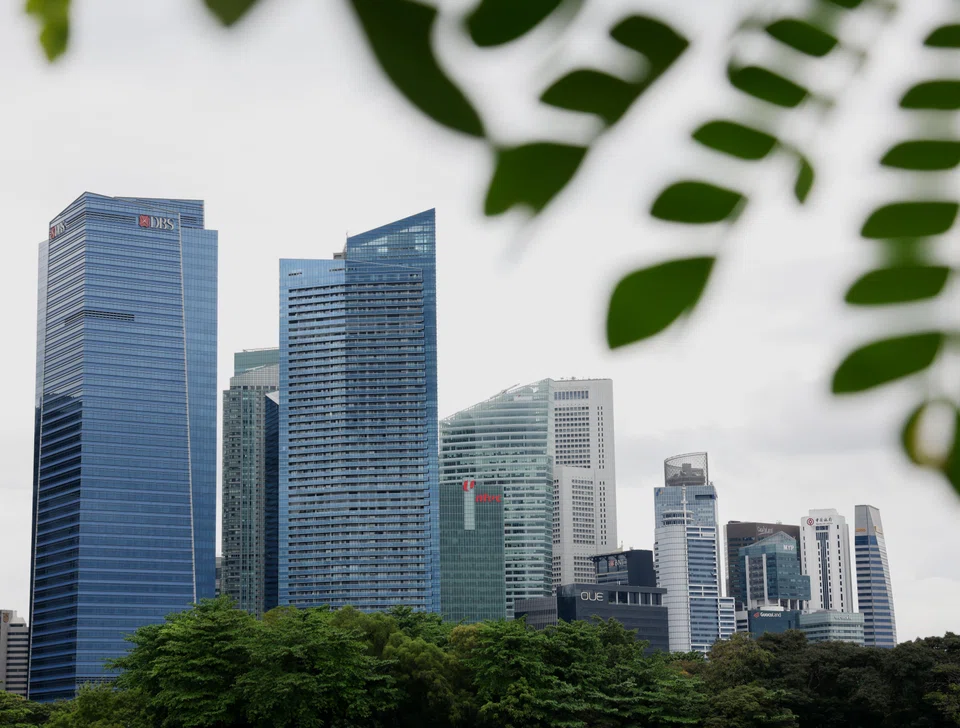
    • The Republic’s economy expanded 4.8% year on year in 2025, while Q4 GDP growth came in at 5.7%, advance estimates from MTI showed. PHOTO: TAY CHU YI, BT

    [SINGAPORE] Private-sector economists largely kept their 2026 growth forecasts unchanged, even after Singapore’s economy turned in a stronger-than-expected performance at the end of 2025.

    The economy expanded 4.8 per cent year on year in 2025, supported by strong growth in the manufacturing sector, based on advance estimates from the Ministry of Trade and Industry (MTI) released on Friday (Jan 2). 

    While the growth momentum is expected to carry into early 2026, economists cautioned that activity could cool later in the year as manufacturing growth normalises and external risks resurface.


    OCBC chief economist Selena Ling said the outlook remains shaped largely by external factors, including uncertainty over US sectoral tariffs, US-China tensions and broader geopolitical risks.

    Adding to those concerns, Maybank economists Chua Hak Bin and Brian Lee flagged the risk of further domestic property cooling measures if prices run too hot, which could dampen activity in the real estate, construction and retail sectors.

    Aside from being faster than the revised 4.4 per cent growth recorded in the previous year, 2025’s gross domestic product expansion also exceeded the official forecast of “around 4 per cent”, to which MTI upgraded last November.

    Fourth-quarter GDP growth came in at 5.7 per cent, faster than the revised 4.3 per cent expansion for Q3, and higher than the 5 per cent growth booked in the same period in 2024. 

    On a seasonally adjusted, quarterly basis, the economy grew 1.9 per cent in Q4, easing from the previous quarter’s 2.4 per cent expansion.

    Outlook for the year

    In 2026, MTI expects Singapore’s economy to grow by 1 to 3 per cent. DBS senior economist Chua Han Teng said the range “reflects a cautious outlook”, with the lower bound leaving room for a deeper cyclical downturn should unexpected negative shocks materialise after a strong 2025. He said: “Singapore’s better-than-expected overall growth in 2025 was due to the resilient manufacturing and trade-related services sectors, which surprisingly handled the US tariff shock well.”

    Manufacturing growth rose to 7.6 per cent in 2025, from 4.3 per cent the year prior. Meanwhile, wholesale and retail trade, as well as transportation and storage – which are part of the services industry – expanded 4.5 per cent last year, extending the 5 per cent increase in 2024. 

    In Q4, manufacturing growth jumped to 15 per cent from 4.9 per cent, while wholesale and retail trade, and transportation and storage, expanded 0.4 per cent, reversing a 1 per cent contraction in Q3

    DBS’ Chua added that the US tariff implementation in 2025 was staggered and “proved to be less blanket and burdensome than initially feared”.

    However, OCBC’s Ling said that “given that 2025 was already a blockbuster year, 2026 may pale somewhat in comparison”, adding that she expects manufacturing growth to slow on the year as 2025 will be a hard act to beat.

    Private-sector economists generally kept their 2026 growth forecasts unchanged, with projections clustered within MTI’s official 1 to 3 per cent range. 

    DBS maintained its forecast at 1.8 per cent, while OCBC kept its call at 2 per cent, citing expectations that manufacturing growth will ease after a high base in 2025. 

    Maybank was the most upbeat, holding to a forecast of 2.8 per cent growth in 2026, near the upper end of the official forecast range. 

    “The AI (artificial intelligence) boom is expected to continue as mega-cap US tech firms guide for significantly higher (capital expenditure), supporting Singapore’s electronics exports, investments and tech services activity,” the Maybank economists said.

    They added that construction activity should pick up, supported by a pipeline of large-scale infrastructure and housing projects, while falling interest rates and the Monetary Authority of Singapore’s Equity Market Development Programme “should support capital market, lending and real estate activities”.

    Barclays was the only bank to revise its forecast, raising its 2026 projection to 2.5 per cent from 2 per cent following the stronger-than-expected momentum at the end of 2025.

    Sectoral breakdown

    MTI attributed the manufacturing sector’s performance last year largely to higher output in the biomedical manufacturing and electronics clusters. Pharmaceuticals drove biomedical manufacturing, while sustained demand for AI-related semiconductors, servers and related products supported electronics.

    Construction expanded 4.2 per cent year on year in Q4, easing from 5.1 per cent in the previous quarter, bolstered by higher public and private-sector construction activity. For the full year, the sector grew 4.9 per cent.

    The services industries grew 3.8 per cent year on year in Q4, slowing from 4.1 per cent in the preceding quarter, and rose 4.1 per cent for the full year. 

    Within services, the information and communications, finance and insurance, and professional services cluster posted the strongest growth in Q4 at 4.2 per cent, though this was slower than in the previous quarter. For the full year, the cluster grew 4.1 per cent.


