

Economists warn that Singapore factory output could slow or contract further from Gulf conflict, following February’s 0.1% shock dip
February’s performance is in stark contrast to private-sector economists’ estimates, who predict a median 14.1% expansion

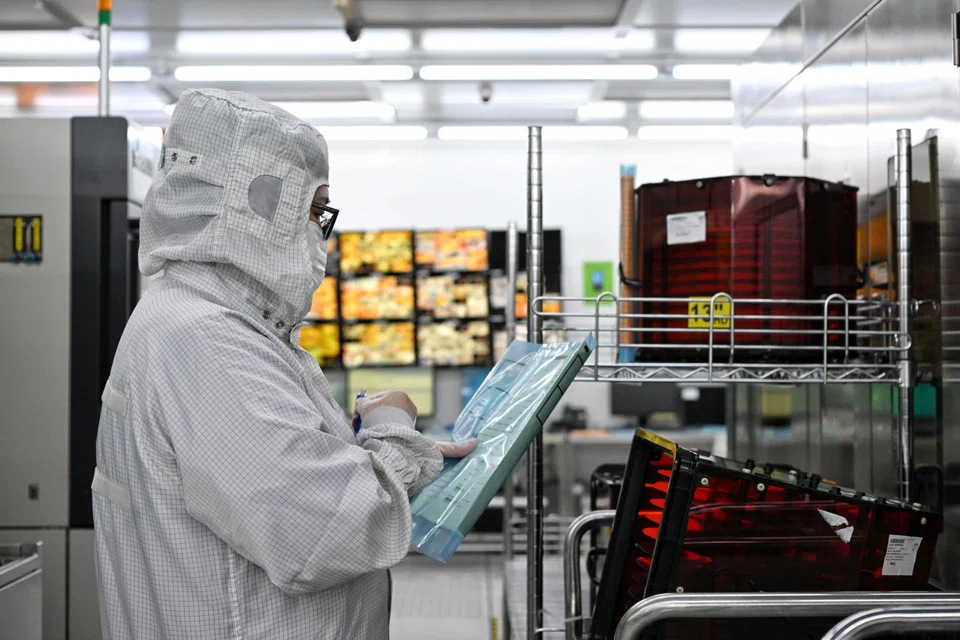
[SINGAPORE] Economists cautioned that the Republic’s industrial production growth could slow – or even turn negative – due to the ongoing Middle East conflict, possibly extending February’s shock 0.1 per cent decline.
Factory output unexpectedly dipped 0.1 per cent year on year in February, dragged by the biomedical cluster, data from the Economic Development Board (EDB) showed on Thursday (Mar 26).
This was a sharp reversal from January’s downwardly revised 12.9 per cent growth, and broke a five-month expansion streak.
February’s performance was also in stark contrast to private-sector economists’ estimates, who had predicted a median 14.1 per cent expansion in a Bloomberg poll.
Excluding the volatile biomedical manufacturing cluster, however, industrial production expanded 3.9 per cent year on year. This was compared to January’s downwardly revised 19.9 per cent increase.
Maybank economists Chua Hak Bin and Brian Lee expect Singapore’s factory output to contract slightly in March due to the “shock” of the Middle East conflict.
“The fallout from the Gulf War outbreak will likely be more apparent in the March manufacturing data, which could see manufacturing stagnate or contract slightly,” they said.
OCBC chief economist Selena Ling said Singapore could see a contraction in industrial production in the second quarter of 2026.
As she sees it, the question is “how long the Iran war drags on for, and how much global demand and confidence may suffer indirectly”, including the shortage of components such as petrochemicals.
UOB senior economist Alvin Liew said February’s performance has reinforced his assessment of downside risks stemming from the Middle East conflict, which could pose a drag on Singapore’s growth.
The persistence of the conflict beyond a quarter could exert a “sharp drag” on the manufacturing sector, with “adverse spillovers” to wholesale trade as well as transportation and storage.
Secondary effects on growth “could also emerge via a drag on consumption and investment activity in Singapore’s key trading partners”, while weakened external demand could weigh on Singapore’s exports, he added.
Declines due to plant shutdowns
All clusters recorded declines in factory output in February, with the exception of the lynchpin electronics sector. The EDB attributed the declines largely to plant shutdowns during the Chinese New Year period.
Still, economists noted that Singapore’s factory output grew 6.9 per cent overall over the first two months of 2026, which evens out the impact from the Chinese New Year period.
Standard Chartered’s chief economist and head of foreign exchange for Asean and South Asia, Edward Lee, said it was “better” to look at the last two months’ data collectively due to the distortions from the festive season.
Electronics grew 13.7 per cent for the month, extending January’s 34 per cent rise.
Growth was led by the segments of other electronic modules and components; infocomms and consumer electronics; and semiconductors segments, with the latter two driven by artificial intelligence (AI) related demand.
However, the sector was dragged down by a decline in the computer peripherals and data storage segment.
Maybank’s Chua and Lee said electronics growth should remain a bright spot as the AI capital expenditure boom “appears unscathed” by disruptions from the Middle East conflict so far.
In contrast to the Maybank economists and Ling, DBS senior economist Chua Han Teng expects Singapore’s manufacturing performance to rebound in March following the Chinese New Year seasonal swings, with electronics output supported by sustained global AI tailwinds.
Nonetheless, he said he is monitoring downside risks such as the escalation of geopolitical tensions in the Middle East. This could disrupt supplies of key inputs – including petrochemicals and critical electronics manufacturing materials – to the Republic’s manufacturing sector.
The worst-performing cluster in February was biomedical manufacturing, sharply declining 27.3 per cent year on year.
The pharmaceuticals segment contracted due to a different mix of active pharmaceutical ingredients being produced, while the medical technology segment fell amid softer demand for medical devices.
The second-worst performing cluster was general manufacturing, with output dipping 5.7 per cent due to festive season shutdowns.
The food, beverages and tobacco segment recorded lower output of dairy and cocoa products, while the miscellaneous industries segment saw lower production of structural metal products and furniture.
Other clusters that recorded declines due to festive plant shutdowns were:
- Chemicals (-4.6 per cent)
- Precision engineering (-3.5 per cent)
- Transport engineering (-0.2 per cent)
On a seasonally adjusted monthly basis, manufacturing output declined 7.2 per cent in February, reversing January’s revised 2 per cent growth.
Excluding biomedical manufacturing, production slumped 9.4 per cent on the month, reversing from the previous month’s revised 7 per cent growth.
TRENDING NOW

LTA proposes combining car COE categories, adding rebate-surcharge system

StarHub to acquire MyRepublic’s mobile business amid ongoing telco consolidation

DBS, OCBC, UOB rout lops billions off STI as inflation, rate concerns spook investors

Grab CEO’s wife Chloe Tong on life with Anthony Tan and finding her purpose

