

EVs to get boost from extended incentives, but hybrids could suffer from emission rebate cut
Even as changes show Republic’s commitment to electric vehicles, some say that hybrids are still relevant

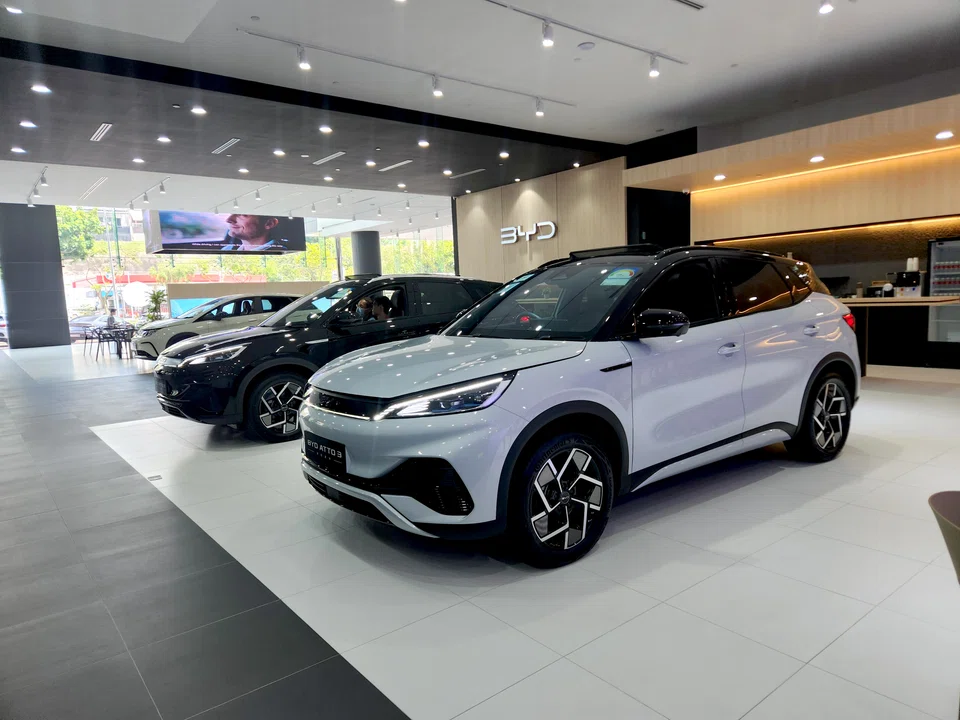
RECENT tweaks to two clean-vehicle schemes show Singapore’s commitment to electric vehicles (EVs) – but possibly at the expense of hybrids, pointed out industry players.
Authorities said last Friday (Sep 20) that the EV Early Adoption Initiative (EEAI) will be extended past its end-2024 expiry for another year, till end-2025.
Under the EEAI, buyers of electric cars and taxis get a 45 per cent discount – capped at S$15,000 – on the Additional Registration Fee. Introduced in 2021 for two years with a cap of S$20,000, the initiative was then extended to end-2024 with a lower cap of S$15,000.
Lars Nielsen, managing director of BMW Group Asia, said that the latest extension was a “strong signal on Singapore’s commitment towards EV adoption”.
In contrast, demand for hybrids may be hit by changes to the Vehicular Emissions Scheme.
This bands passenger cars and taxis based on emissions, with rebates for cleaner bands and surcharges for more pollutive ones.
From 2025, rebates for the A2 band – where most hybrids and higher-performance or larger EVs fall – will be halved to S$2,500, from S$5,000 currently.
All other bands are unchanged. The cleanest vehicles, in the A1 band, will continue to get a S$25,000 rebate.
EVs will thus continue to receive a maximum of S$40,000 in rebates until end-2025, unless they fall in the A2 band.
Electric city
Automotive consultant Say Kwee Neng welcomed the EEAI extension, noting that EV adoption in Singapore is still at a very early stage.
“I don’t think we are at the natural tipping point yet where demand for EVs will, by consumer choice, exceed that of internal combustion engine (ICE) vehicles,” he said. He expects incentives to be reduced when EV demand reaches parity with that for ICE cars.
EVs made up more than a third of new passenger car registrations in the first half of 2024. Their population reached a new high of 20,497 in August, accounting for 3.1 per cent of the total car population.
Walter Theseira, associate professor of economics at the Singapore University of Social Sciences, expects EV adoption to continue at a similar pace, or even improve as battery prices keep falling and China’s carmakers court buyers.
“The policy framework is to make EVs comparable (to ICE cars) after taxes and subsidies but not necessarily unduly attractive. So I think it would be logical to scale down rebates as EV availability and costs improve,” he said, saying that the next revision of EEAI could lower the rebate.
EV > hybrid?
In contrast, hybrid demand could be hurt by the cut in emissions rebates.
Ng Choon Wee, the commercial director for Hyundai distributor Komoco Motors, said that the recent moves aim at extending the advantage of EVs in the market, but the A2 rebate cut comes at the expense of hybrids.
Since hybrids tend to cost more than petrol cars, the reduced rebate could cause consumers to choose the latter, which receive neither rebates nor penalties, he noted.
Still, the change in rebate is small enough that it could be negated by fluctuations in Certificate of Entitlement premiums – so it remains to be seen if it will hurt hybrid sales significantly, he added.
Ng and Prof Theseira agreed that hybrids will remain the vehicles of choice for buyers who are conscious of fuel efficiency – including private hire car fleets – as they are significantly more fuel-efficient than ICE cars and will cover the higher initial cost in the long run.
Nicholas Wong, chief executive officer for authorised Honda dealer Kah Motor, said that the rebate change might not be big enough to dent hybrid sales.
Still, the government would be wise to diversify its approach instead of focusing on pushing EVs, he felt. “Instead of adopting a single-pronged approach and putting all the eggs in the EV basket, the more sustainable and less-disruptive way to go would be to consider hybrids, as they are self-charging and cleaner than ICE-only cars.”
He added: “We should give serious thought to continue to promote hybrids. It’s not something that should be discarded so early in the game.”
Similarly, consultant Say said: “I think (favouring EVs only) can be perceived as premature if you feel that the jury is still out on whether EVs are the sustainable future for transportation.”






