

External headwinds weigh on Singapore’s export growth despite forecast upgrade: economists

Sharon See
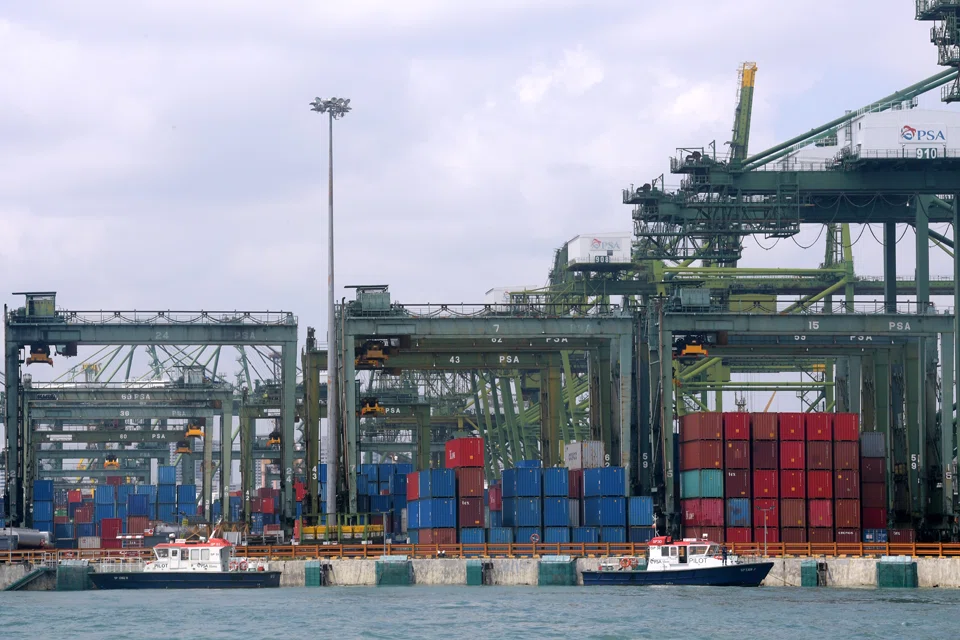
DOWNSIDE risks are likely to continue weighing on Singapore’s export performance in the months ahead, even though the authorities on Wednesday (May 25) significantly upgraded their full-year trade forecast, said economists.
Total merchandise trade is now expected to grow 8-10 per cent, while the outlook for non-oil domestic exports (NODX) is 3-5 per cent, according to Enterprise Singapore’s quarterly trade review.
As recently as February, the official forecast for both indicators was maintained at 0-2 per cent, “considering that the pace of growth is likely to moderate from the high base in 2021, in line with the global economic and trade outlook”, said EnterpriseSG.
Since then, both indicators outperformed expectations in the first quarter, the agency said.
Total merchandise trade grew 20.8 per cent year on year in Q1, extending the previous quarter’s 28.8 per cent increase. NODX rose 11.4 per cent in Q1, easing from 20.1 per cent in the fourth quarter.
OCBC chief economist Selena Ling noted that the main contributors to the better-than-expected NODX performance were non-electronics exports, namely structures of ships and boats, specialised machinery and pharmaceuticals, reflecting the increased infrastructure investment demand and the ongoing Covid-19 pandemic.
The authorities’ forecast upgrade came as no surprise to economists, as their projections were already closer to the new numbers. Maybank economists said their 2022 NODX growth forecast is 4-6 per cent; DBS’s is 4-5 per cent; and OCBC’s is 4-8 per cent.
But the improved outlook is not exactly one that fuels optimism, economists cautioned, with external uncertainties such as the Russia-Ukraine war and China’s Covid-19 lockdowns likely to bear down on trade performance in the coming months.
This comes even as one of EnterpriseSG’s reasons for upgrading its forecast is that “most of Singapore’s key trade partners including China, the US, eurozone and Asean-5 were expected to grow in 2022 despite downgraded growth forecasts due to the spillover effects from the Russia-Ukraine conflict”.
“This shows that they were earlier on too overly cautious in their prediction, and their growth outlook in some of the key markets was too bearish,” DBS senior economist Irvin Seah told The Business Times. “What happened in Ukraine came as a shock to everyone, and I think when the war first started, there was too much risk aversion being priced in.”
He added: “The point now is that the downside risks have actually picked up, so citing such reasoning sounds a bit contradictory. It’s quite clear that the economic climate has become more challenging.”
Still, OCBC’s Ling noted that the US tied with China as Singapore’s largest NODX partner in Q1, with both having a 15.8 per cent share. This, she said, is a testament to the strength of the US economy, particularly in private consumption.
“Of course, looking ahead, more aggressive monetary policy tightening by the FOMC (Federal Open Market Committee) could potentially result in a policy mistake that risks missing a soft landing,” she added.
Maybank economist Lee Ju Ye said the global trade outlook is “clouded by headwinds”, including China’s slowdown and the Russia-Ukraine war.
“We expect Singapore’s NODX momentum to slow to low or mid single-digit growth in the coming quarters. Electronics exports, while resilient on the back of strong global chip demand, are also slowing from high-base effects. This will likely more than offset the growing demand from neighbouring countries that are reopening,” Lee said.
Meanwhile, higher oil prices will also drive trade growth in nominal terms and in turn, total trade, EnterpriseSG said, adding that oil prices are tipped to stay above US$100 per barrel this year, while global semiconductor revenue projections are higher than before.
Noting that NODX is measured in nominal terms, DBS’s Seah said: “The current resilient performance is because of the increase in prices, so in real terms actually, it has declined.”
TRENDING NOW
Despite the de-dollarisation debate, demand for dollar liquidity in Asia is growing
URA to review guidelines on floor space to give developers more design flexibility: Chee Hong Tat

He built the Vingroup empire. Now South-east Asia’s richest man is handing some key roles to his sons
Can a first-time homebuyer couple earning S$18,000 a month afford a new EC unit?

