

Growth in factory output for August hits nadir for this year
Factory output grew 3.3% yoy; economists expect muted factory activity in coming months
Singapore
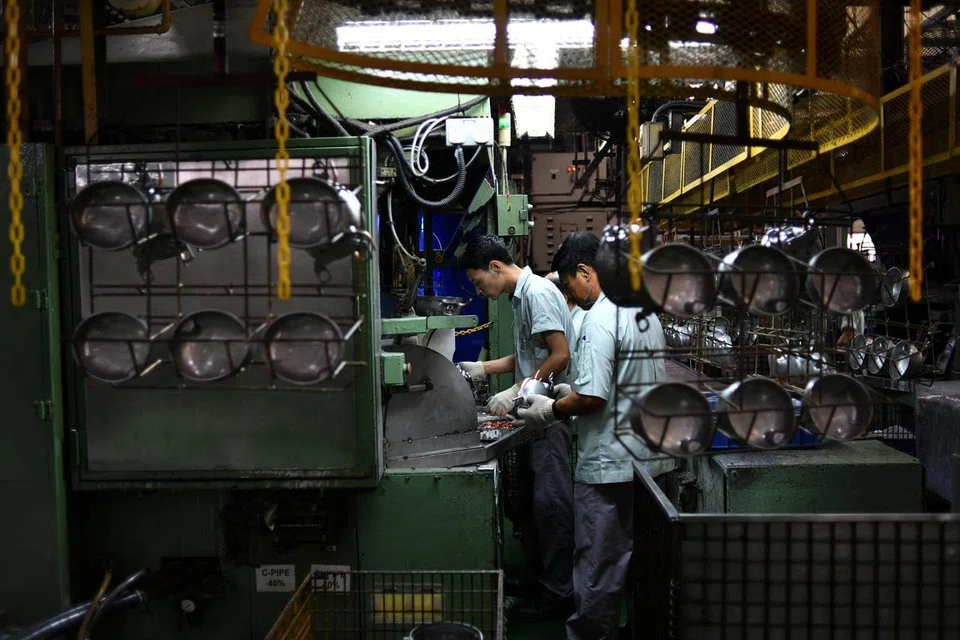
THE growth rate in Singapore's factory output for August fell to its lowest this year, on the back of the triple whammy of the Sino-US trade conflict, slowing electronics demand and the high base from last year.
But manufacturers hoping for quick relief will just have to hang tight; economists told The Business Times that they expect factory activity to remain muted over the next few months.
Maybank Kim Eng economists Chua Hak Bin and Lee Ju Ye noted: "The fading electronics cycle and supply-chain disruptions from the US-China trade war will likely lower manufacturing growth to low single digits for the rest of the year."
Industrial production grew by a subdued 3.3 per cent year on year in August, coming in below economist expectations of 4.7 per cent. This continued the downward trend of the past few months. Growth was 6.7 per cent in July and 8.1 per cent in June.
Manufacturing output actually declined 2 per cent on a seasonally adjusted month-on-month basis.
While production numbers were underwhelming, slower factory activity in the second half of the year has long been anticipated by economists.
DBS economist Irvin Seah said: "The global business cycle was already easing on the back of tighter liquidity conditions associated with monetary policy normalisation. The US Fed is on a hiking cycle, while China was previously undergoing deleveraging.
"The trade war is just another factor weighing down on the manufacturing sector, but not the main reason."
Most recently on Monday, the US slapped 10 per cent tariffs on US$200 billion worth of Chinese imports. China has retaliated with 5 to 10 per cent tariffs on US$60 billion in American goods.
Regardless, the trade conflict has thrown a spanner in the works by fuelling uncertainty among businesses and curtailing demand, said economists.
In the electronics sector, the star performer driving Singapore's economy last year, growth slowed to its lowest level in almost 21/2 years, with an expansion of 3.6 per cent. It was the second-weakest-performing manufacturing cluster behind general manufacturing last month.
Economists flagged that the easing electronics output is finally starting to converge with the print reflected in the non-oil domestic export (NODX) figures, which have registered nine consecutive months of contraction in electronics exports.
Among the clusters, chemicals led growth this time with an increase of 5.7 per cent in August, thanks to the specialities segment.
Precision engineering also clocked solid growth, with an output expansion of 5.6 per cent last month, buoyed by the precision modules and components segment.
Output in the transport engineering sector was up 4.7 per cent, due mostly to the marine and offshore engineering segment.
The volatile biomedical manufacturing cluster, which fuelled manufacturing growth in June and July with double-digit increases, grew at a more subdued pace of 4.2 per cent last month, pushed up by pharmaceuticals.
General manufacturing was the only cluster to shrink in August, falling 6 per cent from a year ago, with all segments recording declines.
With industrial production growth expected to ease in the next few months, economists say that overall growth in the third quarter will likewise be affected, with some expecting the upcoming quarter to be the weakest this year.
OCBC economist Selena Ling said: "With industrial production seeing a high base in September to October 2017, there remains a risk for industrial production growth to slow further into the next two months."
She expects economic growth for Q3 to come in at 2.3 per cent year on year.
Nomura economist Euben Paracuelles and Maybank Kim Eng's economists both project that economic growth will come in at 2.6 per cent for Q3, as both manufacturing and services continue to ease.
Meanwhile, manufacturers have little option but to wait and see.
Dr Tan Khay Boon, senior lecturer at SIM Global Education, pointed out that there are currently "no signs that the trade tensions will reach resolution anytime soon" - in fact, they could escalate.
"This will certainly lead to very negative sentiments in the manufacturing sector, since Singapore's economy is trade-dependent," he warned.
TRENDING NOW

Peter Kwee’s Ridley Park bungalow on the market with S$100 million asking price

Motoring tycoon Peter Kwee is back in court: Here are his previous legal battles

Demand, tech capabilities position Apac and AI as Skyscanner’s next growth frontiers: CEO Bryan Batista

South-east Asia has lost Nvidia’s best salesman

