

In Hong Kong's all-out fight against Covid, Singapore is winning
 Add BT as a preferred source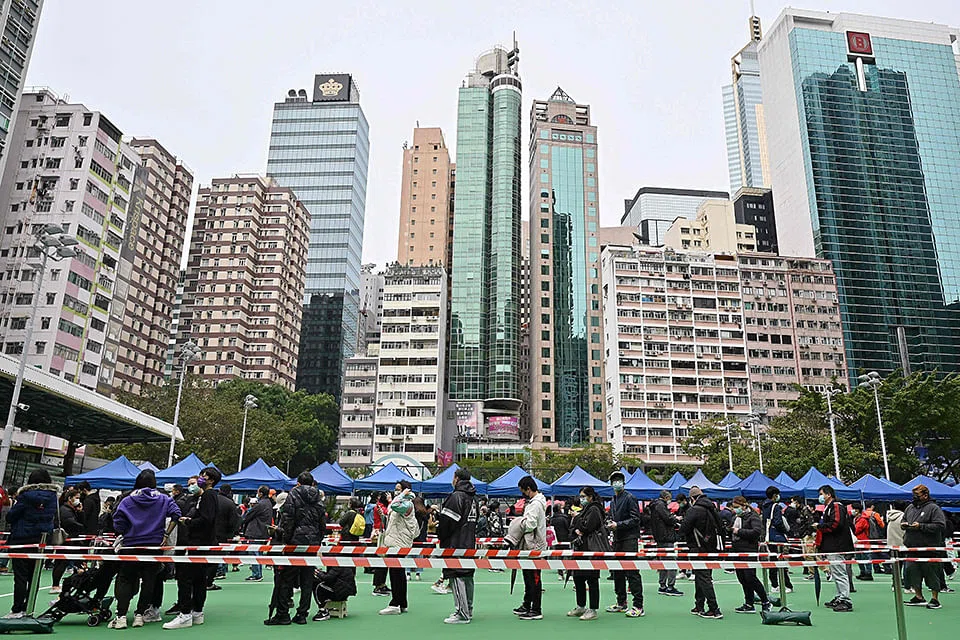
DeeperDive is a beta AI feature. Refer to full articles for the facts.
[HONG KONG] In pursuit of a tough Covid Zero strategy to fight its worst ever coronavirus outbreak, Hong Kong is ceding ground to Singapore, a rival Asian financial and transport hub that's been easing pandemic-linked restrictions to get its economy back on track.
Key data compiled by Bloomberg Economics economists Tamara Mast Henderson and Eric Zhu show that some businesses, weary of stringent quarantine rules and the inability to travel freely, have been shifting to Singapore.
The analysts have cut their economic growth forecast for Hong Kong by 0.6 percentage point to 1.4 per cent this year, and expect Singapore's gross domestic product to grow 4.7 per cent.
While both the governments followed a Covid Zero strategy until recently, Singapore is now transitioning to living with the virus. On the other hand, Hong Kong is doubling down on strict social-distancing rules - a policy that some residents and business groups have criticised as being futile in the face of Omicron's increased transmissibility.
GDP Growth
Both Hong Kong and Singapore experienced sharp economic contractions in 2020, followed by rebounds in 2021, but overall Singapore has pulled ahead on growth, Henderson and Zhu say.
Navigate Asia in
a new global order
Get the insights delivered to your inbox.
Looking ahead, Bloomberg Economics expects substantial damage to Hong Kong's economy this year, even if there is a policy rethink about its zero-Covid strategy.
Vaccinations, Curbs
Hong Kong has leaned more heavily on restricting activity. Singapore has emphasised vaccinations. Hong Kong requires 14 days of quarantine in a designated hotel for visitors outside of China. Singapore, on the other hand, has established quarantine-free travel lanes with numerous countries. About 70 per cent of Hong Kong's population have taken 2 doses of a vaccine, versus 91 per cent in Singapore, according to data compiled by Bloomberg.
In both Hong Kong and Singapore, Covid fatalities are far below the global average, and the former British colony that returned to Chinese rule in 1997 has had greater success with about 3 deaths per 100,000, versus Singapore's 15. But 3 years into the pandemic, patience with restrictions is wearing thin across the world, and more so with people in the 2 Asian financial hubs trapped within tight city limits, Henderson and Zhu say.
Bank Deposits
Bank deposits show the clearest sign of a shift. Deposit growth in Hong Kong has roughly halved in the last 3 years, dropping to an average of 4.3 per cent year on year from 9.1 per cent in the prior 3 years.
Singapore's deposit growth grew on average 7.3 per cent between 2019 and 2021, about double the pace in the previous three years, according to data from the cities' monetary authorities.
Foreign currency deposits in Singapore grew at an even faster pace: 82.7 per cent year on year between January 2019 and June 2021.
Real Estate
Both cities have seen similar impact on commercial and retail rents due to the pandemic, but Hong Kong was experiencing a higher vacancy rate, reaching 10.6 per cent in late 2021, the highest in at least 15 years.
Singapore's vacancy rate reached a four-year high of 6.3 per cent in the third quarter of 2021, the most recent period for which there's data, according to statistics provided by Colliers International and Singapore Urban Redevelopment Authority.
Labour Market
Labour markets have tightened in both cities since the pandemic, with some firms relocating staff from Hong Kong, at least temporarily. In the financial, insurance and professional services sectors, growth is accelerating in Singapore, but slowing in Hong Kong.
But Henderson and Zhu also point out that Singapore's capacity to absorb a material exodus of Hong Kong's professionals is more limited as the government continues to tighten requirements for foreign hires in terms of pay and credentials.
Visitor Arrivals
Few are venturing to Hong Kong these days due to flight bans and hotel quarantines. Arrivals have dropped to a negligible number after they started slumping 40 per cent in the second half of 2019 following months of pro-democracy protests that impeded access. While Singapore's visitor levels have also suffered, arrivals are picking up again as the city reopens. BLOOMBERG
Decoding Asia newsletter: your guide to navigating Asia in a new global order. Sign up here to get Decoding Asia newsletter. Delivered to your inbox. Free.
Share with us your feedback on BT's products and services
TRENDING NOW
From 1MDB to ‘corporate mafia’: Is Malaysia facing a new governance test?
Higher costs, lower returns: Why are Singaporeans still betting on real estate?
South-east Asian markets account for 8.8% of global capital inflows from 2021 to 2024: report

Richard Eu on how core values, customers keep Singapore’s TCM chain Eu Yan Sang relevant

