

Local, global firms both needed for Singapore’s economic success, ministers say
They stress MNCs’ vital role alongside continued support for small businesses and local workers
Annabeth Leow
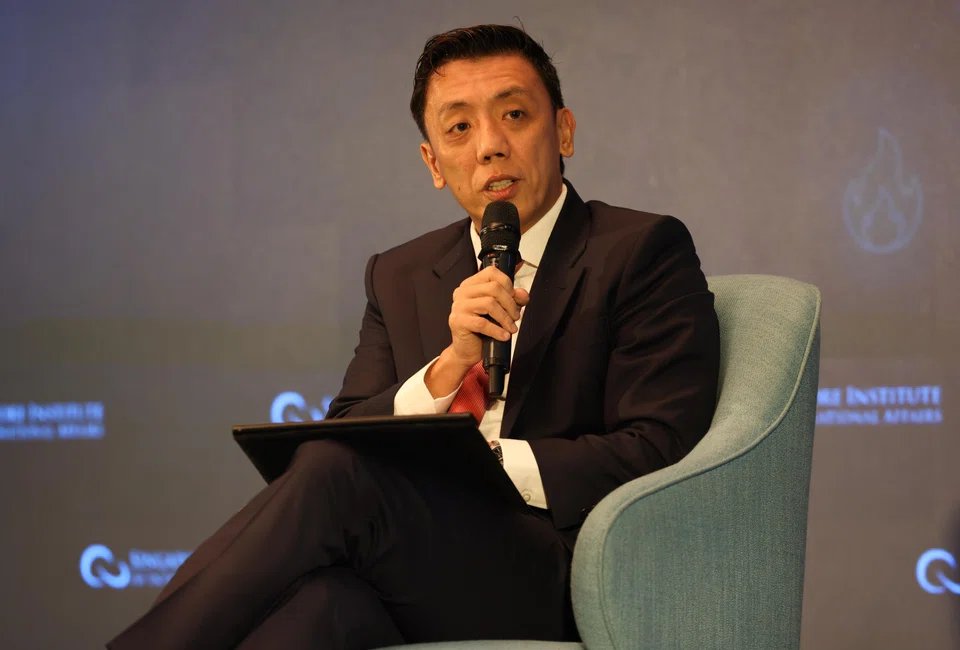
[SINGAPORE] Local and global businesses are both needed for Singapore’s economy to thrive, said Transport Minister Jeffrey Siow in Parliament on Wednesday (Aug 5).
Multinational corporations (MNCs) can bring in resources and capabilities that may not yet be available domestically, he told the House.
Siow, who is also the second minister for finance, added: “Many of our local companies grow and succeed because of their relationships with MNCs, and not in spite of them.”
The economic strategy by the People’s Action Party (PAP) is centred on Singaporeans, and the Singaporean model – which supports small and medium-sized enterprises (SMEs) while attracting MNCs – “has delivered for generation after generation of Singaporeans”, he said.
“Even as we redouble our efforts to support our local companies, we must not forget that MNCs remain important to our economy,” he added.
He raised these points during an hours-long debate on a motion tabled by Workers’ Party (WP) MPs Kenneth Tiong for Aljunied GRC and Jamus Lim for Sengkang GRC.
The motion called for “a more equal and inclusive economy” for Singapore’s future.
MNCs’ role sparks debate
PAP MP Edward Chia for Holland-Bukit Timah GRC kicked off the debate by proposing four amendments to the WP’s motion.
One point of contention was the wording of the original motion as being “notwithstanding” suggestions in the Economic Strategy Review’s final report that was released by the government in June.

Chia proposed replacing the word “notwithstanding” with the phrase “in line with”.
He also proposed inserting the phrases “global enterprises” and “external demand”, against the original motion’s references to only local companies and domestic demand.
WP’s Lim, who seconded the original motion, called for the economic model to shift “away from the interests of large foreign-based MNCs or even our (government-linked company) behemoths”.
“We must evolve away from our traditional reliance on foreign MNCs as a driver of our growth, and pivot towards SMEs as our home-grown economic engine,” he said, while urging less focus on tax competition and “the wooing of footloose multinationals”.
Siow suggested a significant gulf existed between how the PAP and WP understand Singapore’s economic model, and characterised the opposition’s stance as one in which local and global companies are locked in zero-sum competition.
“The WP asserts that if external markets become more uncertain, we should retreat and rely more on domestic demand. This is unrealistic,” he said, calling the local market “simply too small”.
But Lim stressed in his reply to Siow that the WP did not propose excluding foreign capital or sidelining MNCs and government-linked companies.
“Rather, what we want to urge is the growth of consumer demand that historically has been weaker here than in other advanced economies,” he said.
Siow thanked Lim for the clarification, while attributing his party’s view to the original motion’s lack of references to global businesses and the global economy.
Reaffirmed support for SMEs, workers
Siow told the House that “very few countries support local companies like we do here in Singapore”.
Meanwhile, Senior Minister of State for Trade and Industry Low Yen Ling said that the government would help these businesses expand beyond a limited domestic market.
Minister for Trade and Industry (Energy and Industry) Tan See Leng noted that healthy domestic demand reflects confidence and grants companies a first market to grow.
“But Singapore’s domestic market alone cannot provide the scale required for ambitious firms or advanced industries,” he said, highlighting policy efforts to help companies expand.
Ministers also responded to bipartisan concerns about fresh graduates’ job prospects.
WP’s Tiong raised the spectre of offshoring and the adoption of artificial intelligence blocking young Singaporeans from entry-level positions.
Meanwhile, PAP MP Patrick Tay flagged the risk that such roles could be eroded by AI and jeopardise the long-term career progression of entrants to the workforce.
Speaking during the debate, Minister of State for Manpower Dinesh Vasu Dash noted that vacancies in the job market continue to outnumber jobseekers.
He added: “The WP argues that entry pathways for young people are broken, but the current picture is more resilient than suggested.”
The amended motion passed with the support of all 87 PAP MPs and nine Nominated MPs, while the WP’s 12 MPs were against the amendment to replace the word “notwithstanding” and voted unanimously to reject the motion.
Decoding Asia newsletter: your guide to navigating Asia in a new global order. Sign up here to get Decoding Asia newsletter. Delivered to your inbox. Free.
Share with us your feedback on BT's products and services
TRENDING NOW

DBS, OCBC, UOB rout lops billions off STI as inflation, rate concerns spook investors

Grab CEO’s wife Chloe Tong on life with Anthony Tan and finding her purpose

OCBC sheds S$8 billion in value as shares close nearly 6% down; analysts cautious on banks

Deal between tycoon friends sparks scrutiny of Philippine power sector

