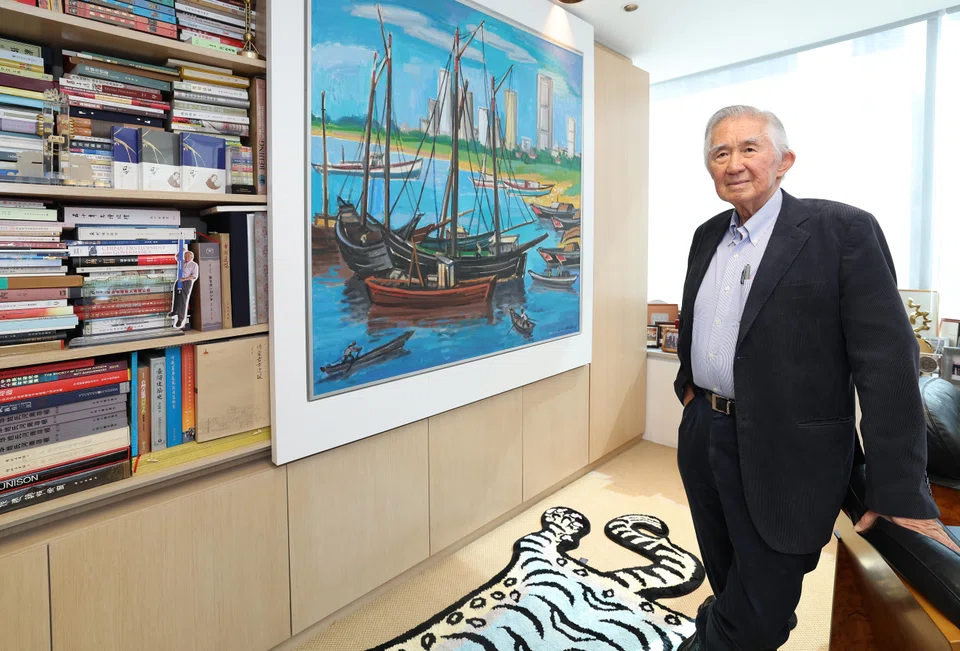
A master plan for seniors to age well and more entertainment sites: Liu Thai Ker’s wishes for the country
Their needs will vary according to the physical, mental and economic conditions they face, says the architect of modern Singapore

SINGAPORE will need to have a city-wide master plan to meet the needs of seniors as the country grapples with an ageing population.
And these needs will vary according to the physical, mental and economic conditions seniors face, Liu Thai Ker, widely known as the architect of modern Singapore, said in an interview with The Business Times.
“Some key considerations for ensuring a good quality of life for senior citizens include opportunities to live near their children, mingle with younger people, and to feel useful by engaging in neighbourhood centres. For all these considerations, instead of making ad hoc decisions for seniors, it would be best to have a long-term master plan,” he said.
“Those who can look after themselves – I would like them to be located in the new towns, near their families. On a daily basis, they can interact with their children or even help them look after their grandchildren.
“But those who cannot look after themselves, you have to put them in a healthcare facility,” Liu said.
A master plan for seniors would need to estimate the number of senior citizens to cater to, identify the types of senior citizens, and determine the facilities that should be provided and where they should be located.
“It is also my wish that we repurpose disused schools as training centres for senior citizens. When their grandchildren grow up and need to attend school, and the seniors are too old to learn, these schools can be readily converted back into educational facilities for the young,” he said.
Now 86, he spent 24 years in Singapore’s public service. While leading the Housing and Development Board from 1979 to 1989, he oversaw the development of 20 new towns and more than half a million housing units.
He was also the city-state’s chief planner and chief executive of the Urban Redevelopment Authority, where he led the agency in developing the 1991 Concept Plan, which went on to be a blueprint for the country’s future development in the decades after. Under his leadership, several landmark buildings in Singapore, including the Raffles Hotel and Chijmes, were restored.
Reflecting on his time in the public service, Liu said: “I feel I have developed a body of planning principles, (and) a body of planning data, which I have left behind in HDB and URA. If they stick to that mainly and do a small amount of updating, Singapore will continue to be a world-class city.”
He said: “A city planner must know the fundamental, unchanging human needs in a city. If you know what their needs are, and you plan according to those needs, the city will stay relevant and useful for a long time.”
Some of Singapore’s white sites can be set aside for entertainment use, Liu suggested, as the Republic has established its reputation as an important centre for entertainment.
He cited Taylor Swift’s arrival in Singapore this year as an event that turned the country into a “concert centre”, and said that the city-state may need to “look (into) that further”.
‘Public housing must be affordable’
When asked about his views on Singapore’s public housing, Liu said he did not want to comment on current policies. However, affordable and readily available public housing “can be done if you use the right method”, he said.
He said: “The most important consideration for public housing is that its rents and selling prices must be affordable. This is achieved partly through government subsidies, and partly through keeping the construction cost low.”
The supply of flats has to be slightly above the demand, Liu added, and the waiting time must be reasonable.
To keep costs low, he took the approach of adopting modular coordination in the design of HDB flats, which made it easier and cheaper for contractors to build them.
He said: “The other is to design buildings that are visually pleasing through well-considered proportions and a thoughtful selection of colours, while completely avoiding any decoration or embellishment on their facades.”
Liu added that when he was in the Singapore government, he told himself he should not allow himself to use high density as an excuse not to create a beautiful city.
To create a high-density environment that is still highly liveable, he devised a technique in which he envisioned the city as a chessboard.
“You put the housing (in) the black squares and the schools and the parks in the white squares, and then you don’t get congestion. But if you put all the black squares together and white squares separately, people who live in the black squares will feel very congested.”
‘You don’t plan your city just for sexy images or economic growth’
In 1992, Liu left the public service and joined RSP Architects Planners & Engineers, where he stayed for the next 25 years before deciding to venture out on his own. In 2017, at the age of 79, he opened his own firm, urban planning and architecture consultancy Morrow.
The firm has worked on projects spanning more than 20 cities in seven countries, including Singapore, China, Indonesia and Fiji.
Liu said: “People often ask me how to plan the city well. My standard answer is that you must have a humanist heart, scientist’s head and artist’s eyes. That means you don’t plan your city just for sexy images or economic growth – you have to plan for the well-being of the people who live there, and for the functionality of the land you are building on.
“A combination of this makes the city highly liveable and highly functional, and helps the city grow (faster) economically.”
One of Morrow’s projects in Kunming, China, took about three years to plan from start to finish and involved a 950 sq km site.
Ou Kenan, Morrow’s executive director of planning, said: “We divided the area into five regions, projected population growth over 50 years, determined urban densities, calculated necessary land sizes, and identified areas to protect, such as nature reserves and historical sites. With these preparations, we began our planning process.”
She added: “This plan not only considers the retention of existing education, health and sports facilities, but also ensures sufficient land is reserved for future needs. We are not relying solely on local standards, but are integrating benchmarks from world-class cities such as Singapore to create a sustainable and forward-looking urban plan.”
Ou said: “Unlike paintings, where small changes may seem minor, urban planning decisions can involve billions of dollars. A poorly designed road can affect the lives of millions, waste vast amounts of money, and impact the environment.”
She added: “The responsibility of planners is immense. They are accountable not only for today, but also for future generations, with their planning potentially resulting in either a timeless masterpiece or a costly mistake.”
TRENDING NOW
Green fuels, autonomous ships: How Singapore is future-proofing its shipping industry
US trade chief to consider trade deal tariff caps in excess capacity probe
Grab CEO’s wife Chloe Tong on life with Anthony Tan and finding her purpose
Deal between tycoon friends sparks scrutiny of Philippine power sector