Retrenchments fall to a record low in Q2 while job vacancies ease: MOM

Tessa Oh
RETRENCHMENTS in Singapore fell to a record low in the second quarter of 2022, but the number of job vacancies decreased slightly as companies filled more positions, according to the Ministry of Manpower (MOM)‘s Labour Market Report on Wednesday (Sep 14).
There were 990 retrenchments in Q2, down from 1,320 in the previous quarter. Although the share of retrenched residents who re-entered employment within 6 months fell to 66 per cent, down from 72 per cent in the previous quarter, this was still better than the 64 per cent rate in the year-ago period.
The number of job vacancies dipped slightly to 126,100 in June, after rising for 7 consecutive quarters, but remained at “historical high levels”. Even with the dip in vacancies, the ratio of job vacancies to unemployed persons edged up to 2.53 as unemployment rates continued to decline.
Though the job market remains tight, lay-offs overseas and a possible recession in the United States could result in labour market demand easing “sooner than we think” – which “may not necessarily be a good situation”, warned Permanent Secretary for Manpower Ng Chee Khern in a media briefing.
“Sometimes we (have to) be careful what we ask for... it is one of those things where it is tight now, and we do expect some easing... but we hope the easing isn’t too much,” said Ng.
With the manufacturing sector hitting a soft patch, especially in the electronics and pharmaceutical segments, there may be some tapering of manpower demand in the near term if growth momentum remains lacklustre, noted OCBC chief economist Selena Ling.
Still, she expects the labour market to remain generally tight for the next 3 to 6 months, as firms which are still seeing growth may be reluctant to “unwind their recent hiring out of fear that it will be difficult to attract or retain talent if this bout of market caution is temporary”.
Maybank senior economist Chua Hak Bin, too, believes the labour market will remain tight despite slowing growth, given the uneven recovery and supply constraints from strict foreign worker measures.
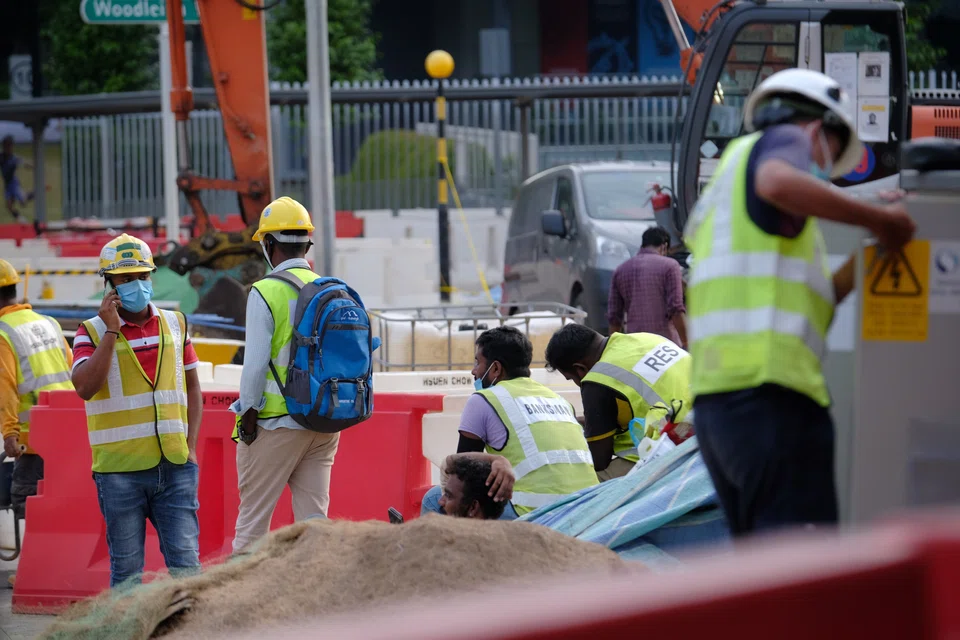
Total employment, excluding migrant domestic workers, grew by 108,500 in the first half of 2022, recovering to around pre-pandemic levels in June. “The increase was mainly contributed by non-residents, particularly in construction and manufacturing, as employers backfilled positions following the significant relaxation of border controls in April 2022,” said MOM.
Non-resident employment rose across all work pass types, with the bulk coming from work permit and other work passes, which rose by 80,900. S Pass holders went up by 7,400, while employment pass holders rose by 7,100.
But non-resident employment levels are still 10 per cent below pre-pandemic levels, noted Ng. “This is mainly because there are still a few sectors that are significantly below (pre-Covid levels),” he said, citing the tourism-related sectors of arts and recreation; accommodation; and food and beverage as examples, which are 50 per cent, 40 per cent and 20 per cent below pre-pandemic levels, respectively.
During the initial phase of recovery, businesses in these sectors may have been more cautious and adopted a wait-and-see approach following the multiple rounds of relaxation and subsequent tightening in the last 2 years of the pandemic, said Ling. “Only when they grow fairly confident that the rebound is sustainable, will they plan to return to more levels of staffing activities.”
“With the significant easing of Singapore’s Covid-19 restrictions, business activities in sectors which had been badly affected by the pandemic are recovering,” said the ministry. “We expect non-resident employment to continue to grow at a robust pace as it catches up to its pre-pandemic level, which will ease labour market tightness.”
But resident employment, which is currently 4.2 per cent above 2019 levels, is likely to see subdued growth in the coming months because the resident unemployment rate is already low.
Unemployment rates held steady at pre-pandemic levels in July, at 2.1 per cent overall; 2.9 per cent for residents; and 3 per cent for citizens. The resident long-term unemployment rate fell for the third consecutive quarter, returning to the pre-pandemic average of 0.7 per cent in June.
The number of employees placed on short work-week or temporarily laid off declined to 590 in Q2, from 670 a quarter earlier. Of these, the majority were placed on short-week arrangements, with few laid off temporarily.
The labour market outlook is uneven across sectors, said MOM, noting that the external demand outlook has weakened given the global economic slowdown.
Global headwinds – such as Russia’s war in Ukraine, inflationary pressures, geopolitical tensions in the region, and the trajectory of the Covid-19 pandemic – may weigh on labour demand, said MOM. Growth in outward-oriented sectors, like finance and insurance services, is thus expected to slow in the face of these headwinds.
In contrast, tourism and aviation-related sectors are expected to continue to benefit from the strong recovery in air travel. Demand in consumer-facing sectors, such as food and beverage services, should remain robust with the easing of domestic and border restrictions.
Accommodation and air transport and supporting services saw the largest increase in recruitment rates in Q2. Other consumer-facing and tourism-related sectors also saw recruitment rates rise, with employers ramping up hiring to meet the rising demand as the sectors recover. Overall, the recruitment rate rose over the quarter to 2.6 per cent – a rate last seen in 2014.
TRENDING NOW
Why US$100 oil, 5% US yields affect Singdollar, ringgit differently vs other Asean currencies
He built the Vingroup empire. Now South-east Asia’s richest man is handing some key roles to his sons
Asia needs new energy security architecture
CDL to launch 570-unit Jurong project Lucerne Grand with prices from S$1.5 million