Reverting to Phase 2 'unlikely to derail Singapore's recovery'

Business associations, economists express support for Covid taskforce's stricter curbs

Sharon See
Janice Heng
Published Tue, May 4, 2021 · 09:50 PM

    Singapore

    THE tightening of Covid-19 community measures is not likely to pose too large an obstacle to the ongoing recovery - as long as this does not last much longer than the planned duration of May 8 to 30, said economists and business associations.

    On Tuesday, Singapore's Covid-19 taskforce announced stricter limits on social gatherings and employees at the workplace, as well as a reduction of activity and event sizes, alongside stricter border controls.

    "Effectively, when you look at the range of measures... (they) will bring us back to Phase 2 for a few weeks," Education Minister Lawrence Wong, who co-chairs the multi-ministry taskforce, told reporters during a virtual briefing.

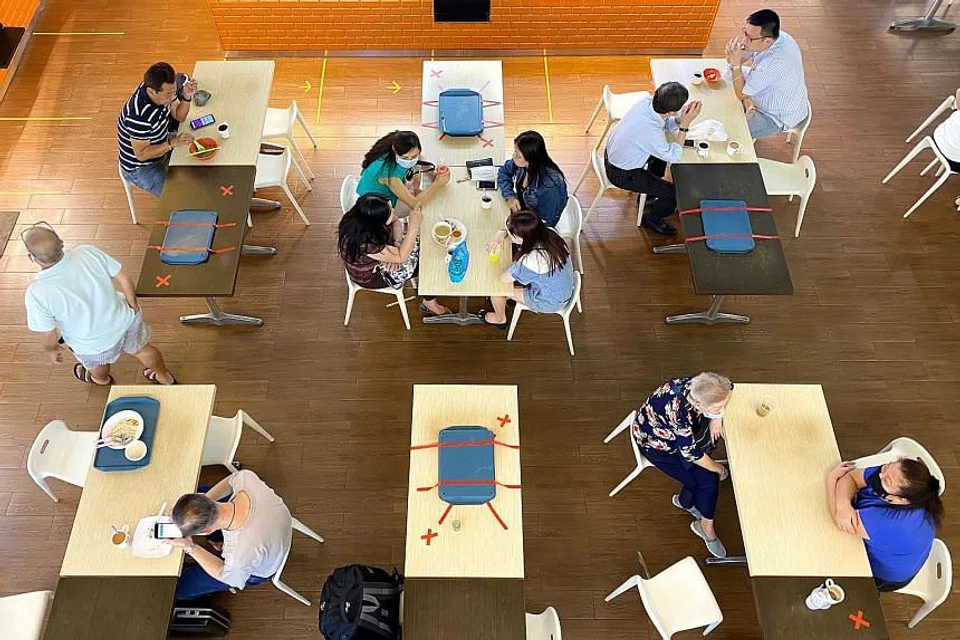
    Singapore Business Federation chief executive officer Lam Yi Young noted that food and beverage businesses will be hit by the reduction of maximum group sizes from eight to five persons, while indoor gyms and fitness studios will have to manage costs while not being able to open.

    But the lower cap on employees in the workplace - 50 per cent of those able to work from home, down from 75 per cent now - "is expected to be manageable as businesses have experience operating at 50 per cent".

    "We urge all businesses to take the tightened measures seriously and play their part in helping to bring the situation under control, so that we can all look forward to relaxation of the measures," he said.

    Association of Small & Medium Enterprises (ASME) president Kurt Wee believes there may be "a quite pronounced scaling-back in activity".

    However, he does not expect the curbs to have a significant impact on the recovery, adding: "I think it's going to have an impact on short-term public consumption, F&B, but generally I think SMEs or individuals are well prepared for these slightly tightened measures."

    Expressing ASME's support for the measures, he said: "We think it's a correct move. We have to slow down before we can move ahead."

    Economists echoed this view, believing the measures are likely to have only a limited impact on Singapore's recovery momentum.

    "It's definitely an unexpected setback to the expected recovery trajectory. But since it's more a tightening of measures back to Phase 2 rather than a 'circuit breaker' per se, the economic impact may be more limited," said Selena Ling, OCBC chief economist.

    Agreeing, Brian Tan, Barclays regional economist, said: "High-frequency indicators such as Google mobility data suggest the Phase Three measures were not substantial enough to trigger a renaissance in economic activity after Dec 28, 2020, which implies a relatively limited cost to reversing them."

    While consumer and business sentiment may be slightly dampened, Singapore has "greater confidence" today than a year ago, with its vaccination programme, better contact tracing, and the benefit of experience, said CIMB Private Banking economist Song Seng Wun.

    The impact of the measures depends on whether they last beyond the planned duration, he added. Even with the move, he expects second quarter growth to be positive quarter-on-quarter - and certainly year-on-year, with the low base effect.

    Before Tuesday, he had expected second quarter growth to be as much as 13 to 15 per cent. This might still be possible if the tighter measures are only in place for May, he added: "What we lost in May, we may be able to recoup somewhat from a rebound in activities in June."

    DBS senior economist Irvin Seah said the new measures are likely to more adversely affect sectors like entertainment, retail and construction, which could cast doubt on the pace of recovery going forward.

    "We should not discount the possibility of at least one quarter of sequential contraction in GDP growth. The biggest risk of course is if Singapore were forced to impose another circuit breaker - that is something we can ill afford," said Mr Seah.

    In the past week, the number of community cases jumped to 60, including cases of more transmissible virus variants, prompting the government to tighten border controls on Friday.

    Asked during the press briefing if border closures to badly hit countries, including India, could have come earlier, Mr Wong said Singapore cannot afford to do so for a prolonged duration, unlike large or resource-rich countries.

    He added that Singapore relies on migrant workers for a wide range of essential services, which is why the country has always taken a risk-based approach in managing its borders.

    Health Minister and taskforce co-chair Gan Kim Yong said the government has not ruled out the possibility of a circuit breaker, although he said Singapore is probably able to avoid getting back into one. Last year, Singapore's circuit breaker, or partial lockdown, saw the closure of non-essential businesses from April 7 to June 1.

    Based on the taskforce's assessment of the current situation, the new measures are "already a very strong pre-emptive move", which can potentially arrest and snuff out hidden cases in the community, said Mr Wong.

    Compared with a year ago, Singapore right now has "far better capabilities" in terms of testing and contact tracing, he said.

    "But if new unlinked cases continue to pop up and new large clusters continue to emerge in the coming days and weeks, then certainly, we will not hesitate to take even more stringent measures, even the possibility of having to enter another circuit breaker down the road," said Mr Wong.

    READ MORE: