Rocky road to recovery for factories
Shock plunge in November output points to 'fits and starts' ahead: Economists

Singapore
SHATTERING fantasies of an immediate turnaround, Singapore's factory output fell in November at the steepest pace in nearly four years, according to an estimate out on Thursday.
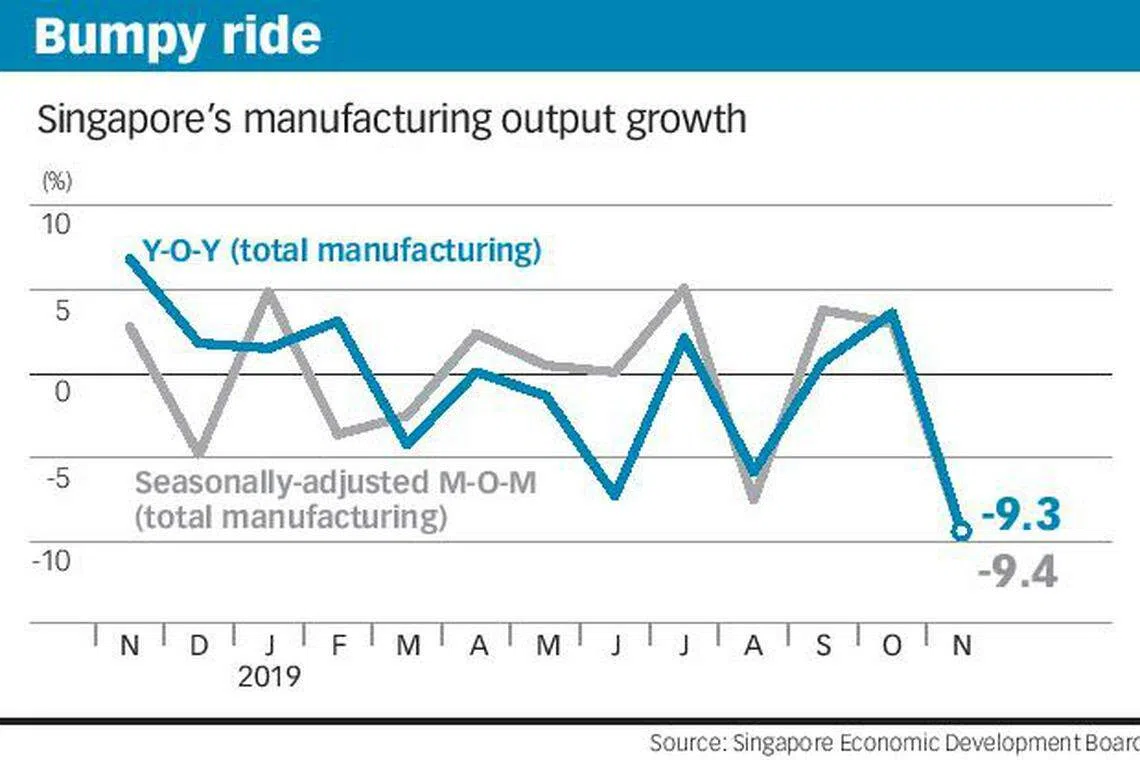
Manufacturing lost 9.3 per cent year on year, erasing the progress of the previous two months, on declines in the heavyweight semiconductor and pharmaceutical industries - the worst showing since December 2015.
Semiconductors, a linchpin segment in the Singapore economy, have been hard-hit this year by global trade tensions, as well as a high year-ago base and a cyclical slowdown.
Watchers now warn that the industry may stay disappointing - despite easing tensions - on a divergence between output and exports, and recession-hit manufacturing will loom over the economy in the year ahead.
As the latest data clashed with market hopes of a steady economic rebound, OCBC Bank chief economist Selena Ling said in a report that it showed biomedical manufacturing's volatility and reinforced "the 'fits and starts' recovery" in the chip market.
Spurred by a production pick-up in recent months, economists polled by Bloomberg had guided for a much gentler 0.8 per cent dip in November.
But even October's encouraging growth was revised downwards by the Economic Development Board (EDB), from 4 per cent to 3.6 per cent.
The EDB, which compiles monthly manufacturing statistics, has pegged a decline of 1.6 per cent for the first 11 months of the year combined.
As Citi economists Kit Wei Zheng and Ang Kai Wei put it in a flash note, the data "is consistent with our earlier view that the growth recovery is likely to be gradual, but uneven".
Biomedical manufacturing lost 10.3 per cent after double-digit expansion in the months prior, which the EDB blamed on "a different mix of active pharmaceutical ingredients and biological products", as well as lower export demand for medical devices.
But even with the volatile biomedical manufacturing data excluded, industrial production fell by 9 per cent.
On a seasonally-adjusted monthly basis, output slid 9.4 per cent, or 8.4 per cent sans the biomedical cluster.
The contraction was led by electronics, which swung into a 20.9 per cent plunge, on worsening performances in the key semiconductor segment and in computer peripherals.
The weakness in these areas "may persist into the start of 2020, given tepid global demand conditions and seasonal effects", Ms Ling said in an e-mail to The Business Times, noting that Chinese New Year - when many factories close their doors - will come early in 2020, falling towards the end of January.
Barclays Bank's Brian Tan also fingered "growing divergence between production and exports", adding: "While there are signs that electronics production may be bottoming, the gap remains sizeable."
And the Citi analysts agreed. While Asian semiconductor trade should improve, a build-up in inventory "suggests that demand will be first met by drawing down inventories rather than a rebound in production - implying that manufacturing production could see a choppy profile", they pointed out.
Meanwhile, other manufacturing clusters also notched losses.
Chemicals production was lower by 10 per cent year on year, widening from the previous month's 9.4 per cent drop, while general manufacturing retreated by 1.5 per cent, after growing by 3.8 per cent in October.
Just two clusters were in the black year on year: Precision engineering growth picked up from 3.6 per cent to 9.7 per cent, while transport engineering swung from a 4.9 per cent contraction to a 2.1 per cent expansion.
"The smaller clusters like chemicals and general manufacturing clusters may continue to underperform in the interim," Ms Ling added in her e-mail, "and I'm not expecting much of a seasonal pick-up into Q1 2020, given that consumer and business sentiments are fairly subdued."
A quarterly poll by the Singapore Business Federation and Experian this week showed small businesses' growth expectations at a decade low.
The factory data has cast a pall over gross domestic product outlook, with Mr Tan citing the electronics output-export gap as a dampener.
Official flash estimates are due on Jan 2.