

Singapore core inflation eases to 1% in January, better than expected
Headline inflation up at 1.4% from 1.2% in December, driven by higher accommodation costs

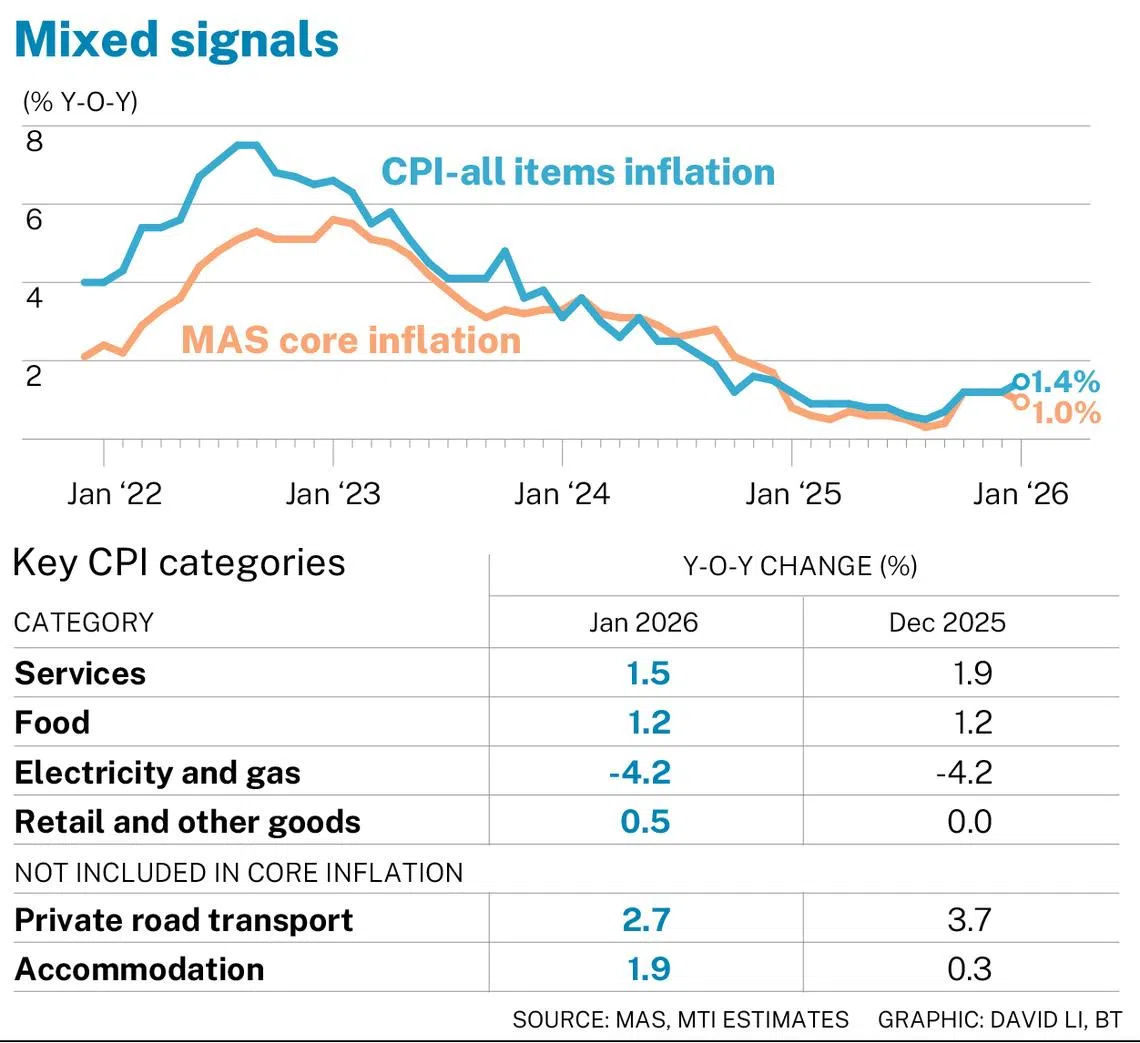
[SINGAPORE] The Republic’s core inflation eased to 1 per cent in January from 1.2 per cent in December, defying economists’ expectations even as headline inflation edged higher.
Private-sector economists had expected the rate for core inflation, which excludes accommodation and private transport, to rise to 1.5 per cent, a Bloomberg poll indicated.
The Monetary Authority of Singapore (MAS) and Ministry of Trade and Industry (MTI) said in a statement on Monday (Feb 23) that this was largely due to moderation in services inflation.
Economists attributed the moderation mainly to lower airfares and education fees. Data showed the consumer price index (CPI) for “other transport services” fell 4.1 per cent month on month and 3.1 per cent year on year, while “general, vocational and higher education” declined 1.7 per cent on the month and 0.6 per cent from a year earlier.
DBS senior economist Chua Han Teng cited a seasonal decline in airfares, while Standard Chartered chief economist Edward Lee linked the fall in education costs to the expansion of the Ministry of Education’s Financial Assistance Scheme.
Meanwhile, headline inflation rose to 1.4 per cent in January, from 1.2 per cent in December and in line with expectations. This was driven by higher accommodation costs that more than offset lower core and private transport inflation.
On a month-on-month basis, core CPI fell 0.3 per cent, while the all-items CPI declined 0.5 per cent.
Inflation outlook
MTI and MAS kept their 2026 full-year forecast range at 1 to 2 per cent for both core and headline inflation, but flagged uncertainties in the inflation outlook.
They said that stronger-than-expected growth could bolster demand-pull inflationary pressures, while supply shocks, including those triggered by geopolitical developments, could also lift imported costs.


“Conversely, a large, discrete shock to growth from macroeconomic and financial stressors could dampen inflation,” said MTI and MAS.
Nevertheless, they said that Singapore’s imported costs should remain contained.
While global crude oil prices have risen in recent weeks, they are expected to remain lower than levels a year earlier, said MTI and MAS.
However, they added that regional consumer inflation is likely to rise slightly after last year’s weak readings, “although broadly subdued producer prices in Asia should cap the extent of inflationary pressures”.
On the domestic front, unit labour costs are set to rise slightly in 2026, though the government expects productivity gains to limit the increase, while private consumption is expected to remain steady on the back of real wage growth.
Monetary policy
Economists are divided on the timing of MAS’s next move, with some expecting the central bank to remain on hold in the near term, while others anticipate a modest tightening as early as April or later this year.
DBS, OCBC and RHB Bank expect MAS to stand pat for now.
OCBC chief economist Selena Ling said the central bank would likely need to “observe a few more months of inflation data before committing to a tightening move down the road”.
DBS’ Chua said with core inflation at the lower bound of the official forecast range and a possible February rebound due to Chinese New Year effects, near-term pressure to tighten remains limited.
RHB group chief economist Barnabas Gan added that resilient growth and tame inflation could keep policy settings unchanged at least through the first half of 2026.
In contrast, UOB, Maybank and Standard Chartered expect MAS to tighten in April.
Maybank anticipates a slight steepening of the Singapore dollar nominal effective exchange rate (S$NEER) appreciation bias, while UOB expects the slope of the policy band to rise by 50 basis points to 1 per cent per annum, describing the move as a one-off adjustment rather than the start of a tightening cycle.
Standard Chartered’s Lee said the softer core inflation reading reduces the immediate impetus for tightening, but the bank is maintaining its call as the weakness was largely driven by administrative factors.
Barclays economist Brian Tan concurred with UOB’s view on the scale of the adjustment, but expects it to take place in July instead.
He said MAS’ caution reflects risks to the growth outlook, particularly uncertainties surrounding the sustainability of the artificial intelligence-driven investment boom.
Key CPI categories
In January, inflation trends across CPI categories were mixed, with most segments recording slower price increases or outright declines.
Retail and other goods inflation edged up to 0.5 per cent in January from 0 per cent in December, as higher prices for personal care appliances drove the increase.
Accommodation inflation rose to 1.9 per cent from 0.3 per cent in December, due to a larger increase in the cost of housing maintenance and repairs.
Services inflation eased to 1.5 per cent from 1.9 per cent in the previous month, due to a larger fall in airfares and a decline in general, vocational and higher education fees.
Meanwhile, private transport inflation eased to 2.7 per cent from 3.7 per cent, on account of a smaller increase in car prices and a steeper decline in petrol prices.
Electricity and gas prices fell 4.2 per cent in January, unchanged from the rate of decline in December, as electricity tariffs eased at a similar pace.
As for food inflation, it held steady at 1.2 per cent as the prices of non-cooked food and food services rose at similar rates in January and December.
Decoding Asia newsletter: your guide to navigating Asia in a new global order. Sign up here to get Decoding Asia newsletter. Delivered to your inbox. Free.
Copyright SPH Media. All rights reserved.
TRENDING NOW

Stocks to watch: CapitaLand Ascott Trust, Keppel Infrastructure Trust, iFast, ESR Reit, First Sponsor

Indonesia says gas export cuts to Singapore remain within contract terms

If Europe goes to war, the fallout will be felt in East Asia

Government to bring forward raising of retirement age, give employers more financial support to create flexi-load jobs

