

Singapore core inflation spikes to two-year peak in July on higher energy costs
 Add BT as a preferred source
DeeperDive is a beta AI feature. Refer to full articles for the facts.
ELECTRICITY and gas costs drove up consumer prices in July, although the authorities have signalled that the impact of higher oil prices is starting to moderate.
Singapore's core inflation gauge jumped to 1.0 per cent in July - its highest level since mid-2019 - from 0.6 per cent in the month before.
Meanwhile, headline inflation inched up to 2.5 per cent, from 2.4 per cent in June, according to data on Monday. Both increases were in line with analysts' expectations.
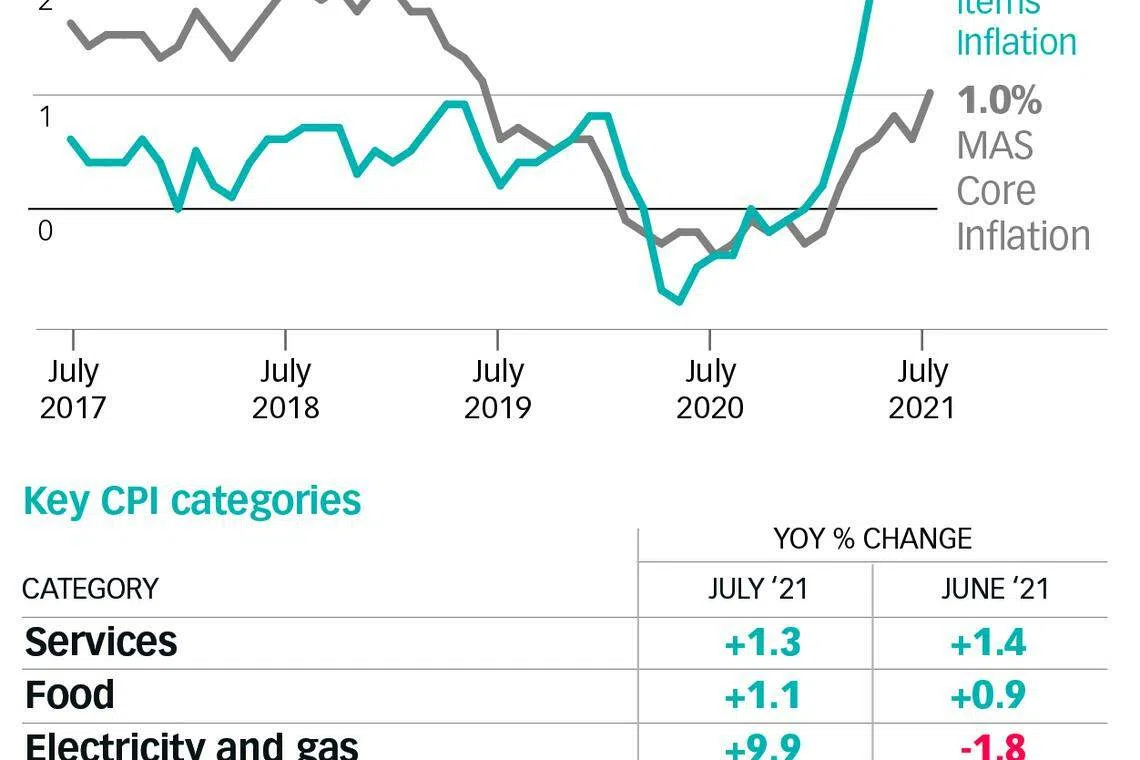
"External inflation has remained elevated amid the passthrough of higher oil prices and cost of intermediate goods to final consumer prices," the Monetary Authority of Singapore (MAS) and Ministry of Trade and Industry (MTI) noted in a joint statement.
But they added: "These upward pressures on global inflation should ease over the course of the year. Crude oil prices have moderated recently alongside higher oil production."
The gain in private transport prices slipped to 12.6 per cent in July, from 14.9 per cent in the previous month, on a smaller increase in car prices. Meanwhile, accommodation costs rose by 1.4 per cent year on year, against 1.1 per cent in June, as rents grew faster.
Navigate Asia in
a new global order
Get the insights delivered to your inbox.
Both private transport and accommodation expenses are excluded from the core inflation indicator, which influences the MAS's exchange rate-based monetary policy.
But the stronger accommodation costs pushed up all-items inflation, alongside the surge in electricity and gas expenses, as well as higher food prices.
Energy prices jumped by 9.9 per cent in July, compared with an earlier fall of 1.8 per cent in June, as the electricity tariff rose by 19.3 per cent and the gas tariff went up by 12.9 per cent on a year-on-year basis.
"The large year‐on‐year increases in electricity and gas tariffs were partly due to the low base in (the third quarter) last year when energy tariffs had fallen sharply following the collapse in global oil prices," the MAS and MTI said in their statement.
Food prices also rose at a faster clip; with an increase of 1.1 per cent in July, against 0.9 per cent before - which was attributed to higher non-cooked food inflation.
Meanwhile, retail costs slipped by a gentler 1.2 per cent in July, against a decline of 1.8 per cent in June, as the cost of shoes and clothes continued to fall at a slower pace.
On the other hand, service inflation ticked down to 1.3 per cent, from 1.4 per cent in June. Cheaper telecommunication services were only partially offset by the rise in the cost of services such as tuition and transport.
All the same, headline inflation is tipped to ease in the coming months as the year-ago low base effect subsides, though core inflation will rise over the rest of the year.
"Supply‐demand mismatches in some goods markets, as well as bottlenecks in global transportation, are mainly transitory and should ease with the gradual normalisation of production," said the MAS and MTI.
"On the domestic front, lingering uncertainty as Singapore transits to a virus‐endemic state could weigh on consumer sentiment and hence dampen domestic price increases in the near term."
The headline inflation reading is officially forecast to fall between 1 per cent and 2 per cent in 2021, while core inflation is projected to average zero to 1 per cent.
Decoding Asia newsletter: your guide to navigating Asia in a new global order. Sign up here to get Decoding Asia newsletter. Delivered to your inbox. Free.
Copyright SPH Media. All rights reserved.
TRENDING NOW
‘Boring’ is the new black: The stars are aligning for a Singapore stock market revival
Near sell-out launches in March boost developer sales to 1,300 units after four slow months

China pips the US if Asean is forced to choose, but analysts warn against reading it like a sports result

Genting Singapore’s Lim Kok Thay receives S$7.5 million pay package for FY2025

