

Singapore expects trade growth of -2% to 0% for 2023; full-year forecast for 2022 upgraded

Mindy Tan
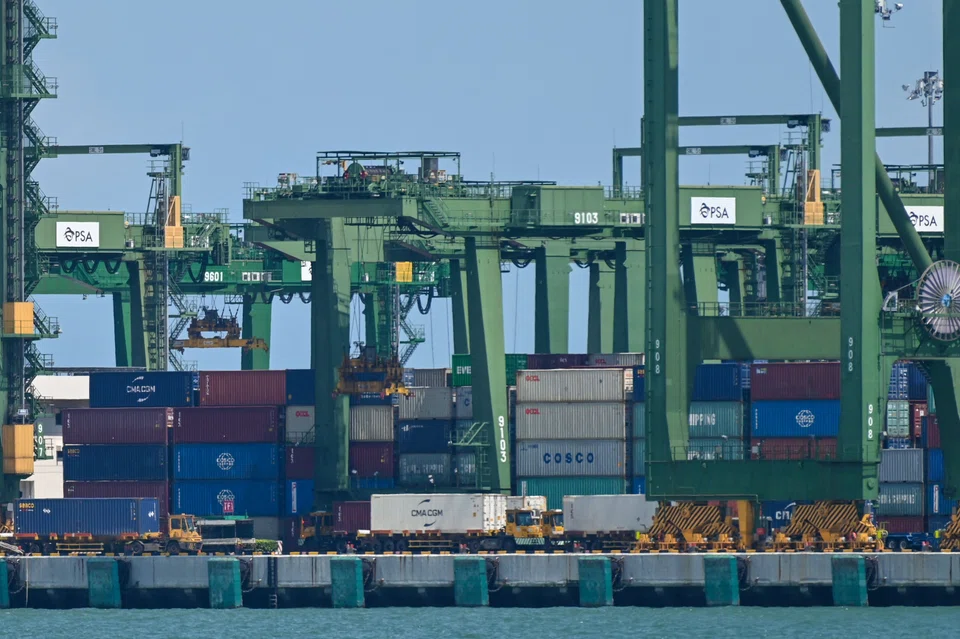
SINGAPORE on Wednesday (Nov 23) upgraded its 2022 full-year trade forecasts for the third time this year, even as it projected negative to flat trade growth for 2023.
Total merchandise trade is now projected to grow 19.5-20 per cent in 2022, up from an earlier prediction of 15-16 per cent, according to Enterprise Singapore (EnterpriseSG). The agency attributed this to better-than-expected performance, driven by oil and electronics trade.
The growth projection for non-oil domestic exports (NODX) was narrowed to “around 6 per cent”, from 5-6 per cent previously.
For 2023, the growth projection of -2 per cent to 0 per cent for both total merchandise trade and NODX is a “cautiously optimistic” one, after a high base in 2022, said EnterpriseSG. Performance of electronics trade and exports is expected to ease. Oil prices are also expected to be lower in the coming year, weighing on total trade.
Maybank analysts Chua Hak Bin and Lee Ju Ye were less optimistic, forecasting that NODX will come in at between -4 per cent and -1 per cent in 2023. They expect a continued decline in Q4 2022 and throughout the first half of 2023 as external demand weakens, especially for electronics.
“NODX to the United States and regional countries such as Indonesia and Malaysia have been key contributors to growth this year but we expect that momentum to decelerate in 2023 as US likely enters a recession while the reopening boost for Asean fades,” they told The Business Times.
Still, a China reopening remains a “wildcard” and could boost Singapore’s exports given that China accounts for 17.6 per cent of total NODX, they added.
In Q3, total merchandise trade jumped 25.7 per cent year-on-year, extending the 28.1 per cent growth in the previous quarter. Oil trade leaped 65.8 per cent year on year, though this was slightly slower than Q2’s 69.5 per cent growth. Non-oil trade rose 18 per cent, slower than Q2’s 19.9 per cent.
NODX grew 7.2 per cent in Q3, easing from 8.9 per cent in Q2. Exports of electronic products ended a nine-quarter growth streak, declining by 1.8 per cent instead. Contractions in exports of disk media products, PC parts and capacitors contributed the most to the decrease in electronic NODX.
Selena Ling, OCBC chief economist and head of treasury research & strategy, said the “increasingly bearish guidance” from US Big Tech companies suggests that global semiconductor and electronics demand will “have weak legs in the near term”. Electronics exports may remain on a soft footing in the coming months, she said.
In contrast, non-electronic exports rose for the seventh quarter, up 10 per cent in Q3 and extending Q2’s 8.6 per cent increase.
Non-oil re-exports (NORX) expanded by 19.8 per cent in Q3, following 21.5 per cent growth in Q2. The year-on-year increase was due to higher shipments of both electronic and non-electronic re-exports.
On a quarter-on-quarter seasonally adjusted basis, total merchandise trade declined by 0.1 per cent in Q3. Oil trade decreased by 0.7 per cent, while non-oil trade growth was flat.
Total services trade grew 14.2 per cent year on year to S$173 billion in Q3, with services exports and imports growing by 15.8 per cent and 12.4 per cent respectively.






