Singapore exports set to slow further in Q4, may even contract: economists

Sharon See
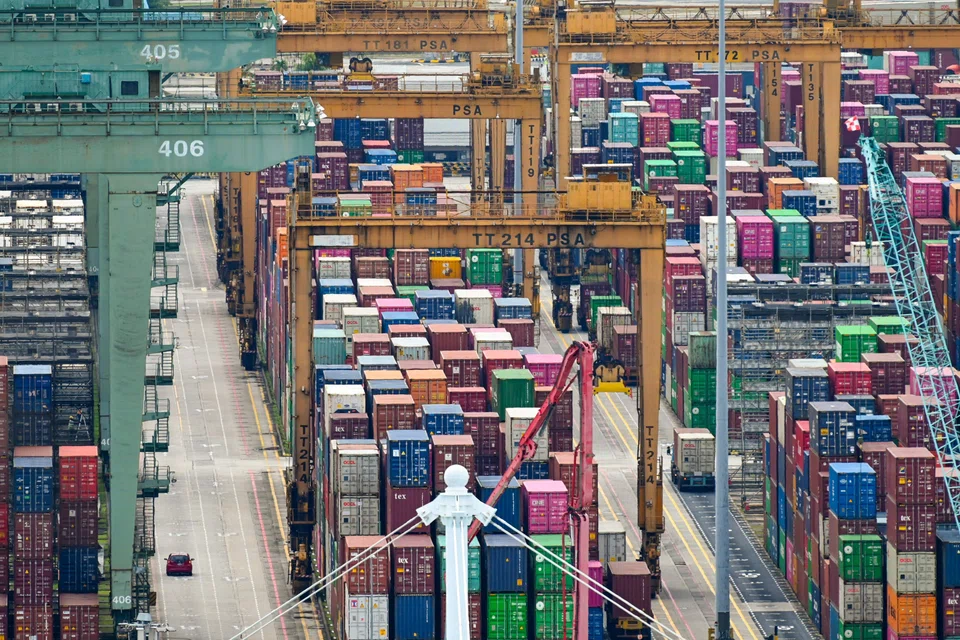
THE outlook for Singapore’s key exports turned a shade gloomier on Monday (Oct 17), with fresh data from Enterprise Singapore (EnterpriseSG) revealing further drag from China’s slowdown alongside the global electronics downturn.
Non-oil domestic exports (NODX) in September grew just 3.1 per cent year on year, easing from an expansion of 11.4 per cent in the previous month, according to EnterpriseSG.
This was lower than the 6.9 per cent growth that private-sector economists had pencilled in, based on a Bloomberg poll.
Sequentially, NODX shrank 4 per cent, extending August’s 3.9 per cent contraction.
While NODX has clocked 22 straight months of year-on-year expansions – outrunning the 17-month stretch beginning in November 2009 following the global financial crisis – UOB senior economist Alvin Liew said “the cracks in the export outlook is getting more visible”.
This comes down to a few reasons. For one thing, exports of electronic shipments have decelerated for a second straight month, with the contraction deepening to 10.6 per cent in September, from 4.5 per cent in the previous month.
This was unsurprising to watchers, given the sharp decline seen in last month’s Purchasing Managers’ Index for the electronics sector to 49.4, the lowest level in over two years.
“Global demand for chips and electronics is falling as rising inflation and interest rates weigh on consumer demand,” Maybank economists Chua Hak Bin and Lee Ju Ye said. “Major chipmakers Samsung, AMD, and TSMC have reported results that widely missed projections and warned of a prolonged downturn.”
Meanwhile, non-electronics exports slowed to 7.6 per cent in September, from 16.9 per cent in the previous month. Although the growth in export of non-electronic products was what kept NODX in positive territory, UOB’s Liew said this was partly helped by low base effects.
At the same time, exports to Singapore’s top 10 markets fell as a whole in September, dragged by a 33.8 per cent year-on-year contraction in shipments to China, compared with the previous month’s 18.2 per cent decline.
In dollar terms, China’s NODX value in September was S$2.1 billion, compared with S$3.18 billion in the same period a year ago, UOB’s Liew pointed out.
Exports to Hong Kong shrank by a lesser degree in September at 16.7 per cent, compared with the 31 per cent contraction in the previous month.
But even markets that saw double-digit year-on-year expansion in August saw only modest growth last month.
In particular, export growth to the United States moderated to 8.6 per cent in September from 60 per cent previously, while that to the eurozone eased to 3 per cent, from 57.3 per cent.
OCBC chief economist Selena Ling noted that the US share of Singapore’s export market has grown to 14.3 per cent year to date, from 12.4 per cent last year, and the “healthy” growth is a silver lining to the increasingly bleak outlook.
On the other hand, China’s share has slipped to 15.1 per cent year to date, from an average 17.6 per cent in 2021.
This means that China’s reopening, if it does materialise, could provide a boost to Singapore’s exports, Maybank economists said.
But without any indication to suggest an imminent relaxation of China’s zero-Covid strategy or a step-up in policy stimulus, OCBC’s Ling said the soft patch in the East Asian market “could continue to be somewhat of a millstone around the neck in the near-term for regional manufacturing momentum”, especially with US-China relations seemingly worsening.
Bucking the trend was Taiwan, with shipments there growing 10 per cent year-on-year in September, compared with the 24.5 per cent contraction in the previous month.
But the durability of the rebound is uncertain, UOB’s Liew said, adding that he remains concerned about the overall weaker demand from East Asia.
RHB senior economist Barnabas Gan said moderating commodity prices should also continue to drag Singapore’s nominal trade values in Q4.
He noted that September NODX growth in real terms contracted by 3.5 per cent, suggesting that NODX, in volume terms, was lower than a year ago.
“As such, nominal NODX had been underpinned chiefly by higher export prices rather than volume,” he said.
Most economists are now expecting non-oil domestic exports to decelerate further in the fourth quarter, with some even bracing for a contraction.
“We expect NODX growth to turn negative in the coming months on the back of an electronics downturn and softer growth in non-electronics,” Maybank economists. The team is keeping its full-year NODX growth forecast at 5 to 6 per cent, but is downgrading its 2023 forecast to -4 to -1 per cent, from -2 to 1 per cent.
UOB’s Liew is also maintaining his 2022 outlook at 5 per cent: “We factor in a slowdown in NODX growth for the rest of 2022 with the assumption of NODX growth turning potentially weaker in October at 0.5 per cent year on year and recording significant contractions in November at -5.4 per cent year on year and December at -14.2 per cent year on year.”
RHB’s Gan is also staying with his prediction of 7 per cent but believes NODX could shrink in real terms by 1.7 per cent, against the year-to-date pace of a 1.3 per cent contraction.
EnterpriseSG in August upgraded its full-year NODX outlook to 5 to 6 per cent.
TRENDING NOW
He built the Vingroup empire. Now South-east Asia’s richest man is handing some key roles to his sons
Grab CEO’s wife Chloe Tong on life with Anthony Tan and finding her purpose
What role can Japan play in Asean’s future?
From folding clothes to factory work: Why China is sending humanoid robots to school