

Economists expect global AI tailwinds to sustain through H1 2026, as Singapore’s factory output rises 16.6% in January
Factory output was driven by a surge in electronics manufacturing, which more than doubled from the previous month

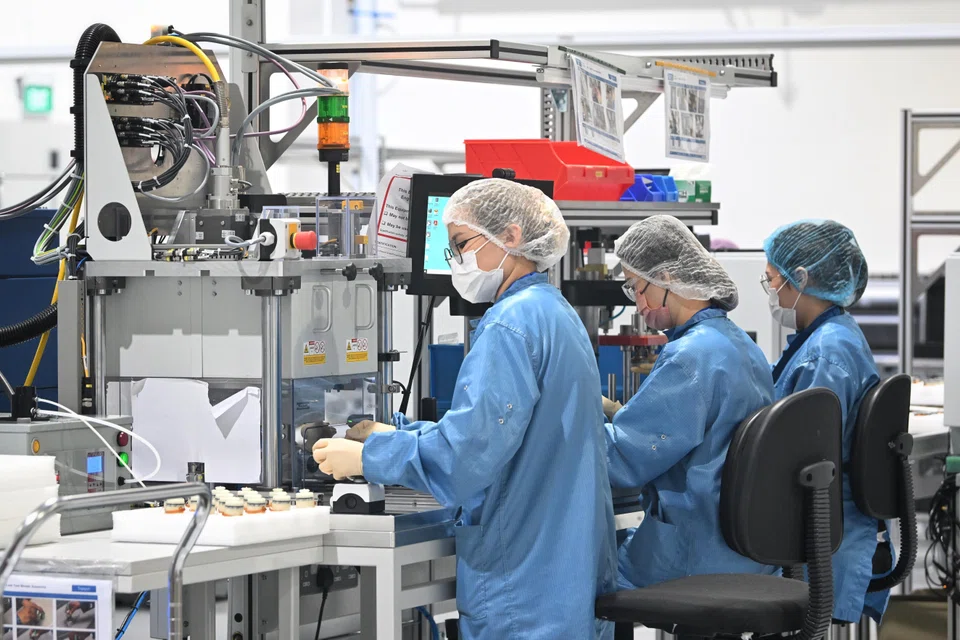
[SINGAPORE] Private-sector economists expect global artificial intelligence (AI)-related tailwinds to bolster the Republic’s manufacturing growth at least through the first half of 2026, following January’s 16.6 per cent year-on-year increase in factory output.
January’s performance exceeded private-sector economists’ estimates. They had predicted a median 12.1 per cent expansion in a Bloomberg poll.
Excluding the volatile biomedical manufacturing cluster, industrial production surged 24.1 per cent year on year, compared with December’s revised 13.1 per cent increase.
Maybank economists Chua Hak Bin and Brian Lee expect manufacturing and export growth to remain “robust” for at least the first half of 2026, due to the sustained AI investment boom.
As they see it, President Donald Trump’s higher US tariff threats are unlikely to affect the AI boom and strong electronics demand. “The timeline for implementing his previously threatened 15 per cent tariffs is uncertain and may not materialise for all countries,” they said.
They reiterated Maybank’s 2026 gross domestic product growth forecast of 3.6 per cent, which stands at the upper end of the Ministry of Trade and Industry’s official forecast range of 2 to 4 per cent.
Similarly, UOB associate economist Jester Koh expects AI-related tailwinds to sustain through H1 2026 at least, underpinned by an estimated 30 per cent increase in capital expenditure by major technology firms.
OCBC chief economist Selena Ling noted that January’s factory output figures marked the largest surge since November 2025, but said this was due to a low base effect stemming from the Chinese New Year (CNY) holidays taking place in January last year.
She said February’s industrial production prints are likely to lean lower “towards 5 per cent” as a result of the CNY holidays falling in February this year. Still, she expects manufacturing momentum in Q1 2026 to stay resilient at 9.4 per cent year on year, while full-year manufacturing growth could come in at 3 per cent or even higher, depending on how long the AI boom lasts.
The latest prints come after Singapore’s manufacturing Purchasing Manager’s Index (PMI) rose to 50.5 last month – its highest reading in 10 months – arriving on the back of sustained demand for AI related products. The electronics sector registered its eighth consecutive month of expansion.
A reading above 50 on the index indicates growth from the previous month.
Cluster performance
All clusters recorded growth in factory output in January, except general manufacturing and biomedical manufacturing.
The linchpin electronics sector rose 44 per cent for the month, more than doubling December’s 19.6 per cent increase. Growth was led by the segments of other electronic modules and components, as well as semiconductors, with the latter supported by strong AI-related demand.
Maybank’s Dr Chua and Lee pointed out that semiconductor exports remain exempt from US tariffs.
Many of Singapore’s trading partners are also facing lower tariff rates for the time being with the Supreme Court’s repeal of US President Donald Trump’s International Emergency Economic Powers Act (IEEPA)-based reciprocal tariffs, they noted.
Therefore, they think Asian exporters could step up frontloading to the US to capitalise on the temporarily lower tariff rates, in anticipation of fresh country-specific or product-specific tariffs. This would in turn benefit Singapore’s manufacturing sector and exports.
Meanwhile, DBS senior economist Chua Han Teng noted that electronics firms remain optimistic about the near-term outlook, as indicated in the recent PMI and EDB’s business expectations survey.
Of the clusters, transport engineering was the next best-performing, growing 25.2 per cent year on year. This was driven by the aerospace segment, which saw higher production of aircraft parts and sustained maintenance, repair and overhaul jobs.
Next was precision engineering, with output jumping 13.2 per cent. The cluster recorded growth in the segments of precision modules and components, as well as machinery and systems.
The chemicals cluster edged up a marginal 2.3 per cent for the month. While the other chemicals and petroleum segments recorded gains, these were partially offset by declines in the petrochemicals segment – due to weak demand and plant shutdowns – and the specialties segment, such as industrial gases.
In contrast, biomedical manufacturing recorded the biggest decline at 33.1 per cent in January.
The pharmaceuticals segment contracted on lower production of biological products and active pharmaceutical ingredients, while the medical technology segment fell due to softer demand for medical devices.
General manufacturing declined 2.6 per cent for the month, as gains in the miscellaneous industries and printing segments were offset by declines in the food, beverages and tobacco segment.
On a seasonally adjusted monthly basis, factory output rose 5.3 per cent in January, in a turnaround from December’s 0.3 per cent decline. Excluding biomedical manufacturing, output rose 10.8 per cent on the month, reversing from the previous month’s 2.5 per cent decline.
Decoding Asia newsletter: your guide to navigating Asia in a new global order. Sign up here to get Decoding Asia newsletter. Delivered to your inbox. Free.
Copyright SPH Media. All rights reserved.
TRENDING NOW

ComfortDelGro appoints two new independent directors

Once staunchly pro-China, Malaysian Chinese businesses are now distancing themselves from Beijing

NoonTalk needs continued financial support from CEO Dasmond Koh, auditors warn

DP Architects sets the benchmark for sustainability disclosure and design

