

Singapore factory output reverses into negative territory in March, down 9.2%
The reading falls below private sector economists’ expectations of a 1.5% contraction

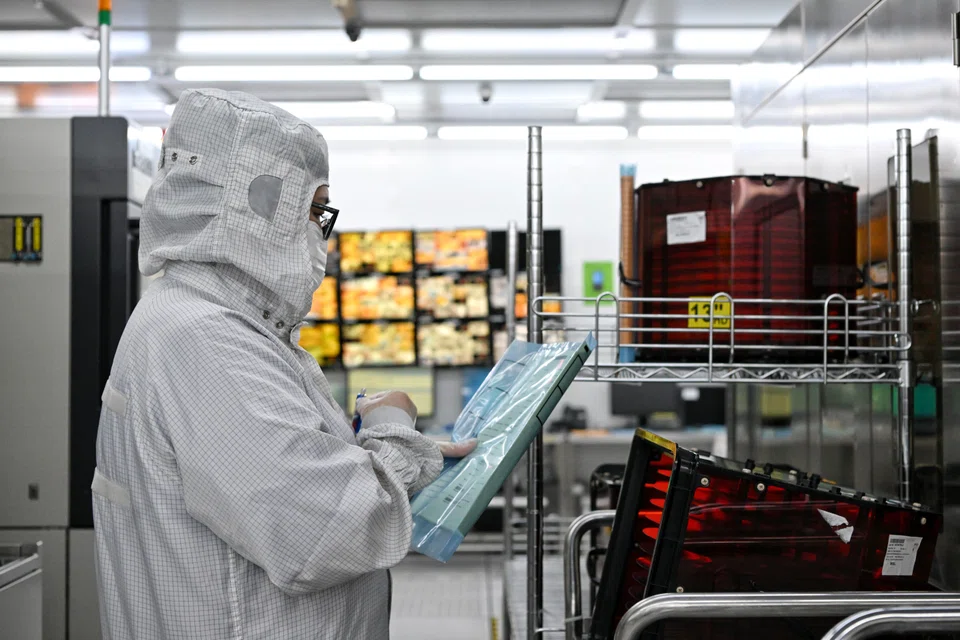
SINGAPORE’S industrial production contracted 9.2 per cent year on year (yoy) in March, dragged down by double-digit declines in the electronics and biomedical clusters, data from the Singapore Economic Development Board (EDB) showed on Friday (Apr 26).
The reading came in below private sector economists’ expectations of a 1.5 per cent contraction, as indicated in a Bloomberg poll. This was also a reversal from February’s revised figure of a 4.4 per cent growth.
Excluding the volatile biomedical manufacturing cluster, factory output fell 5.9 per cent yoy.
March’s prints come after Singapore’s non-oil domestic exports saw a steeper-than-expected contraction, as well as weak gross domestic product growth estimates for the first quarter of 2024.
DBS economist Chua Han Teng said: “The choppy and uneven factory performance in the first three months of 2024 suggests that the recovery will be gradual, with our expectations still for better manufacturing prospects in 2024 versus 2023’s full-year contraction.”
Similarly, RHB acting group chief economist Barnabas Gan remains positive despite March’s performance falling below estimates. This is on account of March 2023’s high base, he noted, as well as the fact that the decline was led primarily by the volatile biomedical cluster, especially the pharmaceutical segment.
It is essential to note, he added, that semiconductor-related segments, such as precision engineering – led by machinery and systems – as well as consumer-related segments, such as infocomms and consumer electronics, “continued to rise on a sequential and annual basis, basically shadowing the continued recovery in key economies such as the United States and China”.
“As such, we look for Singapore’s industrial production growth momentum to recover into H2 2024, on the back of an improved global backdrop.”
Factory output in the key electronics cluster declined 11.3 per cent from the year-ago period, reversing from February’s 3.9 per cent yoy growth.
While the infocomms and consumer electronics segment recorded gains of 18.8 per cent for the month, this was offset by the drag from computer peripherals and data storage (minus 4.5 per cent) as well as semiconductors (minus 14.4 per cent).
But there are signs of improving electronics demand, said DBS’ Chua, noting faster increment in Singapore’s electronics purchasing managers’ index sub-indices in March, such as new orders, new export orders and backlog orders.
The biomedical manufacturing cluster registered a steep 34.3 per cent decline in March. The medical technology segment fell 5.3 per cent due to lower exports of medical devices, while the pharmaceuticals segment decreased 54.1 per cent, on account of a different mix of active pharmaceutical ingredients being produced compared with a year ago.
Other clusters that recorded falls were transport engineering (minus 9.7 per cent) and general manufacturing (minus 3.2 per cent).
In transport engineering, the aerospace as well as marine and offshore engineering segments declined 7.8 per cent and 15.3 per cent, respectively. This fall in the latter was due to a lower level of activity in the shipyards as a result of lower project milestones being met, on top of weaker production in oil and gas field equipment.
Moody’s Analytics economist Denise Cheok noted that while the pickup in international travel had supported the transport engineering cluster for the past year and offset declines in electronics and biomedical manufacturing, the initial surge in tourist arrivals “appears to be petering out”.
She therefore expects the transport engineering cluster to start normalising to pre-pandemic levels in the coming months.
Production in the remaining clusters grew yoy in March:
- Chemicals (4.2 per cent)
- Precision engineering (3.2 per cent)
All segments in the chemicals cluster recorded gains in March, with the exception of the other chemicals segment, which declined 17.6 per cent on account of lower output in fragrances.
The petrochemicals segment expanded 17 per cent on the back of a low production base last year, due to plant maintenance shutdowns. The specialities and petroleum segments grew 5.4 per cent and 2.1 per cent, respectively, with the latter recording higher production of jet fuel.
Despite the projected recovery for Singapore’s manufacturing output in the second half of 2024, economists flagged ongoing geopolitical tensions as downside risks.
While the reaction by oil markets has been muted so far, Cheok, for one, warned that an escalation in the Middle East conflict could cause a spike in oil prices.
“Nonetheless, our baseline scenario sees Middle East tensions easing somewhat in coming months, as the Biden administration puts pressure on Israel and seeks a diplomatic solution to the conflict,” she said.
On a seasonally adjusted monthly basis, manufacturing output declined 16 per cent in March, reversing from February’s revised 14.6 per cent growth.
Excluding biomedical manufacturing, production slipped 8.7 per cent on the month, seasonally adjusted, reversing from the 10.4 per cent growth recorded in the previous month.
TRENDING NOW

The only common thing in S-E Asia is that we all eat rice: Cisco’s Asean president
‘How many will survive?’: Bubble fears arise as China’s humanoid robotics face reality check
Green fuels, autonomous ships: How Singapore is future-proofing its shipping industry

Could stablecoins be the future of money?

