

Singapore inflation busts analyst forecasts in June; more MAS policy tightening expected

Annabeth Leow
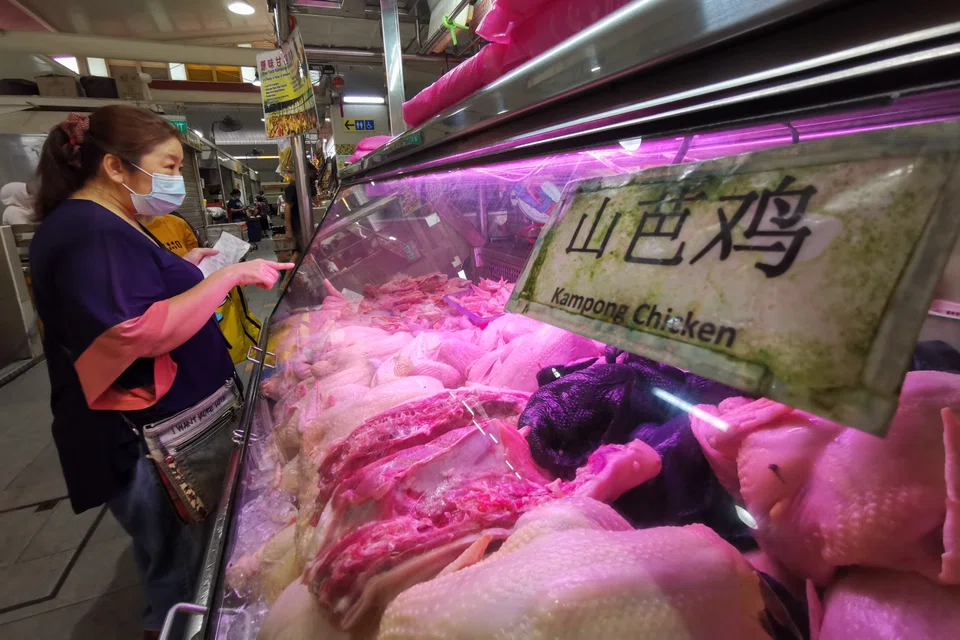
SINGAPORE inflation blew past analysts’ expectations and surged in June to levels last seen during the tail end of the global financial crisis (GFC), when energy prices were high.
All the same, analysts do not expect the central bank to ease policy settings – as the Monetary Authority of Singapore (MAS) did then, when gross domestic product (GDP) was in decline.
Barclays economist Brian Tan noted that tight labour market conditions will generate “steady demand-pull inflation pressures”, among other factors that could prompt MAS hawkishness.
The all-items consumer price index (CPI) rose by 6.7 per cent year on year in June, up from 5.6 per in May. Core inflation – which excludes private transport and accommodation costs – rose to 4.4 per cent, from 3.6 per cent before, figures released on Monday (Jul 25) showed.
Separately, all-items inflation rose by 5.2 per cent year on year for general households in the first half of 2022, fresh figures from the Department of Statistics showed, also on Monday. The increase was faster than the 3.1 per cent increase in the 6 months prior.
The increase was sharpest for households in the top 20 per cent of income, who saw CPI grow by 6.0 per cent. Households in the middle 60 per cent felt an increase of 4.9 per cent in consumer prices, while the bottom 20 per cent saw prices up by 4.2 per cent.
“The firmer GDP growth has allowed the MAS to tighten more aggressively, while during 2008, growth was weakening and also back then, inflation was on its way down – though as elevated as current levels – from the peak in mid-2008,” Maybank economist Lee Ju Ye said.
Maybank senior economist Chua Hak Bin said that a difference between now and the GFC has been a foreign worker crunch and ongoing policies to raise lower-wage local workers’ pay.
“Wage cost pressures and the risks of a wage-price spiral are far more acute in this cycle and may keep core inflation elevated even as economic growth slows,” he told The Business Times.
Selena Ling, chief economist at OCBC, added that another difference was a rate-slashing by the US Federal Reserve in 2008, in contrast to its aggressive rate hikes now.
Therefore, analysts are keeping an eye on the MAS’ next half-yearly policy meeting in October.
Besides moving the mid-point and raising the pace of appreciation of the Singapore dollar nominal effective exchange rate (S$NEER) policy band in April, the MAS tightened policy in 2 off-cycle moves this year. It steepened the slope in January and re-centred the band in July.
But as Nicholas Mapa, ING senior economist, observed: “Despite delivering a series of tightening measures since late 2021, MAS has struggled to contain stubbornly high inflation … and today’s inflation reading suggests that the central bank may be called to action again very soon.”
Several bank economists now expect the MAS to steepen the slope of the S$NEER band by a “slight increase” of 50 basis points, to an estimated 2 per cent in October.
Alvin Liew, senior economist at UOB, said that he could not rule out an even steeper slope of about 2.5 per cent, as well as adjustments to the mid-point and width of the policy band, “especially if core inflation accelerates well above 4 per cent in the next few months”.
But the MAS is still expected to wait until its next scheduled meeting to take further action, with Liew calling a third round of off-cycle tightening unlikely in the third quarter – “unless we get an extreme acceleration in CPI inflation numbers for July and August”, he added.
HSBC economist Yun Liu wrote: “While the MAS expects inflation to peak before easing towards year-end, our inflation forecasts point to sticky high prices for the upcoming quarters. Thus, we do not believe the MAS is at its finishing line in the current tightening cycle.”
On the other hand, Maybank’s Lee and Chua – who expect the MAS to maintain its stance in October, barring another increase in the official inflation forecast – said in a note: “There is still room for the Singdollar to appreciate. A slowing global economy and rising interest rates are deflationary forces that could cool price pressures in the second half.”
Though core inflation is expected to peak in the third quarter, watchers warned that consumer prices will stay high, as the MAS and Ministry of Trade and Industry (MTI) noted in a joint statement that “inflationary pressures will remain elevated in the months ahead”.
“There remain upside risks to inflation from fresh shocks to global commodity prices, as well as domestic wage pressures,” the MAS and MTI added.
Said Tan, from Barclays: “Our estimates suggest sequential core inflation momentum remains very strong – even after excluding uncooked food, energy and the travel-related components – which suggests it may take some time before price pressures cool off.”
“Continued lagged pass-through of raw food prices, and still elevated labour costs could imply only a slight moderation from the peak,” added Citi analysts Kit Wei Zheng and Jester Koh, whose report projected core inflation to average 4.6 per cent in the third quarter and 4.1 per cent in the fourth quarter of 2022.
The MAS’ latest full-year forecasts are for core inflation forecasts of between 3.0 per cent and 4.0 per cent in 2022, and headline inflation of between 5.0 per cent and 6.0 per cent.
Barnabas Gan, RHB senior economist, has raised his full-year core inflation forecast to 3.8 per cent in 2022, from 3.1 per cent before, and his headline forecast to 5.8 per cent, up from 4.8 per cent.
Similarly, Tan, from Barclays, hiked his core inflation forecast to 4.2 per cent in 2022, from 3.5 per cent before – which he noted would bust the official forecast range. He expects core inflation to cool “only slightly” to 4.0 per cent in 2023, which is higher than an earlier full-year projection of 3.0 per cent for that year.
TRENDING NOW

Two Singapore-listed palm oil firms named in Greenpeace report on Indonesian plantation fires

Singapore Airlines flight returns to San Francisco after ‘unruly’ passenger incident

Singapore looking into which companies responsible for haze-causing fires: PM Wong

Deluge IPO 3.86 times subscribed ahead of SGX debut

