

Singapore narrows 2025 NODX forecast to ‘around 2.5%’, expects ‘moderated growth’ in 2026
EnterpriseSG projects an expansion of 0% to 2% for next year, in line with global trade outlook

[SINGAPORE] The Republic has narrowed its 2025 full-year growth forecast for non-oil domestic exports (NODX) to “around 2.5 per cent” – from 1 to 3 per cent – in line with a projected moderation in the second half of 2025.
In its quarterly review of trade performance on Friday (Nov 21), EnterpriseSG said that it expects robust artificial intelligence (AI)-related demand and high gold prices to provide “some support” to NODX in the fourth quarter, though performance may be weighed down by the high base in November and December last year.
For 2026, EnterpriseSG forecasts a “moderated growth” of 0 to 2 per cent, which “primarily reflects the materialisation of tariff-related impact and the easing of front-loading effects”.
It noted that the slowdown is in line with the World Trade Organization’s (WTO) projection for slower global merchandise trade growth of 0.5 per cent in 2026, down from 2.4 per cent this year.
EnterpriseSG also flagged downside risks such as the re-escalation of tariff actions and sector-specific tariffs, which could “raise global economic uncertainty and dampen demand”.
Private-sector economists remained cautious on Singapore’s 2026 trade outlook, flagging the risk of further sectoral tariffs.
DBS senior economist Chua Han Teng expects the Republic’s trade-related prospects to be “restrained”, given its strong correlation with global dynamics.
Moody’s Analytics economist Denise Cheok said that while Singapore has avoided tariffs on semiconductors and pharmaceuticals so far, “there is no guarantee” that this will hold till the end of next year.
While recent trade deals between the US and various Asian markets provide a short-term reprieve, “key disputes remain largely unresolved”, she added, expecting “periodic flare-ups” next year.
After front-loading earlier this year, the “trade payback” in 2026 may be a drag on growth, said HSBC Asean economist Yun Liu.
Q3 performance
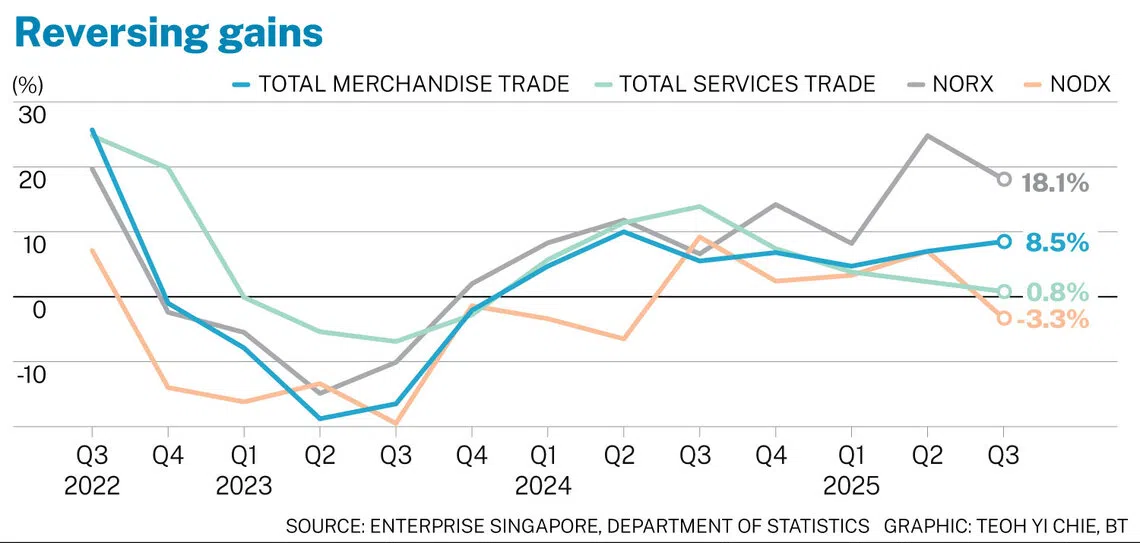
NODX declined 3.3 per cent year on year in the third quarter of 2025, reversing from the previous quarter’s 7 per cent expansion.
Electronics grew at a slower 7.1 per cent pace, down from the previous quarter’s 10.5 per cent growth. The increase was led by PCs, integrated circuits and disk drives.
This was “surprisingly resilient”, given that US tariffs took effect for most trade partners in August, added Cheok.
“While the effects of front-loading are likely to start fading, spillover from the ongoing AI boom will help take the edge off the hit from tariffs.”
But she flagged the risk that the AI boom may reach “unsustainable” growth levels before sharply correcting.
Overall, Q3’s performance was weighed down by the decline in non-electronics, which outweighed the growth in electronics, said EnterpriseSG.
This was driven by weakness in the food preparations, petrochemicals and the volatile pharmaceuticals segments. Non-electronic NODX declined 6.5 per cent, reversing from the previous quarter’s 5.9 per cent rise.
OCBC chief economist Selena Ling thinks that full-year NODX growth could still surpass the official growth estimate, as it is “unlikely” for NODX to fall 11 per cent year on year in November and December – the amount needed to miss the 2.5 full-year figure.
Cheok expects that electronics exports and shipments of non-monetary gold – which surged in October – will likely push up NODX for the last two months of Q4.
In Q3, exports to Singapore’s top three markets declined: by 30.7 per cent for the US; 29.3 per cent for Indonesia; and 8.3 per cent for China.
Total merchandise trade grew 8.5 per cent on the year in Q3, extending the 7 per cent rise in the preceding quarter.
Total services trade expanded by 0.8 per cent year on year in Q3, following the 2.3 per cent rise in the previous quarter.
TRENDING NOW

Government to bring forward raising of retirement age, give employers more financial support to create flexi-load jobs
Former minister Maliki Osman, Revolut chairman join Asia Gulf Holdings advisory board

Is Manila Asia’s new dining hot spot?
Simba at risk of losing operating licence over spectrum misuse

