Singapore NODX up 6.0% in April, but growth lags expansion in March
 Add BT as a preferred source
DeeperDive is a beta AI feature. Refer to full articles for the facts.
SINGAPORE exports grew in April from the same period last year, reflecting a general growth this year, but signalled a downward growth trend from March.
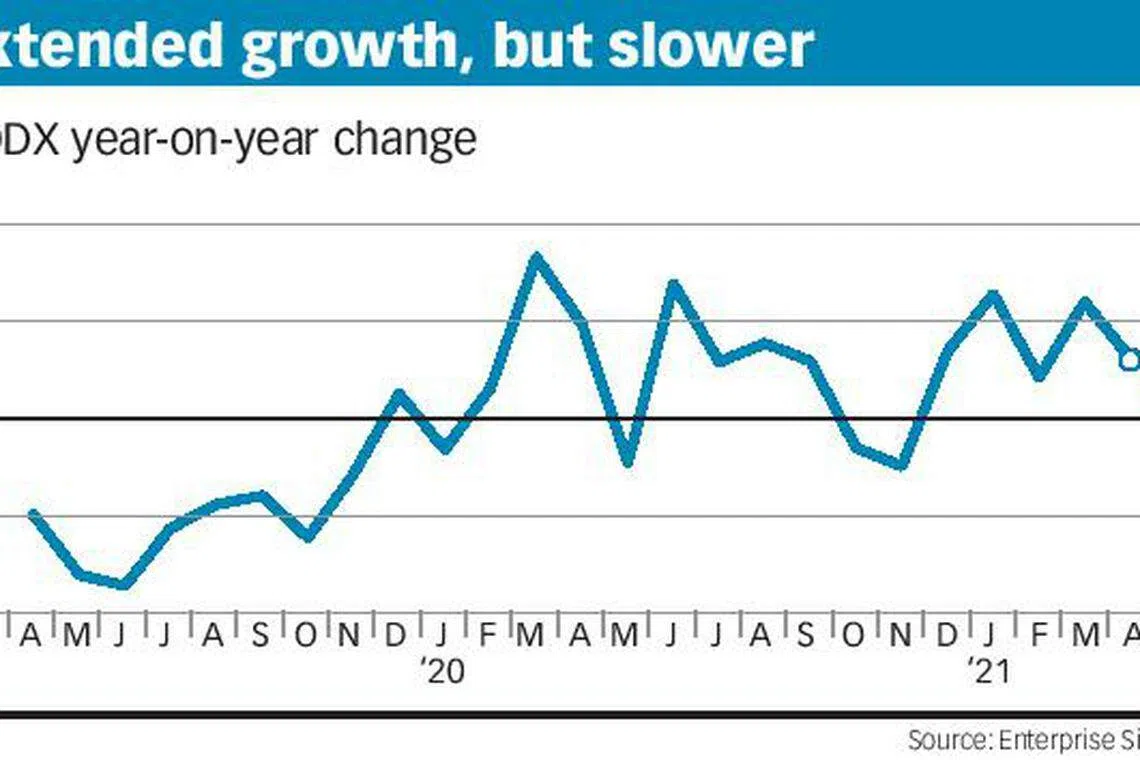
Non-oil domestic exports (NODX) grew by 6 per cent year on year (yoy) in April, according to data from Enterprise Singapore (ESG) on Monday, making it the fifth consecutive month to record growth. This was propelled mainly by non-electronics, though electronics also rose, the trade agency said.
However, the results underperformed against the 11.5 per cent growth that analysts polled by Bloomberg were expecting.
NODX growth in April follows a revised 11.9 per cent growth yoy in March, and on a month-on-month (mom) seasonally adjusted basis, NODX declined by 8.8 per cent in April 2021, after the previous month's 1.1 per cent increase.
However, Prakash Sakpal, a senior economist at ING, noted: "The export slowdown may be transitory and low base effects will still help a strong bounce in GDP (gross domestic product) of double-digits in the current quarter."
The non-electronics sector led growth in April, with shipments rising by 4.7 per cent yoy, boosted by specialised machinery, petrochemicals and primary chemicals. Electronics NODX also rose in April, up 10.9 per cent, with PCs, diodes & transistors and ICs being the largest contributors.
Navigate Asia in
a new global order
Get the insights delivered to your inbox.
Economist Jung Sung Eun at Oxford Economics suggested in a report on Monday that a global chip shortage is a downside risk to Singapore's trade rebound. In contrast, Maybank Kim Eng (Maybank KE) analysts Chua Hak Bin and Lee Ju Ye noted that PCs and diodes and transistors continued to post robust growth, despite concerns over chip shortages.
Growth was more limited than in the previous month, following increases of 9.2 per cent and 24.4 per cent in non-electronics and electronics respectively in March.
Semiconductors growth eased to a five-month low, partly due to a higher base last year, contributing to a lower electronics NODX, according to the Maybank KE analysts. Semiconductor production is likely running close to full capacity, its report added.
ING's Mr Sakpal also noted that "pharmaceutical weakness" was observed in April.
As a whole, NODX to Singapore's top 10 markets declined in April 2021, mainly due to the US, where exports contracted by 42.3 per cent, the European Union (EU), which saw exports decline by 30.2 per cent, and Japan, where NODX contracted by 33.2 per cent.
In the US and Japan, these follow smaller declines in March, while it reverses a 31.6 per cent rise in exports to the EU.
On the other hand, NODX to China, Malaysia, Hong Kong, South Korea and Thailand rose, but was insufficient to offset the declines.
Overall, total trade expanded by 26.3 per cent in April, extending the 19.6 per cent growth in the previous month as both exports and imports rose. However, both total exports and total imports decreased on a mom, seasonally adjusted basis, bringing total trade down by 2.6 per cent in April, reversing the 7.1 per cent rise in March.
Analysts remain wary of tightened Covid-19 restrictions, but reactions are mixed regarding their impact on export outlook forecasts.
Selena Ling, OCBC's head of Treasury Research & Strategy, said that with the pandemic and tightened restrictions, "there is a risk that NODX momentum may moderate further in the coming months", and that the situation "remains very dynamic" possibly posing a downside risk to OCBC's existing full-year 2021 NODX growth forecast.
ING's Mr Sakpal expects that fiscal policy will soften Covid-19's impact, but said that it will look to scale back its Q2 GDP forecast on "more signs of economic weakness in forthcoming activity data".
Ms Jung at Oxford Economics said that while vaccination roll-outs mean that the global outlook remains more positive than this time last year, reduced economic activities due to spikes in Covid cases in Asean, a key trading bloc, will have a negative impact on Singapore's trade in the coming months.
On the other hand, Maybank KE said that the stricter Covid-19 measures, which currently mainly restrict food and beverage services, will likely not materially slow down the key sectors powering growth, which include manufacturing and professional services. It has maintained its 2021 GDP growth forecast.
UOB economist Barnabas Gan also noted that "trade demand in the region as a whole has continued to stay buoyant", as evidenced by the expansion in NODX to key trading partners especially in Asia.
Considering that the enhanced Covid-19 restrictions introduced in Singapore are expected to be limited in both scope and timeframe, especially compared to last year's "circuit breaker", Mr Gan believes they will likely have "little impact".
In a report from Moody's Analytics, analyst Eric Chiang said: "The outlook for Singapore's overall economy and especially the jobs market may worsen in the second quarter, but we do not expect to see a downturn of the same magnitude as last year."
Decoding Asia newsletter: your guide to navigating Asia in a new global order. Sign up here to get Decoding Asia newsletter. Delivered to your inbox. Free.
Copyright SPH Media. All rights reserved.