

Singapore on track to ease tightened Covid-19 curbs after June 13: PM Lee
In the new normal where virus is endemic, Singapore 'must stay connected to the world' with effective safeguards and border restrictions in place
 Add BT as a preferred source
DeeperDive is a beta AI feature. Refer to full articles for the facts.
Singapore
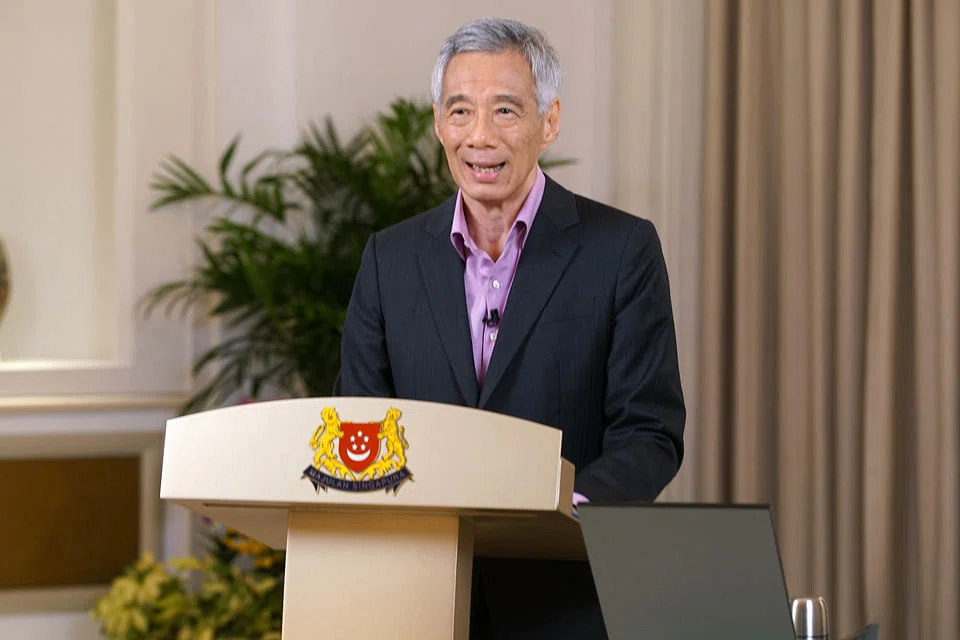
WHILE Covid-19 is likely to become endemic and circulate for years to come, living with the virus does not mean Singapore will completely close its borders, said Prime Minister Lee Hsien Loong on Monday.
And barring any super-spreader events or large clusters forming, the country should be "on track" to bring the outbreak under control, and that "we will know for sure" in another week or so. He added that if the situation improves and the number of community cases falls further, the authorities "should be able to" relax the restrictions under the current Phase 2 (Heightened Alert) after June 13.
In a televised address delivered at the Istana, Mr Lee said the priority for now is to get through the pandemic and position Singapore strongly for the future, even as the virus continues to rage elsewhere.
He said that countries that are "united, disciplined and put in place sensible safeguards" will be able to reopen their economies and reconnect to the rest of the world.
"Singapore will be among these countries - more confident and resilient than before, and toughened by what we have overcome together as one nation," he said.
Navigate Asia in
a new global order
Get the insights delivered to your inbox.
He stressed that Singapore needs food, essential supplies, workers, businesses and other travellers to keep on flowing, and the country "must stay connected to the world" with effective safeguards and border restrictions in place to keep people safe. However, he also made the point that it was not possible to prevent some infections from slipping through every now and then.
"But as long as our population is mostly vaccinated, we should be able to trace, isolate and treat the cases that pop up, and prevent a severe and disastrous outbreak," he said.
With new variants emerging around the world, Mr Lee said a more infectious virus means that Singapore will have to "raise (its) game" to keep the pandemic under control.
He outlined a three-pronged strategy where Singapore must carry out Covid-19 tests faster and more extensively, speed up and widen the contact-tracing process, and vaccinate as many people as possible within the shortest amount of time.
On the testing front, he said more and different kinds of tests are coming on stream. These include breathalyser tests that take only a minute and are being used at the Causeway and the airport. Do-it-yourself tests will soon be sold over the counter at pharmacies, he added.
"These alternatives to PCR (polymerase chain reaction) tests help us detect and isolate persons quickly when they are most infectious. This will be a big help in slowing down the spread of Covid-19," he said, adding that authorities must respond by testing more widely as the virus mutates to become more transmissible.
Mr Lee said Singapore's approach to testing is undergoing a shift, where routine and regular testing will be done for people who appear well, in normal work or social or community settings, to make these places safe.
"Extensive testing will give us confidence to resume larger-scale events or gatherings... Therefore, you should expect routine, large-scale, fast and simple testing to be part of our new normal," he said.
Turning to the move towards faster and more effective contacttracing, Mr Lee said the current system can be improved by casting the net wider to identify and quarantine close contacts of an infected case.
In future, a first-degree contact will be isolated and tested for the virus. His household members will be notified to isolate themselves immediately - without waiting to see if the first-degree contact tests positive.
As for vaccinations, Mr Lee announced that there will be faster vaccine deliveries over the next two months. This will enable the government to boost the vaccination programme and offer the shots to everyone, "even sooner than we expected".
With those 40 and above already eligible for the jabs, Mr Lee said the next group in the queue are students.
Bookings will open on June 1 with priority given to the graduating cohorts for the 'O', 'N' and 'A' Level examinations, as well as special-needs students. Those aged 12 and above will follow after, including students in institutes of higher learning.
Young adults aged 39 and younger will have their turn from around mid-June, with the Singaporeans in this group given a two-week priority window to book their appointments first.
As at Monday, close to 40 per cent of residents have taken at least one vaccine dose; Mr Lee said the next target is to have two-thirds getting at least the first shot by early-July, provided supplies arrive as planned.
"Everyone who is eligible for a vaccination and wants one should be able to get at least their first jab by National Day (on Aug 9). Whether you are old or young, please come forward to be vaccinated once it is your turn," he said. "With the more infectious virus strains, we need as many people as possible to be vaccinated in order to reach herd immunity, or get close to it. This is the way to make everyone safe and resume more normal activities."
Mr Lee said that in the "new normal", Covid-19 "will not dominate" the lives of Singapore and its people.
More people will be mostly vaccinated, and possibly taking booster shots every year. Testing will be carried out often, and this will be done in a fast and easy manner, he said.
People will be allowed to resume many regular pre-pandemic activities such as attending religious services and entertainment and sports events.
"We will reopen our borders safely. Visitors will again come to Singapore. Singaporeans will travel again to countries where the disease is well under control, especially if we have been vaccinated," he said. "Eventually we will even go about without masks again, at least outdoors. Right now, we are some ways off from this happy state. But we are heading in the right direction."
At a press conference held after Mr Lee's speech, Finance Minister and Covid-19 taskforce co-chair Lawrence Wong said it was "very unlikely" that Singapore will immediately go back to Phase 3 of its re-opening at the end of Heightened Alert on June 13. "If all goes to plan, there may be a chance... for some adjustment and relaxation of measures," he said, adding that this had to be done "gradually and in a controlled manner".
READ MORE:
- Reassuring to plan a future in which Covid 19 is endemic, say economists
- Singapore residents can get more types of Covid-19 jabs - but at their own cost and risk
Decoding Asia newsletter: your guide to navigating Asia in a new global order. Sign up here to get Decoding Asia newsletter. Delivered to your inbox. Free.
Copyright SPH Media. All rights reserved.
TRENDING NOW
Air India asks Tata, Singapore Airlines for funds after US$2.4 billion loss
‘Boring’ is the new black: The stars are aligning for a Singapore stock market revival

From 1MDB to ‘corporate mafia’: Is Malaysia facing a new governance test?
South-east Asian markets account for 8.8% of global capital inflows from 2021 to 2024: report

