

Singapore’s April PMI contracts for second month in a row

Tessa Oh
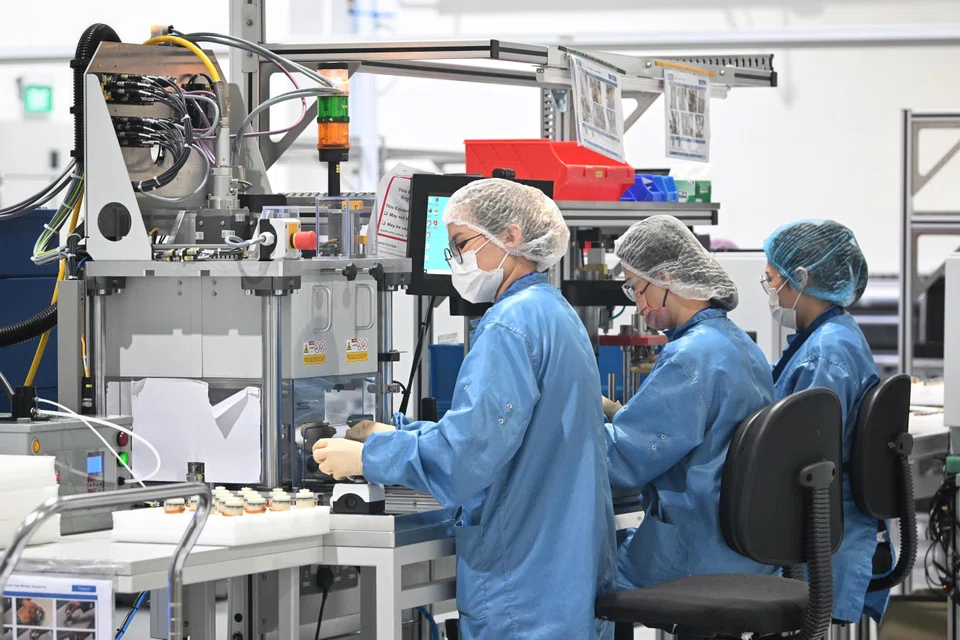
SINGAPORE’S overall factory activity resumed its downward trajectory in April, echoing the region-wide softening in manufacturing sentiment as external demand remains weak.
The Purchasing Managers’ Index (PMI) dropped 0.2 point to 49.7 last month, shrinking for the second time in a row, data from the Singapore Institute of Purchasing and Materials Management (SIPMM) showed on Wednesday (May 3).
A reading below 50 indicates the manufacturing sector is declining, while a reading above 50 means growth.
Likewise, the lynchpin electronics sector slipped 0.2 point from the previous month to post a faster contraction at 49.2. This is the ninth consecutive contraction since August 2022, after two years of continuous expansion.
“The Western banking crisis continues to cloud global economic uncertainty, with the latest being the troubled First Republic Bank,” said Stephen Poh, executive director at SIPMM. Singapore manufacturers are also becoming less optimistic about an immediate recovery following China’s reopening.
The latest print shows that Singapore is still in a manufacturing downturn due to the worsening electronics downcycle and weaker external demand, said UOB senior economist Alvin Liew, who noted that most of the PMI sub-indices either remained in or slipped further into contractionary territory.
The combination of weaker external demand and the electronics downcycle is typically bad for trade-reliant economies like Singapore, South Korea and Taiwan, where electronics makes up a significant share of manufacturing, added Liew.
Noting that the Monetary Authority of Singapore has warned that the manufacturing drag is likely to persist in the coming quarters, Liew expects Singapore’s PMI to remain in contraction territory at least for the first half of the year. Even so, a recovery in the second half of the year is “far from certain”.
The glum manufacturing sentiment is in sync with other regional economies, which also saw manufacturing activity soften in April.
China’s official manufacturing PMI fell to a four-month low of 49.2 in April, from 51.9 the previous month. Barclays analysts Yingke Zhou, Ying Zhang and Jian Chang said the disappointing print suggests that the real estate sector remains a drag on manufacturing activity, resulting in a weak demand for industrial products.
Additionally, the recovery of domestic consumer goods demand likely underperformed as “China’s reopening-driven rebound this year will mainly be driven by services consumption,” said the analysts.
In neighbouring South Korea, the S&P Global Manufacturing PMI nudged up slightly to 48.1 in April, from 47.6 the previous month – though it still remained in contractionary territory.
Meanwhile, the S&P Global Taiwan Manufacturing PMI dropped to 47.1 in April, from 48.6. “There were reports that weak demand conditions, particularly across key export markets such as the United States, Europe and mainland China, continued to act as a drag on performance,” said Annabel Fiddes, economics associate director at S&P Global Market Intelligence.
“That said, the data also suggest that the worst of the downturn is over, as rates of contraction are much less severe than those seen from the second half of 2022 into January,” she added.
Closer to home, the S&P Global Malaysia Manufacturing PMI came in at 48.8, flat from the previous month. The S&P Global Philippines Manufacturing PMI also eased to an eight-month low of 51.4 in April, from 52.5 in March.
Bucking the trend was Indonesia and Thailand, which saw improved manufacturing sentiment in April. The S&P Global Indonesia Manufacturing PMI rose to a seven-month high of 52.7, from 51.9, while the S&P Global Thailand Manufacturing PMI rose to 60.4 last month, from 53.1.
“China’s reopening is still having a limited spillover effect for the region in terms of goods exports, as China’s export order remain weak,” said analysts from Barclays in a research note.
“On the other hand, resilience in domestic demand means we continue to expect the domestically-oriented economies of India and Indonesia to maintain their outperformance in PMI data in the near term.”






