

Singapore's core, headline inflation at -0.1% in November
 Add BT as a preferred source
Janice Heng
DeeperDive is a beta AI feature. Refer to full articles for the facts.
SINGAPORE'S deflation eased in November, with both core and headline inflation at -0.1 per cent year on year, compared to -0.2 per cent in October, according to Department of Statistics (Singstat) consumer price index (CPI) figures on Wednesday.
Economists had expected core inflation to be -0.1 per cent and headline inflation to be -0.2 per cent. After Wednesday's release, most stuck to their full-year estimates and expectations for a return to inflation in 2021.
The Monetary Authority of Singapore (MAS) and the Ministry of Trade and Industry (MTI) kept their official inflation outlook for 2020 and 2021 unchanged from earlier months.
November's slower rate of decline was due mainly to smaller falls in the costs of services, and of electricity and gas, as well as higher food inflation.
Private transport and accommodation inflation - part of the headline measure but excluded from core inflation - stayed unchanged from the month before, at -1.3 per cent and 0.3 per cent respectively.
Services inflation was -0.2 per cent, less steep than October's -0.5 per cent figure, due mainly due to a smaller decline in outpatient services fees and an increase in the costs of recreational and cultural services.
Navigate Asia in
a new global order
Get the insights delivered to your inbox.
The cost of electricity and gas fell 6.8 per cent, slowing from October's 7.2 per cent fall, as targeted utilities rebates ceased in October 2020.
The cost of retail and other goods fell more sharply, with inflation at -2.0 per cent in November, steepening from -1.6 per cent in October.
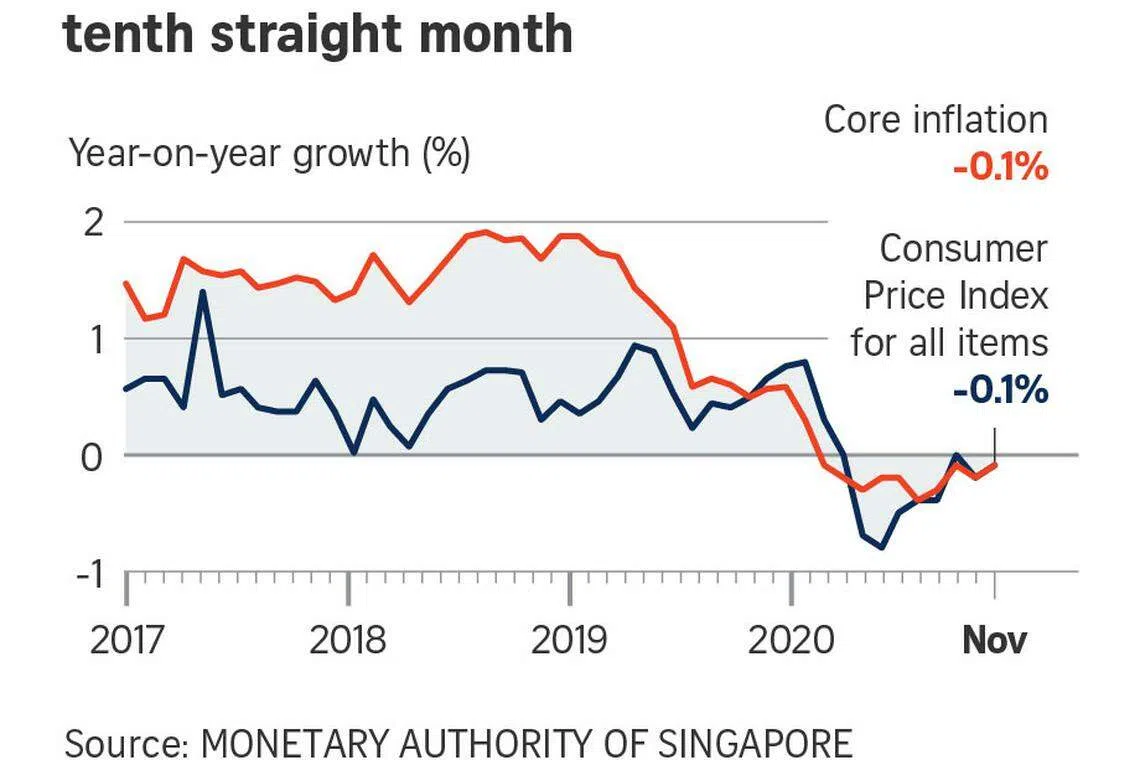
In Singstat's release, food, household durables and services, and communication were the only three categories with positive inflation year on year in November.
In a joint statement, the MAS and MTI maintained an unchanged inflation outlook from the previous two months.
External inflation is likely to stay low, while domestic cost pressures are expected to stay subdued as labour market slack weighs on wages. Still, core inflation is forecast to turn mildly positive in 2021.
Accommodation costs are expected to fall as rentals could soften, due partly to a decline in foreign employment. But private transport costs should rise modestly with an anticipated reduction in the supply of Certificates of Entitlement.
The official forecasts remain the same: core and headline inflation in 2020 are expected to be between -0.5 per cent and zero per cent, while in 2021, core inflation is expected to average zero to 1 per cent and headline inflation is projected to be between -0.5 and 0.5 per cent.
With the latest figures, core CPI has fallen 0.1 per cent year on year in the first 11 months, noted Barclays economist Brian Tan, who kept his full-year forecast of -0.1 per cent.
UOB senior economist Alvin Liew, however, said that while low consumer prices may persist into December, "pockets of inflation from food, communications and vehicle costs could continue to cushion the deflationary effects from other key CPI categories while year-end local holiday demand may provide a temporary increase in domestic services demand and prices". He is keeping a full-year forecast of -0.3 per cent for both core and headline inflation.
UOB is now "slightly more hopeful that headline CPI will turn positive" and average 0.5 per cent year on year in 2021, given the expectations of an improving global economic backdrop as the roll out of Covid-19 vaccines supports consumer demand, he said.
With core CPI likely to start rising again, Mr Tan expects the MAS to leave policy settings unchanged at its next policy review in April.
Decoding Asia newsletter: your guide to navigating Asia in a new global order. Sign up here to get Decoding Asia newsletter. Delivered to your inbox. Free.
Copyright SPH Media. All rights reserved.
TRENDING NOW

From 1MDB to ‘corporate mafia’: Is Malaysia facing a new governance test?
Higher costs, lower returns: Why are Singaporeans still betting on real estate?
South-east Asian markets account for 8.8% of global capital inflows from 2021 to 2024: report

Richard Eu on how core values, customers keep Singapore’s TCM chain Eu Yan Sang relevant

