

Singapore’s core inflation inches up to 1.7% in March; headline inflation at 1.8%
The latest numbers are in line with private-sector economists’ estimates

[SINGAPORE] Both Singapore’s core and headline inflation rose in March, data from the Department of Statistics showed on Thursday (Apr 23).
The Monetary Authority of Singapore (MAS) and the Ministry of Trade and Industry (MTI) maintained their official forecasts for both core and headline inflation at 1.5 to 2.5 per cent for 2026.
MAS had raised its full-year forecasts to this range on Apr 14, up from 1 to 2 per cent in January.
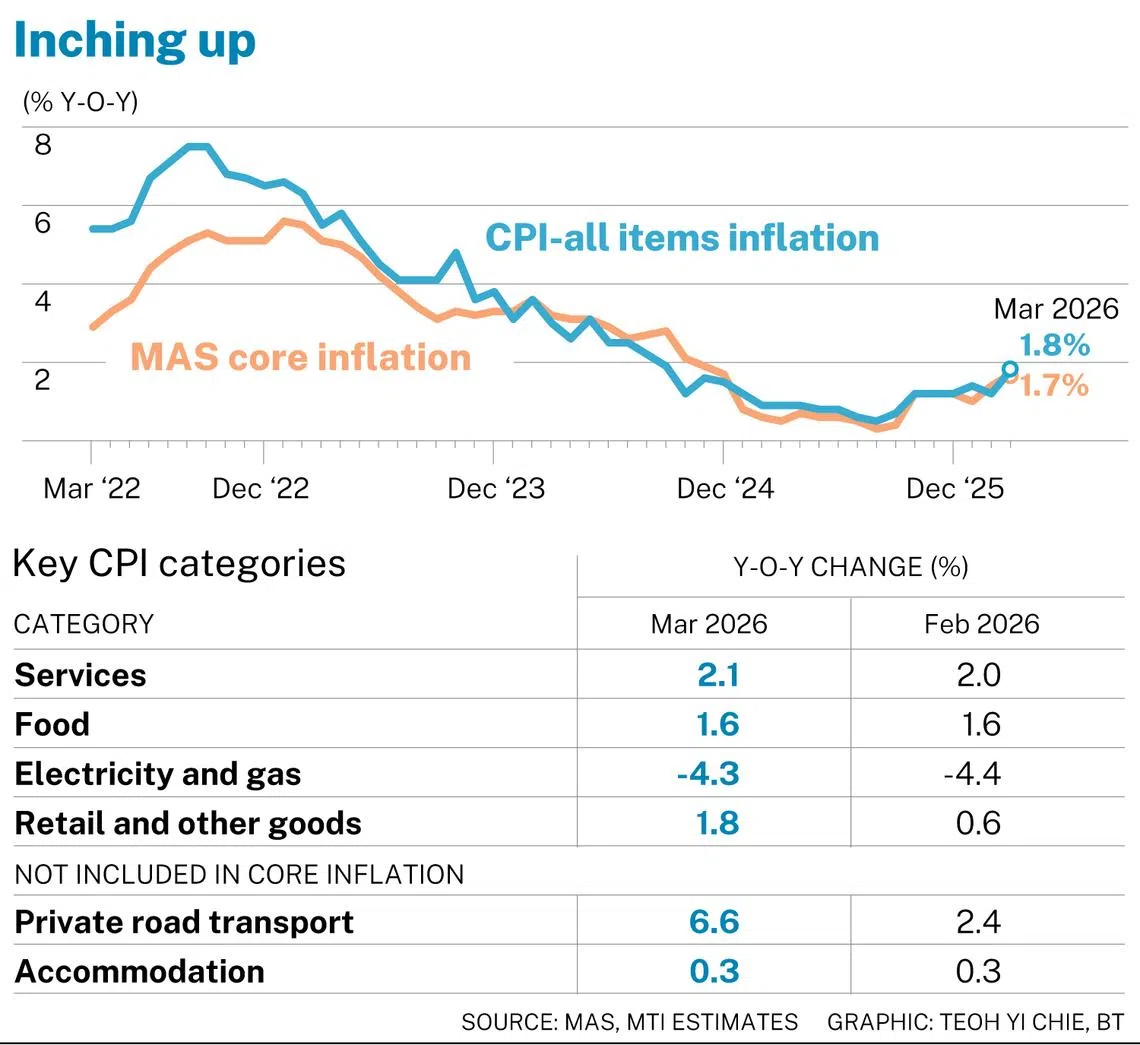
March’s core inflation, which excludes accommodation and private transport, was 1.7 per cent. This was more than February’s 1.4 per cent and in line with the median forecast of 1.7 per cent by private-sector economists polled by Bloomberg.
The authorities attributed the pick-up to an increase in both retail and other goods and services inflation.
Headline inflation rose to 1.8 per cent, up from 1.2 per cent the previous month. It was also in line with economists’ median forecast of 1.8 per cent.
This was due to higher private transport and core inflation, the authorities said.
On a month-on-month basis, the overall consumer price index (CPI) increased 0.5 per cent in March, while core CPI rose 0.1 per cent.
In a joint statement on Thursday, MAS and MTI flagged that Singapore’s imported cost pressures are expected to pick up and broaden in the months ahead.
“As higher energy and other input costs arising from the developments in the Middle East pass through global supply chains, they will raise production and transport costs for a wide range of Singapore’s imported goods and services,” they said.
Domestically, services unit labour costs are likely to grow more slowly in 2026, as nominal wage growth eases from last year’s “firm levels”. Amid rising economic uncertainty, domestic consumer spending could turn more cautious, they added.
On account of these factors, they have kept their official 2026 forecasts for both core and headline inflation at 1.5 to 2.5 per cent.
The authorities said risks to the inflation outlook are tilted to the upside at this juncture, and added that a “more persistent disruption to global energy supplies or shortages in key intermediate inputs to regional supply chains could further raise imported costs for Singapore”.
However, they also flagged downside risks, in the form of industrial production being curtailed due to supply chain disruptions or an abrupt tightening in global financial conditions.
These could lead to a slowdown in economic activity and therefore, lower inflation, they said.
Key CPI categories
In March, retail and other goods inflation rose to 1.8 per cent, from 0.6 per cent in February. This was mainly due to a larger increase in the prices of alcohol and tobacco, as well as higher clothing and footwear prices.
Services inflation inched up to 2.1 per cent from 2 per cent, primarily due to a larger increase in the cost of point-to-point transport services, as well as the higher cost of telecommunications services.
Private transport inflation jumped to 6.6 per cent from 2.4 per cent, on account of an increase in petrol prices.
Meanwhile, accommodation inflation was unchanged at 0.3 per cent in March, as housing rents rose at a similar pace as February.
Food inflation was also unchanged at 1.6 per cent, as non-cooked food prices rose at the same rate in March and February, even as food services inflation moderated slightly last month.
Electricity and gas prices fell at the same rate – by 4.3 per cent – in March as they did in the previous month, because electricity prices declined at a similar pace during this period.
Decoding Asia newsletter: your guide to navigating Asia in a new global order. Sign up here to get Decoding Asia newsletter. Delivered to your inbox. Free.
Copyright SPH Media. All rights reserved.
TRENDING NOW

Malaysian king buys stake in Singapore-listed mining firm expanding into rare earths

Grab CEO’s wife Chloe Tong on life with Anthony Tan and finding her purpose

Once staunchly pro-China, Malaysian Chinese businesses are now distancing themselves from Beijing
Longer wait times expected as S’pore healthcare institutions report system disruptions

