

Economists see higher chance of MAS easing in July, as core inflation falls to four-year low in March
Both core and headline inflation came in below economist estimates

[SINGAPORE] Monetary policy might be loosened further in July, economists said on Wednesday (Apr 23), after core inflation slid to a four-year low of 0.5 per cent in March.
Some lowered their full-year core inflation forecasts to the bottom end of the official range, which spans 0.5 to 1.5 per cent.
But the official forecast ranges themselves were unchanged for both core and headline inflation, in a joint release by the Monetary Authority of Singapore (MAS) and the Ministry of Trade and Industry (MTI).
March’s core inflation – which excludes accommodation and private transport – was 0.5 per cent, data from the Department of Statistics showed on Wednesday. This was marginally below both February’s 0.6 per cent figure, and the median forecast of 0.7 per cent by private-sector economists in a Bloomberg poll.
Headline inflation was unchanged at 0.9 per cent, contrary to economists’ median forecast of 1.1 per cent.
On a month-on-month basis, both the overall consumer price index (CPI) and core CPI edged down by 0.1 per cent.
Explaining the unchanged forecast ranges, MAS and MTI said they expect Singapore’s imported inflation to remain moderate, with lower global crude oil prices and contained food commodity price hikes.
Escalating trade conflicts could be inflationary for some economies, but the impact on Singapore’s import prices is likely “to be more than offset” by disinflationary drags from weaker global demand, they said.
On the domestic front, unit labour costs are projected to rise gradually, while enhanced government subsidies for essential services will continue to dampen services inflation.
MAS and MTI added that the risks to inflation are “tilted towards the downside, given heightened uncertainties in the external environment”.
Further easing?
Noting the “dovish” outlook statement, several economists said monetary policy could be eased once more this year – with one even flagging the possibility of an off-cycle move.
OCBC chief economist Selena Ling said another easing could be on the table if downside risks – especially for core inflation – manifest ahead of July and October’s meetings.
Though reciprocal US tariffs are currently in the 90-day suspension period, “it remains to be seen” if the affected countries can complete negotiations within this time, she added.
Ling retained her full-year core and headline inflation forecasts of 1.2 per cent.
Barclays analysts Brian Tan and Liu Hongying expect the MAS to loosen policy again in July, lowering the slope of the Singapore dollar nominal effective exchange rate (S$NEER) policy band to neutral.
They noted that MTI’s downgraded official 2025 gross domestic product growth forecast range does not take into account “significant future tariff-related weakness”, with policymakers “likely still too hopeful”.
They also see the risk of a downward re-centring of the policy band in the second half of 2025, though this will “likely require much larger declines in economic activity” than their baseline projection.
The Barclays economists lowered their forecast for core inflation to 0.7 per cent, from 0.8 per cent before. They expect headline inflation to fall to 0.9 per cent in 2025.
Similarly, DBS economist Chua Han Teng sees the “rising possibility” of further easing by MAS, as Singapore faces weaker external demand from evolving tariffs developments and downside inflation risks.
He also thinks the policy band slope could be lowered to neutral in subsequent decisions.
With the MAS having turned “significantly more dovish” since its February outlook, UOB associate economist Jester Koh flagged a 20 per cent risk of an off-cycle easing – though his base case is still for a neutral slope in July.
An off-cycle move could involve flattening the slope ahead of July, he said. This “could help to guide markets to drive the S$NEER levels lower within the band parameters…facilitating looser monetary conditions”. (*see amendment note)
He lowered his full-year forecasts to 0.7 per cent for core inflation, from 1 per cent before; and 1 per cent for headline inflation, from 1.3 per cent before.
In contrast, Maybank economists Chua Hak Bin and Brian Lee expect MAS to maintain the current “modest appreciation bias” for the rest of 2025, after two consecutive easing moves in January and April.
They do not rule out an easing to a neutral slope, in the event of a technical recession. But they consider a growth slowdown more likely, at this stage.
They lowered their full-year forecast for core inflation to 0.5 per cent from 0.8 per cent, and for headline inflation to 0.8 per cent, from 1 per cent.
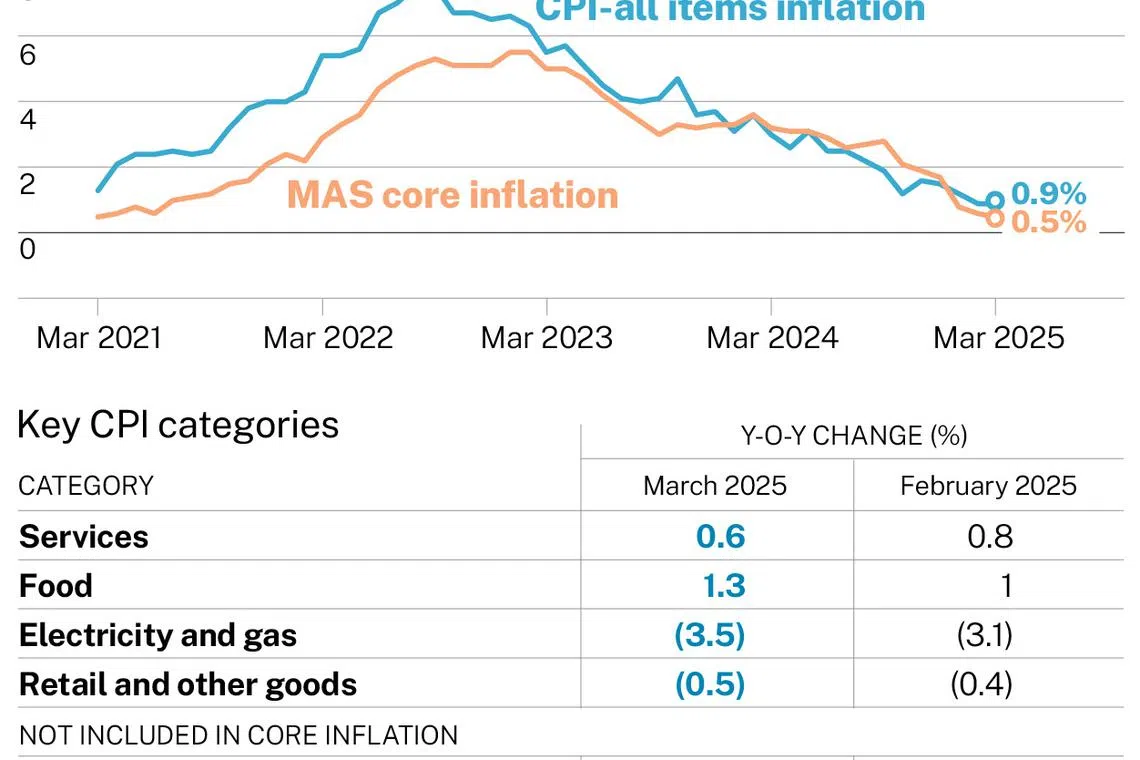
Key CPI categories
In March, accommodation inflation moderated to 1.4 per cent, from 1.6 per cent in February, due to smaller increases in housing rents.
Services inflation eased to 0.6 per cent, from 0.8 per cent before. This was attributed to a steeper decline in the cost of information and communication services and a more modest increase in point-to-point transport fares.
Bucking the trend was food inflation. It increased to 1.3 per cent, from 1 per cent in February, as the prices of non-cooked food and prepared meals rose at a quicker pace. Private transport prices also rose to 2.1 per cent from 1.6 per cent, due to larger increases in car prices.
Retail and other goods, as well as electricity and gas, continued their trend of negative inflation in March.
*Amendment note: An earlier version of the article stated that UOB associate economist Jester Koh’s view of an off-cycle move could involve flattening the slope by 20 per cent. Koh had instead meant that there was a 20 per cent risk of an off-cycle easing.
TRENDING NOW

LTA proposes combining car COE categories, adding rebate-surcharge system

StarHub to acquire MyRepublic’s mobile business amid ongoing telco consolidation

DBS, OCBC, UOB rout lops billions off STI as inflation, rate concerns spook investors

Grab CEO’s wife Chloe Tong on life with Anthony Tan and finding her purpose

