

Singapore’s factory output growth slows to 3.9% in May, but beats estimates
Nearly all clusters, including electronics, have recorded increases in production year on year

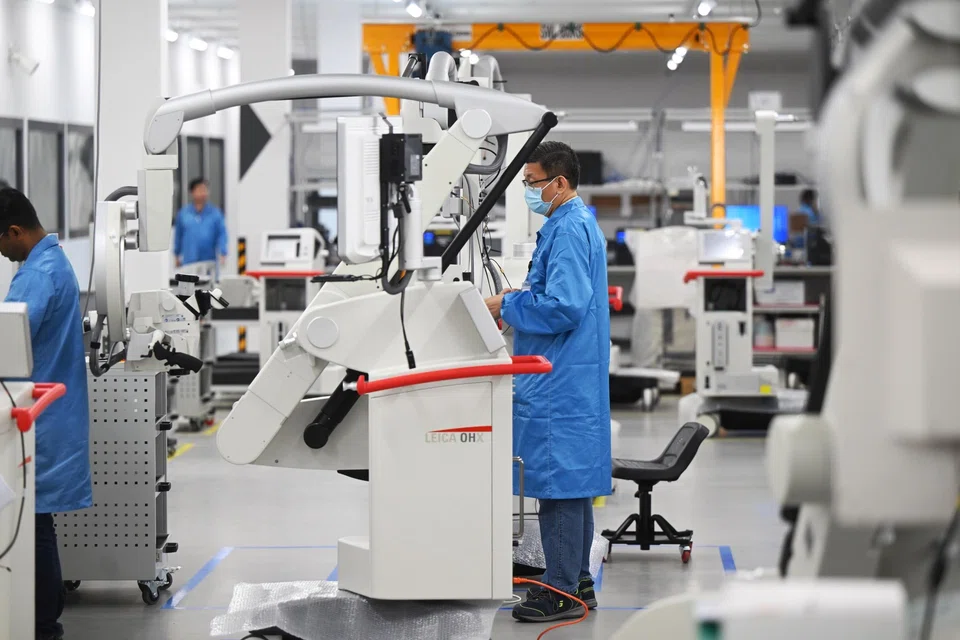
[SINGAPORE] The growth of the Republic’s factory output in May was likely fuelled by continued front-loading ahead of US President Donald Trump’s tariffs, though the slower pace suggests that activity is beginning to cool, economists said on Thursday (Jun 26).
Manufacturing output rose 3.9 per cent in May, easing from April’s revised figure of a 5.6 per cent increase, according to data from the Singapore Economic Development Board.
Still, May’s performance exceeded the expectations of economists, who had predicted a 2.2 per cent expansion in a Bloomberg poll. It also marked the 11th consecutive month of growth.
Maybank analysts Chua Hak Bin and Brian Lee said: “The US reciprocal tariff shock has not disrupted and dampened trade and manufacturing as significantly as initially feared.”
The “healthy” April and May manufacturing readings also suggest that Singapore’s economy did not slide into a technical recession in the second quarter, they added.
Excluding the volatile biomedical manufacturing cluster, output grew 4.9 per cent year on year in May, moderating from the revised 7.8 per cent rise posted in April.
All clusters except one recorded increases in production on the year.
Factory output in the linchpin electronics sector gained 3.9 per cent in May, after increasing 14.6 per cent in the preceding month.
The infocomms and consumer electronics segment recorded the largest jump at 42.6 per cent, followed by semiconductors at 3.4 per cent. Contractions were recorded for the computer peripherals and data storage segment (-18.7 per cent), as well as the other electronic modules and components segment (-20.8 per cent).
Other clusters that recorded rises were:
- Transport engineering (25.6 per cent)
- Precision engineering (10.3 per cent)
- Biomedical manufacturing (6.1 per cent)
- Chemicals (0.3 per cent)
In transport engineering, the aerospace segment grew 43.6 per cent, bolstered by higher production of aircraft parts and more maintenance, repair and overhaul jobs from commercial airlines. The marine and offshore engineering segment increased 5.3 per cent, on account of higher levels of activities in the shipyards. Conversely, the land segment declined 12 per cent.
As for precision engineering, the machinery and systems segment expanded 12.3 per cent, led by higher production of semiconductor equipment and measuring devices. The precision modules and components segment grew 3 per cent with higher output in the plastic precision components and electronic connectors industries.
Maybank’s Dr Chua and Lee noted that front-loading boosted manufacturing and trade-related industries such as wholesale trade and transport in the second quarter, as firms capitalised on the 90-day pause period and reciprocal tariff exemptions on electronic products.
But the front-loading boost “to beat tariff threats” could be cooling down, they flagged, given that May’s electronics growth slowed from two straight months of double-digit expansion.
Barclays analysts Brian Tan and Liu Hongying similarly attributed May’s overall “resilient” industrial production growth to export front-loading, but highlighted some pullback from April.
This is consistent with the softening of Singapore’s non-oil domestic exports (NODX) in May, they noted, which saw electronics NODX growth slow to an eight-month low of 1.7 per cent.
Despite the “decent” reading of May’s manufacturing output, DBS senior economist Chua Han Teng is cautious about the outlook for the second half of 2025. He noted that manufacturers’ sentiment in the Republic “remains subdued” as indicated by the contraction in May’s purchasing managers’ index.
“Significant uncertainty persists regarding ongoing US tariff negotiations, and higher global trade frictions compared to pre-Trump 2.0 will be negative for Singapore’s external demand prospects,” he said. He added that the city-state’s electronics and biomedical manufacturing clusters also remain vulnerable to downside risks from possible US levies on semiconductor and pharmaceutical imports.
With the front-loading of export orders in the first half, economists anticipate some payback in H2 2025.
DBS’ Chua expects the deceleration of trade and industrial production to materialise in H2 and for base effects for factory output to be high, statistically.
But Maybank’s Dr Chua and Lee said the extent of payback and slowdown in H2 will be dependent on the “final reciprocal tariff outcomes for the region”.
The general manufacturing cluster was the only one in which output slipped. Production contracted 8.9 per cent in May; all segments except printing (2.2 per cent) recorded declines.
The food, beverages and tobacco segment declined 4.5 per cent due to lower production of beverage concentrates and bakery products. The miscellaneous industries segment contracted 16.6 per cent, mainly led by lower output of structural metal components and products, as well as paper and paperboard containers and boxes.
On a seasonally adjusted, monthly basis, manufacturing output slipped 0.4 per cent in May, reversing from April’s revised 4.9 per cent expansion.
Excluding biomedical manufacturing, production edged up 0.7 per cent on the month, seasonally adjusted, moderating from the revised 4.3 per cent extension recorded in the previous month.
TRENDING NOW

Singapore’s central gas buyer affirms Indonesia’s role as ‘important partner’ amid export review warning

Why the biggest business decision about AI isn’t which model to choose

Is Manila Asia’s new dining hot spot?

KKR founders among investors buying 42% of Peter Lim’s Valencia; club valued at US$1.4 billion

