

Singapore’s factory output rises 8.5% in November, below estimates
Figure falls short of the 9.7% growth for the month predicted by private-sector economists

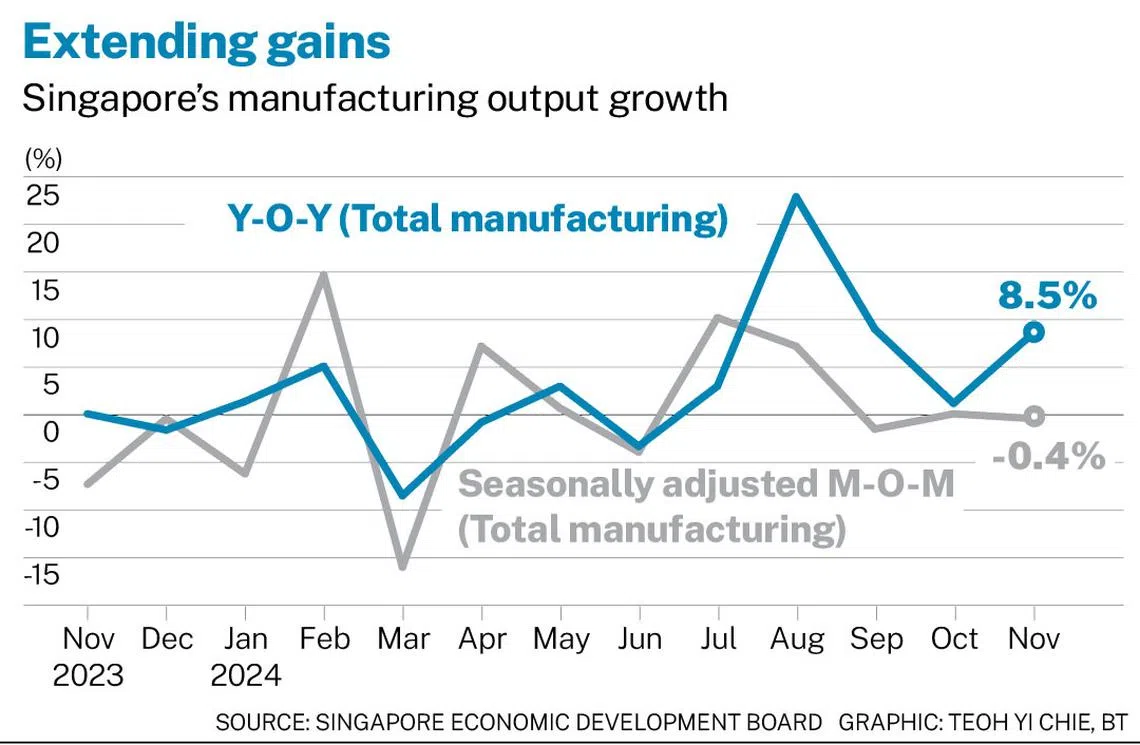
SINGAPORE’S factory output grew 8.5 per cent on year in November, outpacing the previous month’s growth of 1.2 per cent. This came as output in the key electronics sector surged, though gains were offset by the volatile biomedical manufacturing sector, data from the Singapore Economic Development Board showed on Thursday (Dec 26).
The month’s performance fell short of private-sector economists’ expectations, who had predicted a 9.7 per cent expansion in a Bloomberg poll.
Excluding the volatile biomedical manufacturing sector, industrial production was up 13 per cent year on year (yoy), accelerating from October’s 0.4 per cent growth.
November’s prints come after Singapore’s surprisingly strong third-quarter gross domestic product growth of 5.4 per cent, revised upwards from an earlier advance estimate of 4.1 per cent.
The Ministry of Trade and Industry has since upgraded the Republic’s full-year growth forecast for 2024 to around 3.5 per cent. It expects the official growth forecast for 2025 to come in between 1 and 3 per cent.
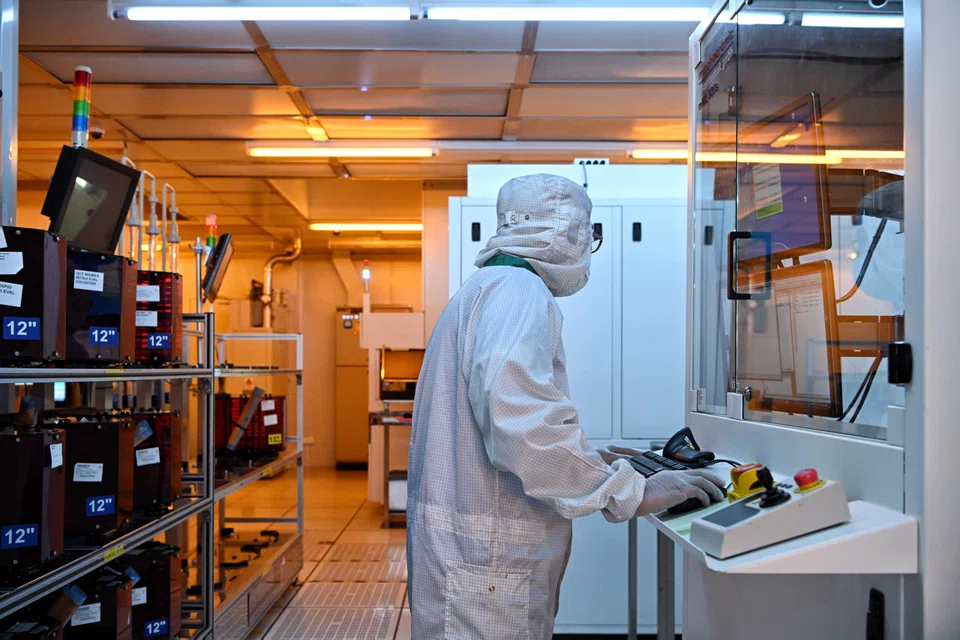
Factory output in the linchpin electronics sector gained 26.2 per cent yoy in November, extending from the previous month’s 4.2 per cent increase. Most segments in the sector grew for the month, with only the other electronic modules and components segment contracting 6.5 per cent.
Output in the precision engineering sector nudged up 0.6 per cent yoy in November.
This was driven by a 4.3 per cent increase in the machinery and systems segment from higher production of front-end semiconductor equipment. Conversely, the precision modules and components segment slid 5.2 per cent, largely due to lower output of optical instruments and metal precision component
Despite earlier signs that electronics exports may be losing momentum, the latest data suggests that tech output “broadly remains on an upcycle” in Singapore, said Barclays regional economist Brian Tan.
Both Tan and UOB associate economist Jester Koh pointed out that November’s overall jump in output was largely due to favourable base effects.
While Koh expects growth momentum in trade-related sectors – including manufacturing – to be sustained in early 2025 by the ongoing upturn in the electronics cycle, the outlook for the rest of the year “remains cloudy”.
He said possible downside risks could emerge from further protectionist measures under US president-elect Donald Trump; elevated geopolitical tensions; a peak in the electronics cycle; as well as uncertainty over the pace of monetary easing by major central banks.
Likewise, Moody’s Analytics economist Sarah Tan said the outlook for manufacturing in 2025 is “largely positive”.
Growth will be supported by the electronics sector, driven by steady demand for consumer electronics and lower-end semiconductor chips.
“However, risk is building with potential tariffs from the incoming Trump administration, which could impact global trade and affect small, open economies like Singapore,” she added.
Cluster performance
November’s performance was dragged by the biomedical manufacturing cluster, which recorded a contraction of 21.2 per cent against the 7.7 per cent growth in October.
Under this, the pharmaceuticals segment declined 37.1 per cent on account of a different mix of active pharmaceutical ingredients being produced compared to a year ago. On the other hand, the medical technology segment grew 5.8 per cent from continued export demand for medical devices.
Production in the remaining clusters also fell yoy:
- Chemicals (-1.1 per cent)
- Transport engineering (-1.8 per cent)
- General manufacturing (-2.6 per cent)
On a seasonally adjusted, monthly basis, November’s manufacturing output fell 0.4 per cent, reversing October’s 0.1 per cent growth.
Excluding biomedical manufacturing, production climbed 11 per cent on the month, seasonally adjusted, reversing the 1.9 per cent contraction recorded in the previous month.
TRENDING NOW

If Europe goes to war, the fallout will be felt in East Asia

Singapore universities could do more to shed light on endowment returns

MAS urges banks to limit exposure or cut ties with clients over clear environmental breaches linked to haze

Keppel posts 20% rise in Q3 net profit; New Keppel earnings up 15%

