

Singapore’s factory output sees shock 1.3% fall in February, contrary to high growth expectations
February’s data is dragged down by the electronics and biomedical sectors

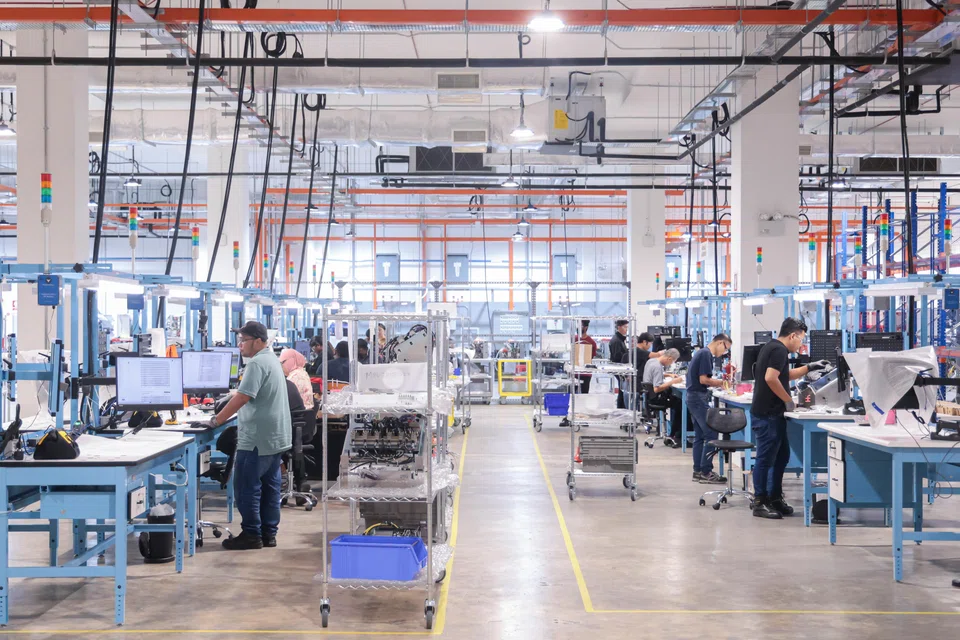
[SINGAPORE] The Republic’s manufacturing output fell 1.3 per cent year on year in February, breaking its seven-month expansion streak after the biomedical and electronics clusters fell into contraction.
This missed private-sector economists’ forecasts of a 7 per cent expansion, in a poll by Bloomberg. February’s data was also a sharp reversal from January’s revised growth of 8 per cent.
Excluding the volatile biomedical sector, February’s industrial production nudged up a slight 0.3 per cent on the year, data released by the Economic Development Board showed on Wednesday (Mar 26).
This was, however, a sharp moderation from January’s revised growth of 6 per cent.
“It bears watching if the February disappointment in the manufacturing output data was transient and potentially attributable to the Trump-related tariff uncertainties after his inauguration on Jan 20,” said OCBC chief economist Selena Ling.
She noted that despite the disappointing February data, the electronics cluster still cumulatively expanded 4.4 per cent on the year in the first two months of 2025, outpacing the 0.8 per cent growth recorded over the same period last year.
Though uncertainties remain due to the possibility that the US will make good on its threats to introduce reciprocal tariffs on Apr 2, it is still possible for industrial production to rebound into positive territory in March due to low base effects, she added.
“At this juncture, given the fluidity of the tariff situation and that Asean, including Singapore, is not the initial target for US tariffs yet, we keep our 2025 industrial output growth forecast of 2.7 per cent year on year.”
Barclays analyst Brian Tan agreed that March’s factory output could perform better due to the “highly favourable base effect”. With that, he forecast that Q1 gross domestic product growth is “on track” to expand 4.6 per cent, moderating slightly from the 5 per cent growth recorded in Q4.
DBS economist Chua Han Teng said further data points are needed to confirm that the manufacturing sector has “clearly shifted into sustained negative gear”, given that indicators such as the new export orders and order backlogs of Singapore’s Purchasing Managers’ Indices remained in expansion in February.
Still, Maybank economists Chua Hak Bin and Brian Lee noted that manufacturers could turn more cautious, given a broadening trade war and uncertainties over US tariffs.
They added that while Singapore will not be directly affected – as it is not one of the “Dirty 15” countries singled out for major trade imbalances – it could be harder hit if the US imposes a 25 per cent tariff on semiconductors and pharmaceuticals.
Cluster performance
On a seasonally adjusted monthly basis, manufacturing output fell 7.5 per cent in February. Excluding biomedical manufacturing, output decreased 7.9 per cent month on month.
Output in the key electronics cluster tumbled 6.4 per cent year on year in February, slipping into negative territory after growth of 15.4 per cent in the month prior.
Most segments within the cluster similarly contracted, with just the infocomms and consumer electronics segment recording growth of 32.2 per cent.
The semiconductors segment fell 9.5 per cent, while the computer peripherals and data storage segment was down 1.5 per cent. The other electronic modules and components segment dropped 7.3 per cent.
Electronic manufacturing output readings could remain soft in the months ahead, said UOB economist Jester Koh, given indications from Taiwan and South Korea – considered regional bellwethers – that the sector has peaked in Q3 2024.
“In our view, Singapore electronics non-oil domestic export growth has similarly peaked in late Q4 2024,” he added.
Meanwhile, biomedical output contracted 14.3 per cent on the year in February, dragged by the pharmaceuticals segment, which tumbled 30 per cent.
Also recording declines were the chemicals sector (-0.1 per cent) and the general manufacturing sector (-0.7 per cent).
In contrast, transport engineering and precision engineering bucked the trend with 16 per cent and 16.2 per cent year on year growth recorded, respectively, in February.
TRENDING NOW

Grab CEO’s wife Chloe Tong on life with Anthony Tan and finding her purpose

Brokers maintain ‘buy’ on CDL despite investor reservations over strategic review

Deal between tycoon friends sparks scrutiny of Philippine power sector

Hwa Seng Builder, two China companies win S$1.2 billion Tuas Road Viaduct phase two contracts

