

Singapore’s key exports up 15.3% in March from AI-related electronics surge
The impact of the Gulf war has been limited so far, economists say

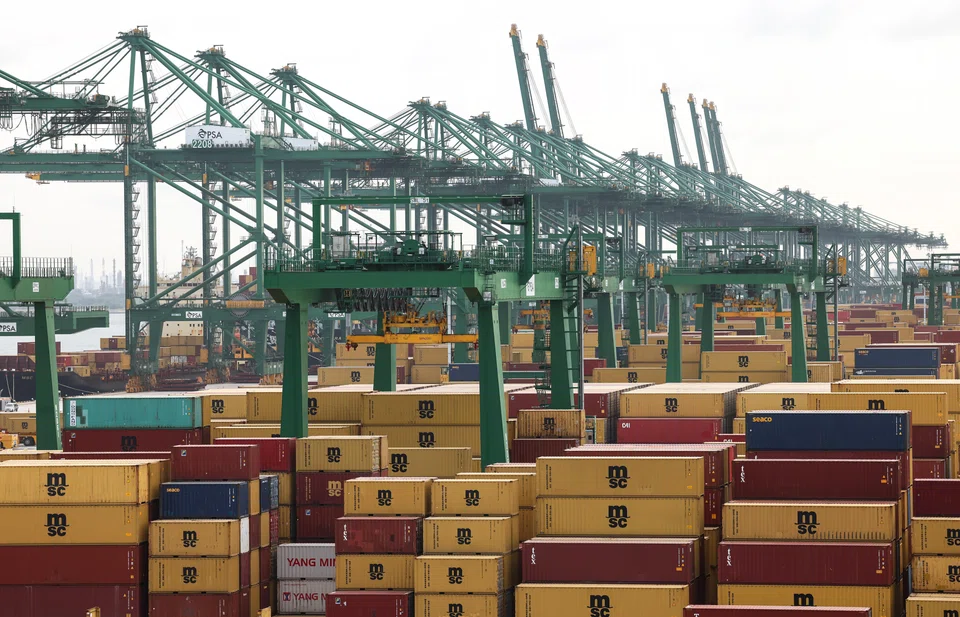
[SINGAPORE] Economists said that the global artificial intelligence (AI) boom has not been crimped by ongoing tensions in the Middle East, as the Republic’s key exports expanded by a stronger-than-expected 15.3 per cent year on year in March.
The latest data came on the back of an electronics surge supported by strong AI-related demand and a low base a year ago, said Enterprise Singapore (EnterpriseSG) on Friday (Apr 17).
March’s expansion extends February’s 4 per cent growth and exceeded the expectations of private-sector economists, who projected an 8.1 per cent year-on-year expansion in a Bloomberg poll. Still, some flagged emerging signs of disruption from the conflict, with any impact possibly showing up in later readings in April or May.
Maybank economists Chua Hak Bin and Brian Lee expect electronics demand to remain a bright spot for the first half of 2026 at least, as the AI capital expenditure boom “appears unscathed” from the war’s disruptions.
Their base case is a ceasefire between the United States and Iran, as well as a restoration of transit in the Strait of Hormuz in the second quarter. They expect full-year non-oil domestic exports (NODX) growth to come in near the upper bound of EnterpriseSG’s official forecast range of 2 to 4 per cent.
Similarly, DBS senior economist Chua Han Teng said that there has been “limited near-term negative impact” from the war on March’s electronics exports momentum, which will remain supported by sustained global AI-related tailwinds and strong demand for Singapore’s memory chips and server products.
Nonetheless, he is still monitoring downside risks as the global AI and electronics cycle “is not fully insulated” from the war’s disruptions given the sector’s reliance on helium, which Qatar is a major global supplier of.
“Moreover, early signs of rising input cost pressures and longer delivery lead times linked to the Middle conflict have emerged, as indicated by the electronics manufacturing purchasing managers’ index in March,” said Chua.
While UOB associate economist Jester Koh noted that developments from the Middle East conflict have yet to show up in March’s NODX data, he expects industrial production and NODX data from April and – more likely May – to provide “a more accurate assessment” of the extent of the conflict’s impact.
Electronics growth to offset non-electronics drag
Electronics exports grew in March, while non-electronics exports fell.
Electronics exports jumped 74 per cent year on year, extending the preceding month’s 43.1 per cent increase. Integrated circuits (113.8 per cent), disk media products (78.3 per cent) and PCs (57.3 per cent) contributed the most to the expansion.
The electronics boost is nearly six times that of the growth clocked for the same period last year, Ling pointed out, which is “a testament to the strength of the ongoing AI-related boom and the resilience of the regional supply chains”.
This is in spite of recent geopolitical developments including the war, she said. She retained her full-year NODX growth forecast between 2 and 4 per cent.
Ling added that risk sentiments have recovered to some extent thanks to the recent ceasefire and ongoing US-Iran negotiations, and that the hope is for global energy prices to stabilise – if not normalise – in the coming periods despite some uncertainties.
Meanwhile, non-electronics shipments fell 0.6 per cent, easing from February’s bigger 6.9 per cent decrease. Categories that had steep declines were structures of ships and boats (minus 99.8 per cent), food preparations (minus 42 per cent) and pharmaceuticals (minus 18.4 per cent).
The Maybank duo said that the outperformance in electronics exports will help to offset the war’s drag on non-electronic shipments, “as producers are hit by higher energy prices and raw material disruptions”.
However, Sheana Yue, senior economist at Oxford Economics, warned that total export growth momentum – which surged to 41.2 per cent in March – is unlikely to last as the war results in higher energy costs, supply disruptions and weaker global demand.
“These will weigh on trade volumes despite continued AI-related support for electronics,” she pointed out.
Beyond the drag on demand, potential shortages of refined fuels could constrain freight and air cargo capacity, creating supply-side limits on Singapore’s trade flows, she added.
Overall, total merchandise trade grew 38.5 per cent year on year in March, up from the previous month’s 13.6 per cent increase. This was as both exports and imports rose.
Key exports to all but four of Singapore’s top 10 markets rose in March.
NODX to Indonesia fell by the largest extent, at 56.8 per cent, followed by the EU27 at 11.9 per cent. The US and Thailand posted single-digit contractions of 2.7 per cent and 1 per cent, respectively.
In contrast, NODX to all other markets posted growth in November. This was led by Hong Kong (99.4 per cent), followed by Taiwan (63.1 per cent) and South Korea (44.1 per cent).
Decoding Asia newsletter: your guide to navigating Asia in a new global order. Sign up here to get Decoding Asia newsletter. Delivered to your inbox. Free.
Copyright SPH Media. All rights reserved.
TRENDING NOW

DBS, OCBC, UOB rout lops billions off STI as inflation, rate concerns spook investors

Grab CEO’s wife Chloe Tong on life with Anthony Tan and finding her purpose

OCBC sheds S$8 billion in value as shares close nearly 6% down; analysts cautious on banks

Deal between tycoon friends sparks scrutiny of Philippine power sector

