

Singapore’s PMI improves in December, in contrast to regional weakness

Paige Lim
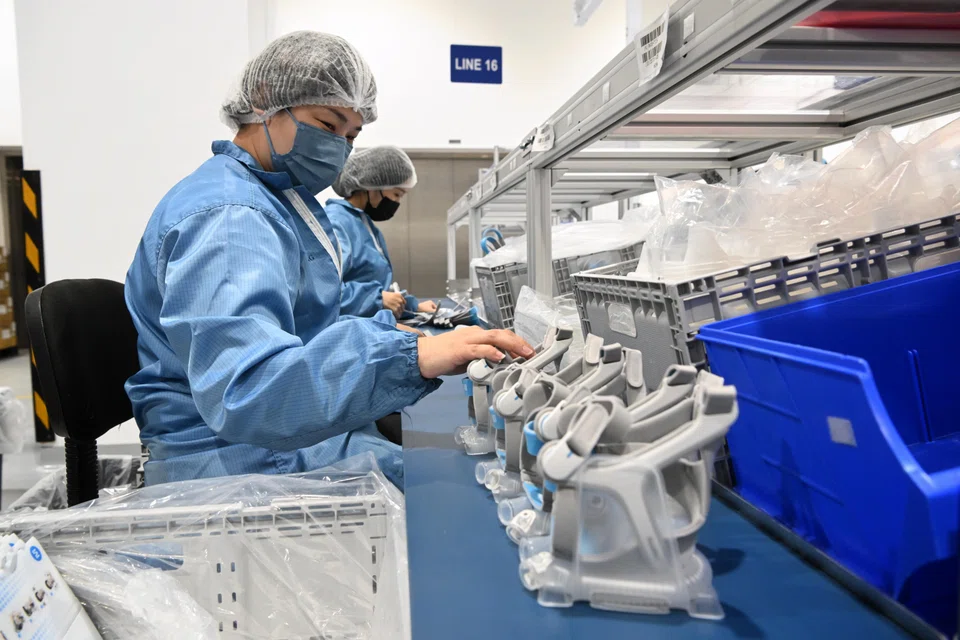
SINGAPORE’S manufacturing sentiment improved further in December, even as regional factory activity continued to be dragged down by weak demand.
Singapore’s purchasing managers’ index (PMI) inched up to 50.5 in December, a 0.2 point gain from the previous month, according to data released by the Singapore Institute of Purchasing and Materials Management (SIPMM) on Wednesday (Jan 3).
SIPMM executive director Stephen Poh said the latest readings “certainly bode well for the manufacturing sector going into the new year”.
He noted the macroeconomic risks faced by major economies, as well as ongoing geopolitical uncertainties, but added: “Nonetheless, local manufacturers remain cautiously optimistic of a firm recovery, especially those in the electronics sector, where global electronics demand appears to be on an uptrend.”
This was the fourth straight month in which the overall PMI was in expansion, after spending half a year in contraction. A reading above 50 indicates growth from the previous month, while one below 50 points to a contraction.
The linchpin electronics sector edged up 0.1 point to 50.2 in December. This marked its second straight month of expansion, after emerging from 15 straight months of contraction in November.
UOB associate economist Jester Koh noted the more “broad-based” improvement in December’s electronics PMI, with several sub-indices turning expansionary – those for imports, stocks of finished goods and new export orders.
This is “supportive” of an upturn in the electronics cycle through 2024, he said.
OCBC chief economist Selena Ling expects the manufacturing sector’s growth to rebound to around 2 per cent year on year in 2024, reversing a 3.6 per cent fall in 2023.
This is assuming “further stabilisation in global electronics demand, a soft global growth landing and no further deterioration in geopolitical tensions”, especially relations between the United States and China, she said. Artificial intelligence is likely to be a driver for the global semiconductor industry, she said.
Ling noted that December’s manufacturing PMI was the highest reading since January 2022, while the electronics PMI was the highest since July 2022.
“This implies that Singapore bucked the general trend in Asia of a softening in manufacturing PMI prints to join the minority camp of China’s Caixin, Indonesia and Vietnam, which saw an improvement in December,” she said.
Most regional economies were dragged down by weak demand in December.
Mainland China’s official manufacturing PMI remained in contraction for the third straight month, falling below market estimates to 49, from 49.4 in November. But the Caixin PMI, derived from smaller private manufacturers, edged up to 50.8 from 50.7.
In Taiwan, the S&P Global Manufacturing PMI remained in contractionary territory, slipping to 47.1 in December from an eight-month high of 48.3 in November.
Thailand’s manufacturing PMI fell to 45.1 in December, from 47.6 in November. This was the fifth successive month in contraction and the sharpest pace of decline since June 2020.
A Barclays report highlighted lower order volume in December’s PMI readings across emerging Asian economies, which they attributed to “sluggish domestic and external demand”.
While firms surveyed by S&P Global appeared positive about the outlook for 2024, the latest readings from China and the region “suggest the pace of recovery in the manufacturing sector on aggregate may only be gradual”, said the report.
TRENDING NOW

Singapore bars Alice Huang, woman tied to affair with Nvidia’s Jensen Huang, for misleading police

Nvidia prepares to oust Jensen Huang after news of second affair, with executive: reports

Higher rates, weaker spending: Is the Philippines entering stagflation?

Special dividend for SIA’s 80th anniversary? CEO says extra payout will need board’s nod

