Singapore’s revised Q3 expansion prompts economists to raise full-year forecasts for 2024, but hold or lower 2025 projections
Still, their estimates for next year fall within official range of 1 to 3%

ECONOMISTS have raised their 2024 full-year growth forecasts for Singapore on the back of better-than-expected third-quarter growth – but they held or lowered their projections for 2025, citing global uncertainty and higher base effects from 2024.
Still, economists’ forecasts for 2025 all fell within the official forecast range of 1 to 3 per cent that was announced by the Ministry of Trade and Industry (MTI) on Friday (Nov 22).
Singapore’s gross domestic product (GDP) grew 5.4 per cent year on year in Q3, faster than the advance estimate of 4.1 per cent and beating economists’ expectations of 4.7 per cent. This was also faster than the second quarter’s 3 per cent growth.
The Q3 figure brings GDP growth for the first nine months to a “better-than-expected” 3.8 per cent, said MTI.
On a seasonally adjusted, quarterly basis, growth was 3.2 per cent in Q3, revised up from the advance estimate of 2.1 per cent and improving from the previous quarter’s 0.5 per cent rate. This marked the fastest sequential expansion since the first quarter of 2021.
Growth in Q3 was primarily driven by manufacturing, wholesale trade as well as finance and insurance, partly fuelled by the upturn in the global electronics cycle.
HSBC economist Liu Yun noted that around 80 per cent of Q3’s growth strength was from a manufacturing upswing – yet the capital-intensive sector accounts for only about 2 per cent of the workforce. “The bulk of the job market lies in services,” she said, noting a mixed growth picture for that sector.
This is a crucial consideration when the Monetary Authority of Singapore assesses the health of the overall economy, she added. The central bank’s next policy decision is due in January.
Higher hopes for 2024
MTI upgraded its full-year 2024 growth projection to “around 3.5 per cent”, with economists generally raising theirs to similar or higher rates, ranging from 3.5 to 3.8 per cent.
In a press briefing, MTI permanent secretary Beh Swan Gin said that the ministry is not ruling out the possibility of growth exceeding 3.5 per cent.
At the higher end was DBS economist Chua Han Teng’s 2024 forecast of 3.8 per cent, up from 3.5 per cent previously. He expects “steady expansion” in external-oriented sectors over the coming quarters.
UOB associate economist Jester Koh, who raised his 2024 forecast in line with MTI’s – from 3.3 per cent previously – expects growth to come in “slightly above potential” in 2024 and “remain around potential” in 2025.
He expects growth momentum in trade-related sectors to be sustained at least for the rest of 2024 and into early 2025. This will be supported by the upturn in the electronics cycle, “with tailwinds from some front-loading of exports ahead of (US president-elect Donald) Trump’s proposed tariffs on US imports”.
Maybank economists Brian Lee and Chua Hak Bin raised their full-year growth forecast for 2024 to 3.6 per cent. They also hiked their 2025 forecast to 2.6 per cent, in the higher half of MTI’s range. This was in light of “positives” for growth momentum in 2025, such as the easing of global monetary policy that may boost loan demand, and an expected decline in Singapore’s mortgage rates.
Construction activity is likely to accelerate on the back of a robust pipeline of major infrastructure projects, they added.
Still uncertain
Most economists kept or lowered their 2025 forecasts instead, with estimates ranging from 1.8 to 2.8 per cent.
At the low end was Barclays regional economist Brian Tan, who downgraded his forecast to 1.8 per cent from 2 per cent earlier. The stronger Q3 showing creates a high base effect, which could hurt year-on-year growth for Q3 2025, he pointed out.
For its forecast, MTI took into account increased global economic uncertainties – including over the policies of the incoming US administration – with risks “tilted to the downside”. These risks include further escalation of geopolitical conflicts, trade tensions among major economies, and disruptions to the global disinflation process.
But Tan noted: “The official projections may not be fully accounting for potential drags from trade tensions.”
He estimates that Singapore’s GDP growth could be lowered by as much as one percentage point if the United States imposes a 10 per cent tariff on all imports and a 60 per cent one on China – as Trump has promised – “and the affected trading partners retaliate fully and symmetrically”.
UOB’s Koh also downgraded his 2025 forecast, to 2.5 per cent from 2.9 per cent previously.
In addition to the risks flagged by MTI, the electronics cycle may peak in 2025, he said. Activity in tourism-related sectors is also likely to soften, as pent-up demand for these services dissipate post-pandemic, he added.
OCBC chief economist Selena Ling and DBS’ Chua maintained their 2025 forecasts at 2.7 per cent and 2.8 per cent, respectively, citing risks related to the incoming Trump administration. Ling also noted the high base effect from 2024.
DBS’ Chua said that Trump’s first presidency, from 2017 to 2021, gives hints of the possible impact on Singapore from a global slowdown.
In particular, higher tariffs and heightened policy uncertainty led to a global slowdown in 2019, with contractions in Singapore’s manufacturing and trade-related services sectors in the second half of that year.
He added: “A significant escalation of the trade war under Trump 2.0 could lead to a sharp global economic slowdown, and possibly a considerable deceleration in Singapore’s economic growth that approaches the lower end of MTI’s growth forecast.”
Q3’s sectoral performance
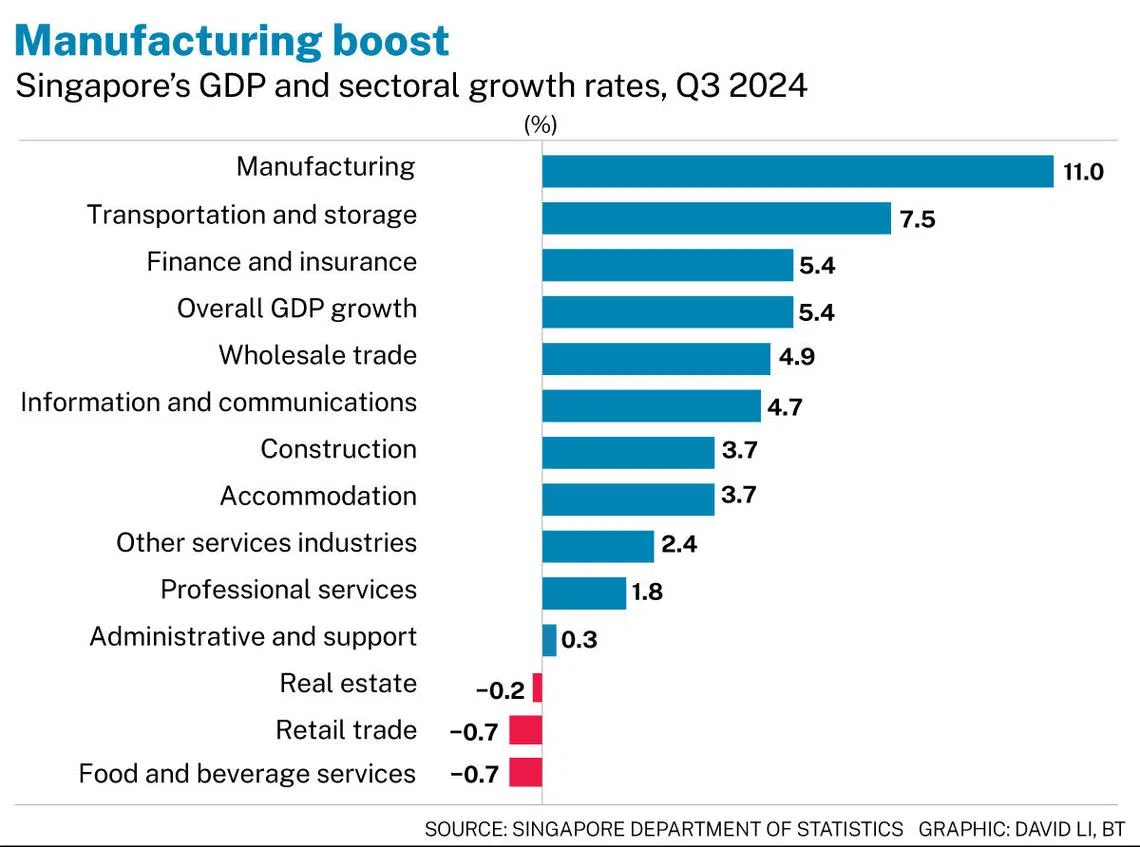
In Q3 2024, manufacturing grew by 11 per cent year on year, reversing the 1.1 per cent contraction in Q2.
This was above the advance estimate of 7.5 per cent, contributing another 0.7 percentage point to Q3 growth, noted Standard Chartered Bank economist Jonathan Koh.
Overall services-producing industries grew 4 per cent, above the advance estimate of 3.3 per cent and accelerating from Q2’s 3.7 per cent rate.
But consumer-facing sectors such as retail and food and beverage services continued to contract, with both seeing a 0.7 per cent fall. This was due to sustained outbound travel by locals, as well as a slower-than-anticipated recovery in arrivals and weak tourist spending.