Edwin Tong rebuts claims that attorney-general appointment is ‘thin’ after WP MP questions selection process
Making the process of appointing the attorney-general public risks politicising the office, says the minister

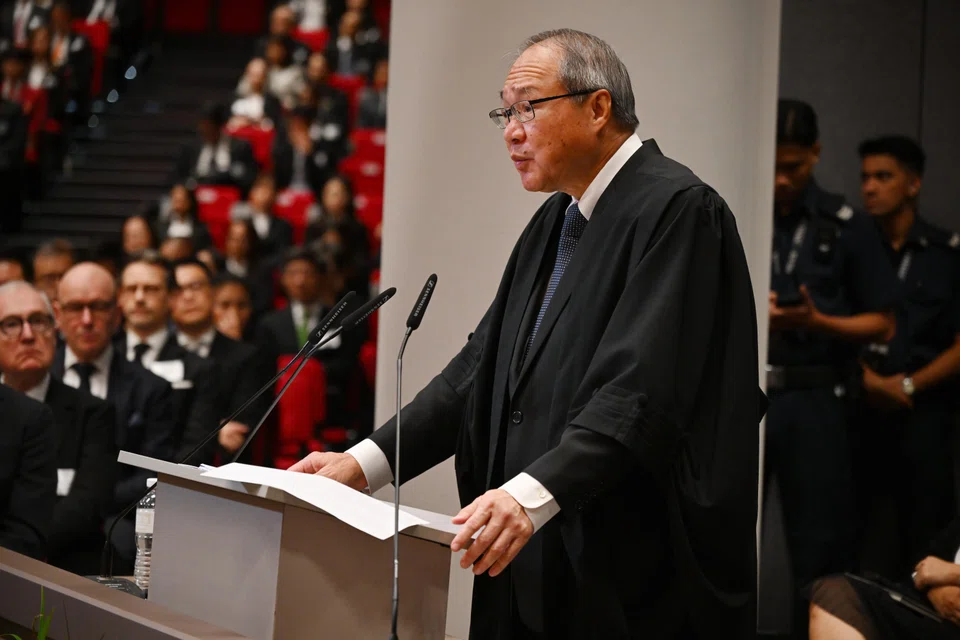
[SINGAPORE] The government has defended its reappointment of Lucien Wong as attorney-general for a fourth three-year term, after a Workers’ Party (WP) Member of Parliament questioned the transparency of the selection process.
Minister for Law Edwin Tong said in Parliament on Monday (Mar 2) that the appointment process is neither thin nor perfunctory, pushing back against WP MP Sylvia Lim, who had called for greater public disclosure on how the attorney-general is selected.
Wong, 72, was reappointed in October last year for a fourth term, and will serve until January 2029. He was first appointed the ninth attorney-general in January 2017.
The reappointment was raised during the Ministry of Law’s Committee of Supply debate by WP MP Sylvia Lim, who argued that the constitutional process governing the appointment was “thin” and called on the government to be more forthcoming about how candidates are selected for the role.
Tong rejected that characterisation, saying the appointment of the attorney-general – whether initial or any subsequent renewal – is made in accordance with the Constitution through “a clear, deliberate and structured process, with the appropriate checks and balances”.
The process involves consultation with the Chief Justice and the chairman of the Public Service Commission, before the prime minister gives advice to the president, who in turn consults the Council of Presidential Advisers.
“This is not a perfunctory process; nor is it ‘thin’ by any measure,” he noted. “This process reflects a careful and considered balance between executive responsibility and institutional safeguards.”
Tong also argued against Lim’s suggestion that there should be more public disclosures on the process.
Making such deliberations public would be counterproductive, he said, as suitable candidates could be deterred from being considered if discussions about their suitability were disclosed.

“The consultation process also requires candour and frank assessment,” he said. “Turning it into a public debate risks politicising an office that must remain scrupulously non-partisan.”
While in some jurisdictions, the attorneys-general are elected officeholders, Singapore has a different model, noted Tong.
“The safeguards lie in the constitutional qualifications required, the consultative process, and ultimately in the performance and conduct of the office,” he added.
Not about meeting minimum qualifications
Noting that Wong will be 75 by the end of his new term, Lim also questioned if other qualified candidates were shortlisted before recommending his renewal.
To this, Tong did not directly address whether a shortlist had been drawn up, but said the availability of other candidates may appear plentiful if one considers only the basic eligibility criteria.
“The selection of an attorney-general is not simply a matter of meeting minimum qualifications. It requires a careful assessment of who is best suited to discharge the full responsibilities of the office,” he said.
Beyond formal qualifications, the role demands high professional standing, wide-ranging legal experience, sound judgment and a strong sense of public duty, Tong said.
The attorney-general must also have “unimpeachable integrity and strong moral fibre”, be prepared to uphold the law impartially and apply it equally to everyone – “whether one is a minister or leader of the opposition”.
Individuals meeting all these criteria are not easily found, he said, adding that the government continuously looks out for suitable candidates while also weighing the incumbent’s performance, his ability and willingness to serve, and whether significant ongoing matters require continuity.
The government continues to rely on Wong’s counsel on significant matters that remain in progress – in maritime boundary negotiations, tax and financial sector legal reforms, and complex cross-border criminal matters.
These responsibilities “benefit from deep expertise, sound judgment and a steady hand”, said Tong.
In supplementary questions, Lim asked if the ongoing matters that Wong is involved in makes him “indispensible”.
Replying, Tong said the government considers a “multitude of factors” when deciding an appointment or reappointment, including whether the current attorney-general is able to continue in his role, his stature and reputation, as well as his ability to contribute to ongoing projects.
“I’m not going to go into whether there is a long list or a short list, but suffice to say that we will consider this carefully,” said Tong.
“Think about what the incumbent has done, whether there is a need to change at that point in time, and, if so, what are the options, and take these factors into consideration before deciding on making a recommendation to the president.”
Decoding Asia newsletter: your guide to navigating Asia in a new global order. Sign up here to get Decoding Asia newsletter. Delivered to your inbox. Free.
Copyright SPH Media. All rights reserved.