Expanded tax scheme to benefit more construction companies from 2026
The enhanced Land Intensification Allowance will be widened to further optimise land use
[SINGAPORE] The Land Intensification Allowance (LIA) scheme for the built environment sector, which provides tax allowances to owners of construction facilities such as prefabrication hubs, will be expanded to cover a greater range of developments from Jan 1, 2026.
National Development Minister Desmond Lee on Wednesday (Apr 9) said the enhanced scheme will support multi-storey design for manufacturing and assembly (DfMA) facilities related to prefabrication operations.
“These include facilities that perform fit-out works, store precast components or produce other DfMA components such as mass engineered timber and prefabricated mechanical, electrical and plumbing systems”, said Lee at the 47th International Federation of Asian and Western Pacific Contractors’ Association convention.
This move is part of the government’s effort to encourage the development of construction facilities that use land more efficiently, he added.
The LIA currently applies only to integrated construction and prefabrication hubs (ICPHs), which are multi-storey and highly mechanised, or automated facilities that produce prefabricated precast concrete components off-site.
The activities conducted in ICPHs include prefabrication of individual components, integrated sub-assemblies and prefinished volumetric construction.
The scheme provides companies with a tax allowance of up to 100 per cent of the qualifying capital expenditure incurred for the construction.
Supported applicants will receive an initial allowance of 25 per cent of the qualifying capital expenditure and subsequently an annual allowance of 5 per cent until the total allowance amounts to 100 per cent.
In order to qualify for the expanded scheme, the DfMA facilities must achieve a minimum gross plot ratio (GPR) of 1.03, while ICPHs must continue to achieve a minimum GPR of 1.6. A gross plot ratio of 1.6 means the development’s total floor area can be 1.6 times the land area.
In addition, at least 80 per cent of the gross floor area must be used by the building owner or related users.
Meanwhile, the shareholding requirement for related users has been lowered from 75 per cent to more than 50 per cent.
The scheme is currently open to businesses in land-intensive sectors with low GPR, such as manufacturing and logistics. Since 2017, it has also been available to businesses developing ICPHs.
The LIA is administered by the Singapore Economic Development Board and the Building and Construction Authority.
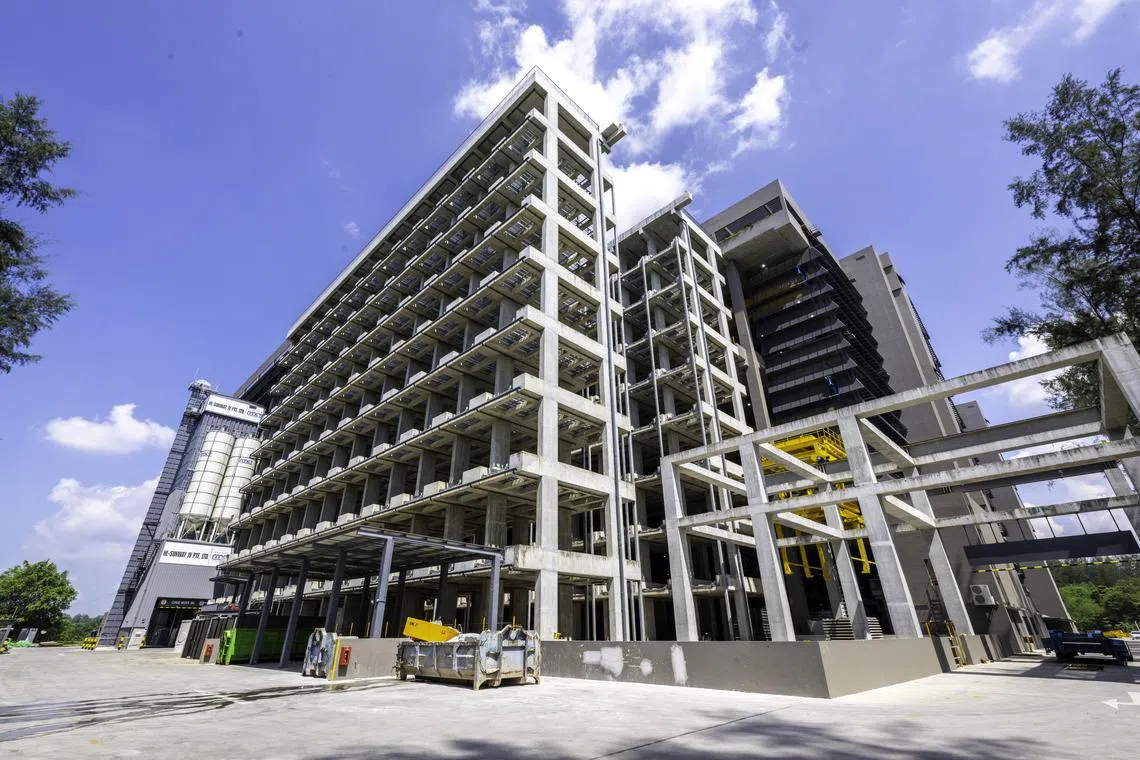
Hong Leong Asia’s ICPH, developed through a joint venture with Malaysia’s Sunway Construction, would have potentially received about S$16 million in tax savings under the LIA scheme. (See *Amendment note)
The HL-Sunway Prefab Hub, located at Punggol Barat Lane and completed in 2023, spans 3.8 hectares and cost more than S$100 million to build, said Simon Loh, chief operating officer of Hong Leong Asia’s building materials group.
He noted that the facility required a structure with higher load-bearing capacity due to the heavy precast components it handles, leading to higher construction costs.
The government scheme, he added, helped offset part of these expenses and also influenced the decision to go ahead with the ICPH project, which was initially planned back in 2017.
Another industry figure welcomed the expansion of the LIA scheme, as it could encourage companies still “on the fence” about investing in such facilities.
“These facilities are a very big investment and any help will definitely benefit the investors,” said Kenneth Loo, executive director and chief operating officer of Straits Construction.
Its Greyform facility, an ICPH in Kaki Bukit spanning 20,000 square metres, cost S$150 million to build. However, the company did not benefit from the scheme, as it was only extended to cover such hubs after the building had already been completed.
In a separate interview with The Business Times, Singapore Contractors Association president Lee Kay Chai welcomed the government’s push towards greater automation in construction, calling it a timely move to ease the sector’s reliance on manpower.
“By leveraging robotics and automation, we can not only speed up work processes but also enhance quality, all while reducing our dependence on foreign labour,” Lee said.
Earlier in January, the Building and Construction Authority (BCA) projected that between S$47 billion and S$53 billion worth of construction contracts could be awarded in 2025, driven by rising demand.
Lee said that construction demand is expected to remain strong, particularly as the majority stems from public sector projects. However, he cautioned that global volatility poses ongoing challenges.
“Singapore is a small, open economy, so global disruptions will inevitably have an impact. While we can’t rule out the possibility of job losses, it’s essential that we stay resilient, take calculated risks, and remain adaptable in an uncertain world,” he added.
Lee on Wednesday also announced key targets for the industry to work towards improving energy efficiency for buildings.
By 2030, it aims to have 80 per cent of new buildings to meet Super Low Energy standards, which demonstrates 60 per cent improvement in energy efficiency compared to the 2005 baseline.
Additionally, the Mandatory Energy Improvement regime will begin in the third quarter of this year for older buildings. Owners of energy-intensive buildings will be required to conduct energy audits and develop improvement plans to reduce energy consumption.
“We want to make the construction process more sustainable, and encourage firms to adopt greener practices,” Lee said.
*Amendment note: An earlier version stated that the tax savings Hong Leong Asia received was S$16 million, when it should be potential tax savings.