

Fewer passengers and goods in the air as a result of US tariffs impact could hurt Singapore’s aviation hub
Although observers are mixed on continuing uncertainty, the Republic’s status as a stable and reliable transhipment hub could give it an edge

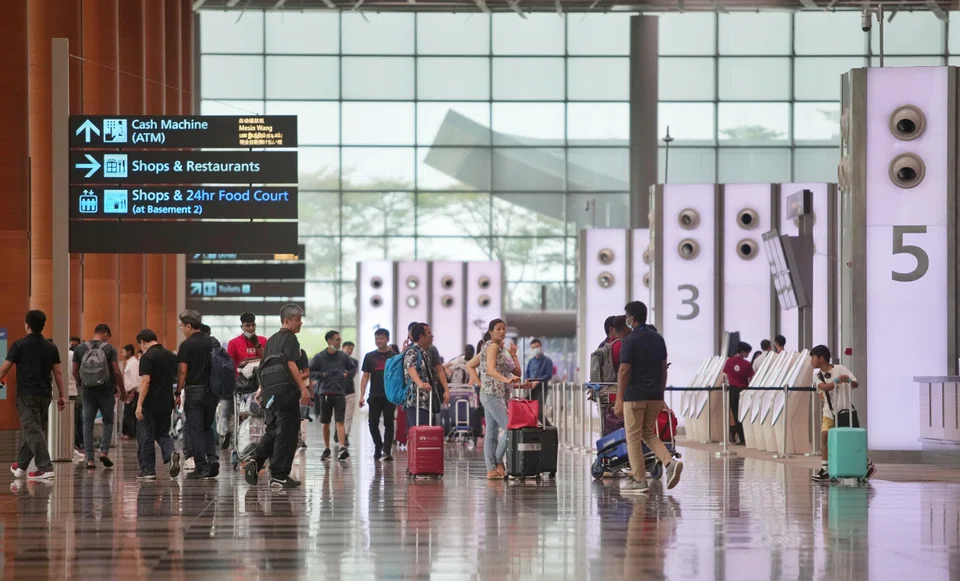
[SINGAPORE] Wide-ranging US tariffs could weaken demand not just for air freight of goods, but also passenger travel – which could hurt Singapore as a regional air hub, said industry watchers. But Singapore’s reputation for stability and its lower tariff rates could help it weather the storm.
“These tariffs are like a receding tide that will ground all boats,” said Subhas Menon, director-general of the Association of Asia Pacific Airlines (AAPA). “Aviation may be badly affected in terms of passenger travel, cargo and its supply chain.”
Apart from lowering both cargo and passenger demand, the tariffs could worsen lingering supply chain issues and thus drive up aircraft prices.
US President Donald Trump’s so-called reciprocal tariffs, which were announced on Apr 2, include a 10 per cent baseline rate and higher rates for certain countries – though on Apr 9, the latter were paused for 90 days for all countries except China.
As air travel is a service, not a good, ticket prices are not directly affected by the tariffs, said observers. Yet air travel demand could likely be hit by the tariffs’ wide-ranging negative effects on the global economy.
Ticket to slide
Air travel is generally sensitive to economic cycles, said Terence Fan, assistant professor of strategic management at the Singapore Management University.
“Tariffs are a form of tax, which in the short run will reduce economic output, reduce GDP of all affected countries and the US and lower demand for air travel,” he said. The effect would hinge on how much the tariffs affect overall GDP, he added.
Menon agreed that the trade war will erode purchasing power. Other currencies will weaken against the US dollar, and consumers may have less discretionary income to travel freely.
With the tariffs also hurting goods exports, blue-collar workers in industries such as manufacturing could be more affected – so leisure travel would see a greater fall than business travel, said Prof Fan.
Similarly, budget airlines and short-haul flights could see weaker demand than full-service carriers or costlier modes of air travel.
AAPA’s Menon, however, thinks the opposite. Demand for more expensive or long-haul travel could fall – so regional travel in the Asia-Pacific could rise if consumers opt for closer, less expensive destinations.
Regardless, Singapore is likely to see less leisure travel, he said.
Apart from direct effects on consumer income, demand will also be hurt by economic uncertainty amid unpredictable tariffs. As consumer confidence falls, so will spending.
In response to queries on the tariffs’ effect on airfares and demand for air travel, a Singapore Airlines spokesperson said: “Our flights are operating as scheduled, and airfares are a function of supply and demand, and therefore they are dynamic and subject to change.”
The company is monitoring the impact of the tariffs, but is unable to provide more specific guidance ahead of its full-year results, expected on May 15.
Silver lining
But Singapore could count on a silver lining.
For air freight, observers predict a mixed bag in the short term with possible upsides further down the road.
Menon expects Singapore’s air freight volumes to fall, with lower exports, imports and transhipment cargo.
But there could be a short-term boost, said Chen Chuanren, South-east Asia and China editor for Air Transport World. This is if companies bring forward shipments before the 90-day tariff pause ends.
Prof Fan said that if higher tariffs resume after the pause, businesses might rush to route goods through countries with lower tariffs – including Singapore. This could mean improved cargo flow through or to such countries.
Javier Bilbao, CEO for DHL supply chain Asia-Pacific, said that “Singapore could actually be one of the big winners” in the wake of higher tariffs.
Speaking on the TransportBT podcast, he noted that the Republic benefits not just from being a transhipment hub, where other countries could route shipments through, it is also a stable and neutral port not overtly aligned to a single bloc.
“One of the things that Singapore provides to the economic world is stability... we are starting to see signs that our customers view Singapore as a safe space,” he added.
Supply chain woes
On the supply side, tariffs on US imports could have a major impact. Major aviation suppliers – including Boeing, RTX, Honeywell and GE Aviation – hail from the US, and foreign ones such as Airbus also produce there.
The US tariffs would cause the prices of aircraft and their parts to rise, said industry watchers.
This would erode profits for airlines, result in higher ticket prices for consumers, or both.
The tariffs could exacerbate post-pandemic aviation supply chain woes, with delays in aircraft and part deliveries.
“(The industry) is already facing supply chain disruptions and delays,” said Chen. “The last thing it needs is an additional obstacle that could further increase operational costs.”
Some aviation suppliers went bust as a result of the pandemic. Tariffs could have a similar effect – with the loss of such suppliers further worsening supply chain issues.
AAPA’s Menon said it was too early to tell if Singapore-based aviation suppliers – such as Pratt & Whitney and GE Aerospace – might further shift production or distribution from the US to Singapore.
RTX-owned Pratt & Whitney already manufactures engine blades in Singapore, while GE Aerospace has a major maintenance, repair and overhaul facility here.
It is no surprise observers are giving mixed forecasts, given the chaotic, teetering nature of Trump’s moves, and one thing they all agree on is the high level of uncertainty.
Aviation analyst Brendan Sobie said: “At this point, it is still too early to predict the longer-term effects of tariffs on the industry.”
TRENDING NOW

Singapore identifies 7 firms responsible for haze fires, notices issued urging action: Grace Fu

Philippine power giant First Gen rebuffs foreign offers, plans up to US$2.6 billion in expansion
DBS remains analysts’ pick ahead of Q3 earnings after Singapore banks’ share slump
Indonesia imposes US$116 million in fines over manipulation of Sinar Mas, Prajogo-linked stocks

