

Flurry of FTAs opens space for S’pore economy: PM Goh
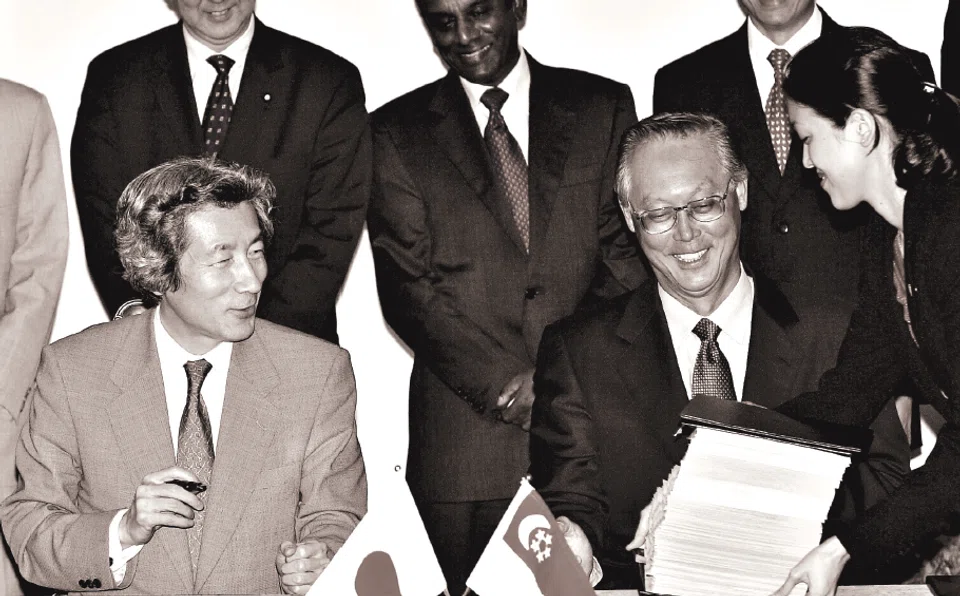
THE Asean summit in Cambodia, which ended with a string of significant free trade links with key powers – the latest being India, has opened up Singapore’s economic space significantly.
This, in a nutshell, is the assessment of Prime Minister Goh Chok Tong, who likened the flurry of free trade agreements to Asean’s construction of a new jumbo jet that will help the region take off on a new flight path.
For Singapore, which is in the midst of remaking its economy, the Asean summit’s decisions to forge FTAs and special economic linkages with key partners would mean a better future in 10 years’ time.
Singapore companies, he said, would be able to compete better and export more easily to key markets like China, Japan and India.
With FTAs, investors will be attracted to Singapore because of its inherent strengths and advantages over others. They could use Singapore as a base to export to other countries with which Singapore has FTAs with, Mr Goh said. If necessary, Singapore would offer itself as a catalyst.
Singapore has an FTA with Japan and New Zealand and is concluding similar arrangements with other major partners such as the United States, Australia and Europe.
Mr Goh said: “The implications for us is now we have something to look forward to. We have been trying to look for a way forward. We are restructuring our economy, remaking it.
“With the FTAs now on track, we can look forward to a better future in 10 years’ time, because the space for Singapore to work with has increased tremendously. The message for Singaporeans is that the future is bright for Singapore. We may be going through some difficulties now, but we can ride the storm, and we have a bright future.”
In the longer term, the Singapore economy would operate within an Asean Economic Community – a single market of 500 million people – within almost zero tariffs and a free movement of goods, services and perhaps professionals, he added.
Asean officials said they were taken by surprise by India’s accelerated interest in an FTA, which they saw as an attempt to play catch-up with China.
They said Prime Minister Atal Behari Vajpayee, in his inaugural statement to Asean, proposed an Asean-India FTA within 10 years – effectively matching the one that China has just secured with Asean.
The officials said India appeared to have been concerned by China’s growing economic penetration into South-east Asia. This is the same concern that has driven Japan to match China’s move with its own comprehensive economic partnership with Asean, which will contain elements of a free trade area.
Prime Minister Junichiro Koizumi yesterday told the media separately that he was happy with the quickened pace of the comprehensive economic partnership (CEP) with Asean which he first floated in Singapore earlier this year.
He said Japan would, under the CEP, pursue FTAs bilaterally with Asean countries that are keen to have such an arrangement.
The Indian proposal revolved around the India-Asean Regional Trade and Investment Area, which was first proposed at the Asean economic ministers meeting in Brunei in September.
An Asean-India task force will be formed to prepare a draft framework agreement to enhance economic ties for submission at the next Asean economic ministers meeting in October next year.
Apart from this new development, the last day of the Asean summit was also marked by an agreement to have a special summit next year in Japan to commemorate the 30th anniversary of economic relations between Asean and Japan.
Scheduled to be held in December, it will be the first time that Asean leaders will have a summit outside the region. This could be seen as Tokyo’s way of tying itself more effectively into a special relationship with Asean.
The commemorative summit will be held two months after the next Asean summit, due to be held in Bali on Oct 7-9 – almost on the first anniversary of the deadly Bali bombings of Oct 12 which drove the Asean leaders to issue a special condemnation against terrorism in the region.
Mr Goh told the Singapore media that Asean, with all the big power interest to forge FTAs, and special linkages – is now back on the international radar screen.
Almost written off for its internal problems and a lack of significant progress in economic integration, the group can now “walk with a spring”, Mr Goh said.
Decoding Asia newsletter: your guide to navigating Asia in a new global order. Sign up here to get Decoding Asia newsletter. Delivered to your inbox. Free.
Share with us your feedback on BT's products and services






