

Front-loading drives Singapore’s factory output growth, which slows to 5.9% in April but far exceeds estimates
But economists expect ‘payback’ in the second half

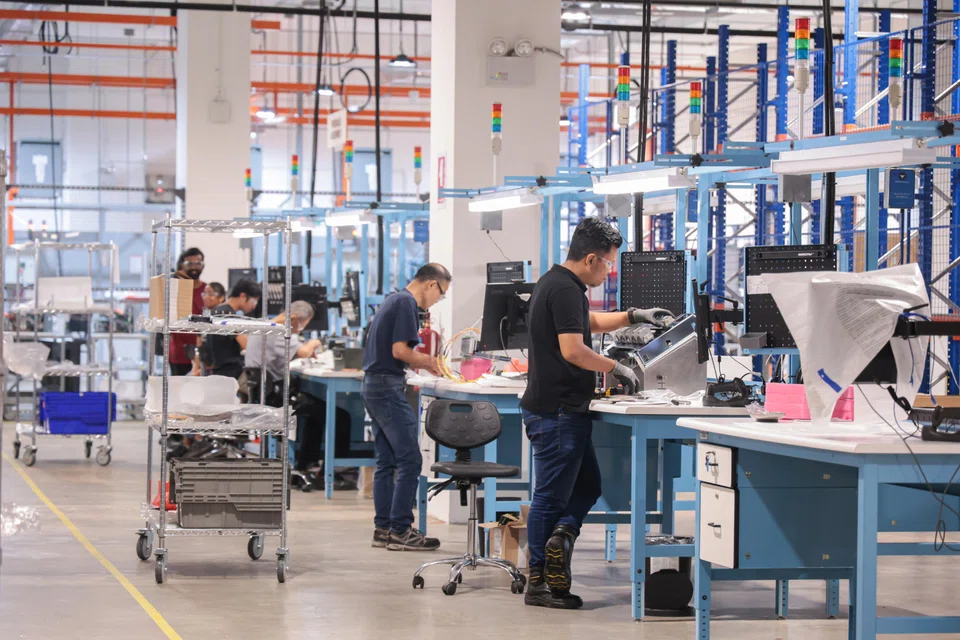
[SINGAPORE] Front-loading activity amid uncertainty over US President Donald Trump’s tariffs supported Singapore’s industrial production growth in April, economists said after the latest prints were released on Monday (May 26).
The Republic’s manufacturing output gained 5.9 per cent year on year in April, slipping from the previous month’s upwardly revised 6.8 per cent growth. Still, the latest print more than doubled the median 2.5 per cent expansion forecast by private-sector economists in a Bloomberg poll.
Manufacturing for the key electronics cluster picked up, data from the Economic Development Board showed.
Excluding the volatile biomedical sector, April’s industrial production jumped 8.1 per cent on year. This was up from March’s revised gain of 6 per cent.
On a seasonally adjusted monthly basis, manufacturing output grew 5.3 per cent in April, reversing from March’s 2.7 per cent contraction. Excluding biomedical manufacturing, output rose 4.7 per cent month on month, widening from 1.9 per cent in the preceding month.
Performance by cluster
Half of the clusters tracked reported increases in production year on year.
Output in the key electronics cluster expanded 15.2 per cent in April, after increasing 11.2 per cent in the preceding month.
All segments within the cluster except electronic modules and components (-10.2 per cent) grew. Manufacturing was up for the infocomms and consumer electronics (67.8 per cent), semiconductors (11.7 per cent) and computer peripherals and data storage (11.3 per cent) segments.
The cluster’s robust production growth is broadly in line with the accelerated expansion of electronics domestic exports during the same period, said DBS senior economist Chua Han Teng.
He added that this reflects “still-resilient global chips demand and possibly some front-loading of orders due to a temporary US tariff exemption on electronics imports, including semiconductors”.
Standard Chartered chief economist Edward Lee pointed to front-loading as a potential reason for the cluster’s “strong” showing.
Maybank analysts Chua Hak Bin and Brian Lee said North Asia and Asean countries have been ramping up production, as exporters and their clients rush shipments into the US during the 90-day reciprocal tariff pause.
This has boosted demand for Singapore’s upstream electronics components, they noted.
But OCBC chief economist Selena Ling said: “For how long more these trends will sustain remains subject to some uncertainties.”
Other clusters posting growth were:
- Precision engineering (1.6 per cent)
- Transport engineering (22.9 per cent)
Lee noted that things are business as usual for some clusters. Transport engineering’s aerospace engineering is “roaring, Trump 2.0 or not”, he said. The segment’s output was up 39.5 per cent in April.
“Travel and logistics are still healthy and kicking,” he said.
In contrast, output slid for:
- Biomedical manufacturing (-1.1 per cent)
- Chemicals (-3.2 per cent)
- General manufacturing (-15.2 per cent)
Maybank’s duo noted that the general manufacturing slump was its steepest in 16 months.
The weak performance of general manufacturing could be a result of the gloomy macro narrative, Standard Chartered’s Lee said.
Year to date, manufacturing output has risen 4.7 per cent year on year, a “sharp improvement” from the 1.1 per cent contraction posted in the corresponding year-ago period, noted Ling.
She believes that front-loading “may have some leeway to continue” until the July deadline, even as she flagged that the 90-day reciprocal tariff reprieve, the truce with China and the latest extension of the 50 per cent tariff deadline for the European Union “continue to illustrate the flip-flop nature of tariff uncertainties”.
UOB associate economist Jester Koh also believes that front-loading will continue “as a hedging strategy, given the risk could now be asymmetrically skewed to higher tariffs” after the expiry of the tariff truce.
Economists agreed that uncertainty over tariffs and global demand will remain a key theme.
Despite the ongoing suspension, Singapore’s export-oriented manufacturing sector remains vulnerable to heightened unpredictability from the US tariff rollercoaster this year, said Chua.
Trump’s threats of imposing US tariffs on imports from the European Union and on smartphones from companies such as Apple and Samsung underscore the ongoing heightened global trade policy uncertainty, he added.
Economists also pointed out that sectoral tariffs could still be in the works.
Trump’s comments that the US is not looking to make sneakers and T-shirts, but military equipment, chips, computers and artificial intelligence development mean semiconductor and pharmaceutical tariffs cannot be ruled out, said Ling.
But Maybank’s team said: “(Deputy Prime Minister Gan Kim Yong) has indicated that negotiations are ongoing for US tariff exemptions on pharmaceutical exports, which may shield Singapore from any impending tariff hike.”
Economists expect that front-loading of exports in H1 this year will be followed by payback and deceleration in H2.
Ling thinks “some extent” of reciprocal tariffs will be implemented in H2, weighing on global and regional growth including China, and hence manufacturing growth prospects.
Chua and Ling also added that high base effects will materialise in the second half.
TRENDING NOW
World’s largest offshore wind platform by Seatrium consortium on track to be completed by 2028

Is stamp collecting enjoying an analogue revival or are its best days over?

GovTech retrenches another 38 staff in second round of layoffs
MBS adjusted property Ebitda falls 20.6% in Q3 with fewer high-roller visits, weaker hold

