
Glass waste destined for landfill finds new use on oil rigs

Renald Yeo
Renald Yeo

Published Wed, Feb 8, 2023 · 02:00 PM
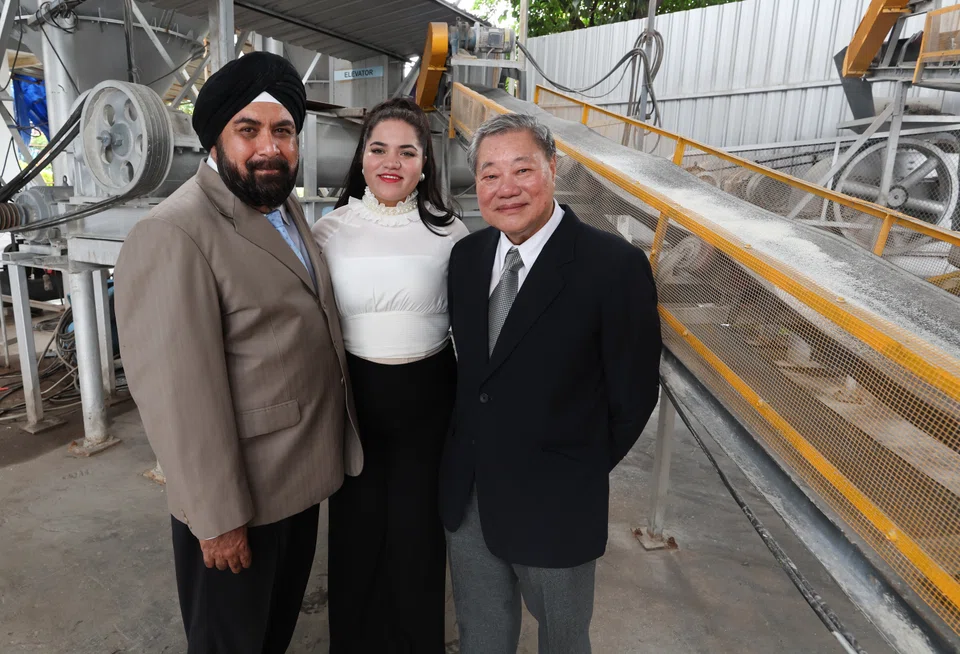
    • From left: Abraclean chairman Gurmit Singh, director Aneesha Sachdev, and director Lau Kee Siong.
    • From left: Abraclean chairman Gurmit Singh, director Aneesha Sachdev, and director Lau Kee Siong. PHOTO: YEN MENG JIIN, BT

    DURING its usual business of spraying surfaces with industrial abrasives, local company Abraclean took a shine to Abrablast, a glass material from the United Kingdom. But finding the price point prickly, it decided to make its own version – and established Singapore’s first glass recycling facility to do so.

    This was part of efforts to diversify and expand the company’s offerings, chairman Gurmit Singh and director Lau Kee Siong told The Business Times. Incorporated in 2017, Abraclean prepares industrial metal surfaces via abrasive blasting and coating.

    Located in Tuas, Abraclean’s 2,000 square metre (sq m) glass recycling facility sits within its existing 16,000 sq m blasting yard. In a process licensed from the UK company, the facility cleans, crushes and sieves glass waste until it is fine enough to be used in blasting.

    Since July 2021, Abraclean has processed a cumulative 600-odd tonnes of glass. This year, it intends to run the facility at full capacity: processing up to 40 tonnes a day in an eight-hour shift. It holds a National Environment Agency (NEA) licence to process up to 50 tonnes daily.

    Saving glass from the landfill

    In 2021, according to NEA data, just 13 per cent of Singapore’s 74,000 tonnes of glass waste was recycled – and had to be exported to countries such as Malaysia for processing.

    Abraclean hopes to change this with its S$1 million facility, officially launched on Jan 31 by Minister for Sustainability and the Environment Grace Fu.

    Speaking at the launch, Fu noted that the amount of waste disposed of in Singapore has increased seven-fold over the past 40 years, adding: “At this rate, Semakau Landfill, our only landfill, is expected to run out of space by 2035.”

    Abraclean can recycle up to 12,000 tonnes of glass waste per year, effectively preventing that amount from ending up in the landfill, Singh said.

    Since November 2021, Singapore’s three public waste collectors have been paying Abraclean to receive glass waste. This arrangement is attractive to the collectors because it is cheaper – less than half the cost – than sending such waste to an incineration plant, Singh said. According to publicly available data, waste incineration prices here range from S$77 to S$97 per tonne.

    A better abrasive

    Blasting is used in industrial settings to clean surfaces or prepare them for painting. Using compressed air, abrasive material – typically metal, sand, or glass – is blasted at the surface to smoothen or roughen it as required, or remove contaminants such as rust.

    The idea of using glass abrasives was mooted in 2020 by Singh’s daughter, Aneesha Sachdev, who is a director at Abraclean. Sachdev was then researching ways to improve sustainability at the company.

    Glass abrasives also have an advantage in settings such as oil and gas rigs, where metallic abrasives are a potential fire hazard, said Singh. Since 2021, Abraclean has been working with ExxonMobil to trial Abrablast, with positive results, he added.

    Unlike a conventional glass recycling plant, which has to sort glass waste by colour, Abraclean’s facility can use all types of glass.

    From 12,000 tonnes of glass waste each year, about 10,000 tonnes of Abrablast can be produced. The leftover glass waste, which is too fine to be used as an abrasive, will be sent to a local company which turns it into lightweight bricks and construction materials.

    Even Abrablast itself can be recycled. After using Abrablast, customers can drop off the used abrasive material with Abraclean, where it is added to the stock of leftover glass waste. Said Singh: “This is part of our zero-waste process.”

    With its glass recycling business ramping up this year, revenue is expected to reach about S$6 million, up from S$4 million in 2022. Abraclean’s ongoing blasting contracts account for about S$4 million.

    Abraclean is profitable, and expects to remain so in the coming years, though Singh declined to give specific figures.

    This projected profitability is key to Abraclean’s sustainability efforts. Said Lau: “You can talk about sustainability all you want, but if you do not have a profitable business, there is no point.”



