

Singapore energy regulator cautions Gulf conflict could hike electricity prices; market players on alert
Meanwhile, petrol companies in the Republic have been quick to raise pump prices

[SINGAPORE] Singapore electricity prices could rise if global gas prices remain elevated amid Middle East tensions, the Republic’s energy regulator told The Business Times.
Market players are watching prices closely, but believe that Singapore’s electricity market is now better equipped to handle volatility than during the 2021 global energy crisis.
Singapore relies on imported natural gas to generate 95 per cent of its electricity.
In 2025, 43 per cent of its gas imports comprised piped natural gas from Malaysia and Indonesia. The remaining 57 per cent was liquefied natural gas (LNG) from different parts of the world, including supply from Qatar shipped through the Strait of Hormuz.
“The situation in the Middle East is likely to increase global energy prices and lead to higher domestic electricity prices,” said a spokesperson for the Energy Market Authority (EMA), in response to queries from BT.
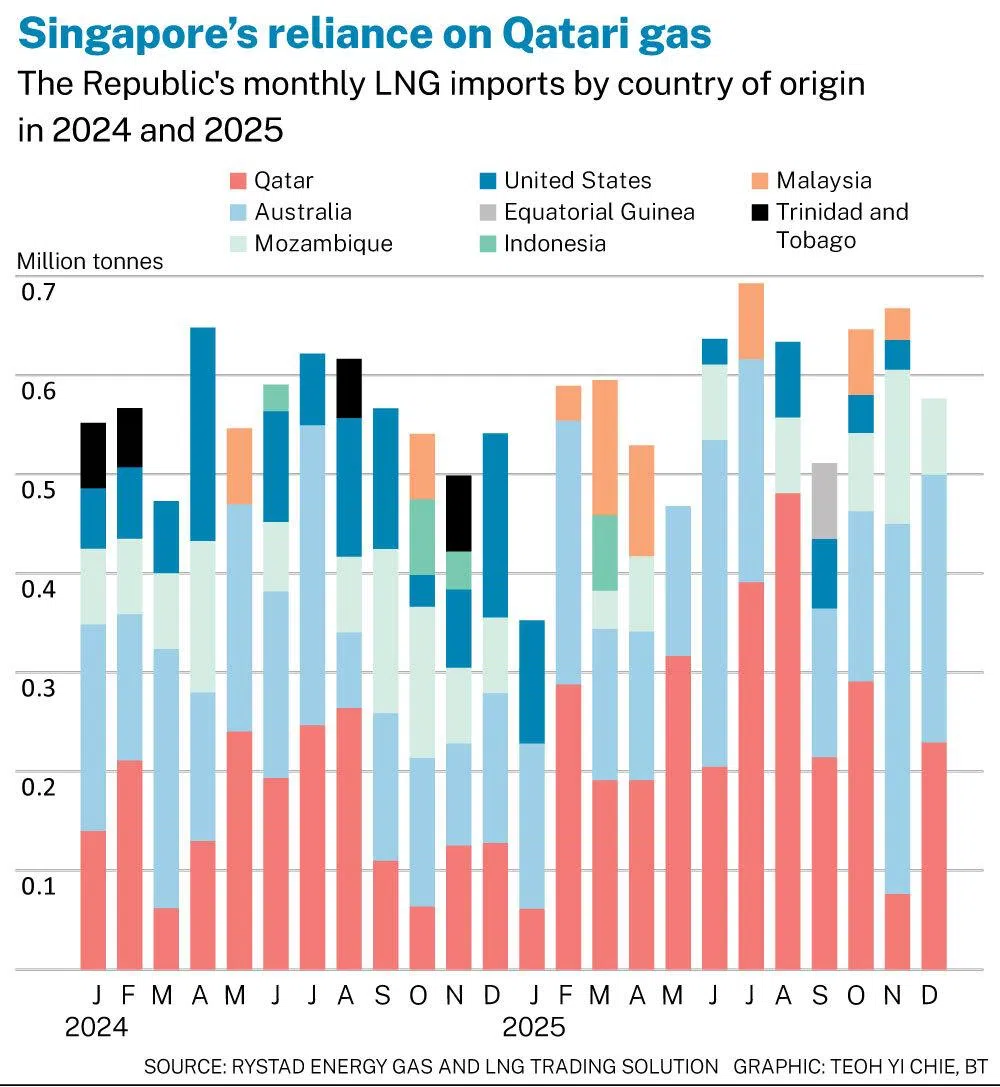
About 42.5 per cent of Singapore’s LNG imports in 2025 originated from Qatar, according to research outfit Rystad Energy. This figure is based on the average of monthly import shares recorded throughout the year.
Gas prices have surged as much as 50 per cent in European and Asian markets, after the world’s largest LNG producer, QatarEnergy, was forced to shut down production in the wake of drone attacks.
The EMA spokesperson said most electricity consumers are “cushioned” from immediate price volatility as they are purchasing electricity either through a fixed-price retail contract from retailers or the regulated tariff from SP Group.
However, some consumers on retail contracts may see an increase in electricity prices at the point of contract renewal, if fuel costs remain elevated at that point, the spokesperson noted.
Likewise, households on the regulated tariff may see a rise in prices in coming quarters if fuel costs stay high. Regulated tariffs are adjusted every quarter based on average fuel costs in the first 2.5 months of the preceding quarter.
The EMA spokesperson said the authority will “continue to closely monitor global developments and work with industry partners to safeguard Singapore’s energy security”.
Prepared since 2021 global energy crisis
Market players are likewise keeping a close eye on gas prices.
Dallon Kay, managing director of electricity retailer Diamond Electric, is concerned about how higher fuel prices “will filter through to the electricity market”.
The Republic’s electricity market was previously hit by the global energy crisis between 2021 and 2023, with large swings in wholesale electricity prices.
The Uniform Singapore Energy Price (USEP) hit S$491.24 per megawatt-hour (MWh) in October 2021, and another high of S$492.09 per MWh in May 2023, according to data from the Energy Market Company, which operates Singapore’s wholesale electricity market.
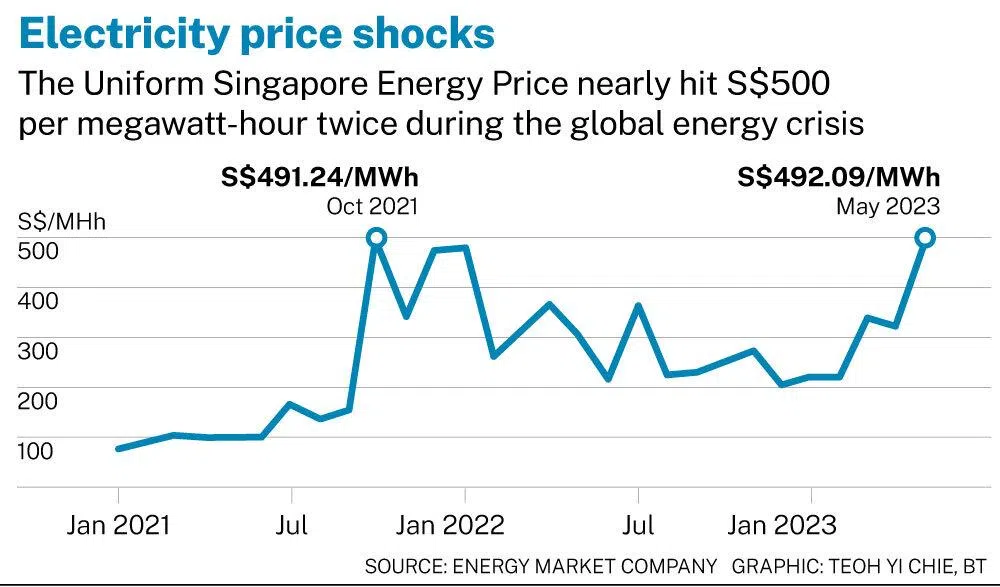
The market is still far from those peaks, with the USEP at $134.15 at 5.25 pm on Wednesday (Mar 4). However, the volatility of 2021 is still fresh on the minds of industry players.
The market was rocked by strong post-pandemic energy demand and an unplanned gas curtailment from Indonesia.
The volatility hit Singapore’s electricity retailers, especially those that did not sufficiently hedge their exposure. Five players exited the market in late 2021 – a development seen as a setback for the liberalisation of the power sector.
Russia’s invasion of Ukraine the next year then deepened the global energy crisis.
That said, Kay of Diamond Electric believes that “with the exit of smaller players previously, those that remain are stronger and more resilient”.
“Things can change quickly, so we do monitor the market and defaults, but so far, there haven’t been any indications of any retailers defaulting,” he told BT in a phone interview.
He also noted that EMA has since taken measures to strengthen the market’s resilience.
Since 2021, the energy regulator has established a standby LNG facility, which power generation companies, or gencos, can draw from to generate electricity if their natural gas supplies are disrupted.
It also requires gencos to maintain sufficient fuel for power generation based on their available generation capacity.
In 2023, EMA introduced the temporary price cap mechanism to act as a “circuit breaker” that is activated during periods of high and sustained volatility in Singapore’s wholesale electricity market.
It also set up a new centralised gas buyer, Singapore GasCo, to procure natural gas from diverse sources and enter into longer-term gas contracts for price stability.
“These measures help secure our fuel and electricity supply and mitigate price volatility,” said the EMA spokesperson.
GasCo declined to comment in response to BT’s queries on Singapore’s exposure to the Middle East gas market and actions it has taken or may take to stabilise the market.
Better equipped, but uncertainty looms
Chong Zhixin, director of Asia gas research at S&P Global Energy, expects that GasCo will likely work with Singapore’s LNG importers – such as Shell, Sembcorp Industries and ExxonMobil – to determine if there will be any supply shortfall in the coming weeks.
“With Singapore having GasCo to centralise procurement, (the country) will be better equipped to import additional LNG supply to maintain energy security,” he said.
Chong also noted that the previous crisis was caused by a permanent reduction in piped gas supplies into Europe, which led to a global shortage of LNG.
But in the case of the Strait of Hormuz, it is in the interest of many countries to ensure that oil and LNG trade out of the Middle East continues flowing.
Paul Everingham, chief executive of the Asia Natural Gas and Energy Association, said South-east Asia should not see any significant supply disruption in the short term, because it also sources LNG from Australia and the US.
Nevertheless, he emphasised the importance of a “diverse” supply chain that includes multiple supply countries and companies, as well as contract lengths.
In the longer term, there are indications that competition for LNG supply could intensify.
The European spot benchmark price for gas has surpassed the Asian one due to low gas storage levels and “panic buying”, noted Sam Reynolds, LNG and gas research lead for Asia with the Institute for Energy Economics and Financial Analysis.
“This is a flash of 2022, when European and Asian buyers were competing for limited supplies of LNG globally,” he said during a webinar on Wednesday. “And we’re starting to see that competition re-emerge, even in the very early days of the conflict.”
Another risk is the devaluation of Asian currencies creating a “vicious feedback loop”.
“Not only do you have higher-priced energy imports, you also have weaker local currencies, which means that those imports become more expensive in local currency terms,” said Reynolds. “Importantly, those currency devaluations can outlast the high cost of energy imports.”
Pump prices up
In the meantime, petrol companies have been quick to raise pump prices.
The Straits Times reported that prices of petrol have largely climbed with a crucial channel for oil supplies shut.
Shell was the first to raise its posted price of the popular 95-octane fuel by S$0.04 to $2.92 a litre on Tuesday morning.
Caltex increased its prices to match Shell’s past midday, a move that was followed closely by Esso. Sinopec backed the trend hours later.
SPC is the only operator that kept its prices of 95-octane petrol unchanged at $2.87 throughout Tuesday. As at midday on Wednesday, it had still not raised the prices of its offerings, according to Price Kaki, a necessities price tracker set up by the Consumers Association of Singapore.
A Shell spokesperson declined to comment on why it raised the prices of its fuel and diesel.
Currently, SPC has the cheapest 92-octane petrol at $2.84, with Esso and Caltex having raised prices to $2.88. Shell and Sinopec do not offer 92-octane petrol.
SPC also offers regular 98-octane petrol at the lowest rate at $3.38. Esso and Sinopec are offering the grade at $3.42, with the priciest being at Shell at $3.44.
The so-called premium 98-octane option ranges from $3.55 at Sinopec to $3.66 at Shell.
Commercial fleet owners and taxi drivers were not spared, with diesel pump prices rising in tandem. The highest posted price is $2.70 at Shell, Esso and Caltex, with the lowest at $2.57 at SPC.
Decoding Asia newsletter: your guide to navigating Asia in a new global order. Sign up here to get Decoding Asia newsletter. Delivered to your inbox. Free.
Copyright SPH Media. All rights reserved.






