

Household debt on the rise but may be cushioned by wage, financial assets growth: MAS
Households’ financial assets grow 8% on the year

DESPITE rising household debt, most borrowers are still likely able to repay loans, as wages and financial assets grow at a faster pace, said the Monetary Authority of Singapore (MAS) in its annual Financial Stability Review on Wednesday (Nov 27).
Singapore households’ financial vulnerabilities remained fairly low over the past year, supported by a “strong balance sheet” and “good credit quality”.
In the third quarter of 2024, households’ financial assets grew 8 per cent on the year, outpacing growth in overall household debt.
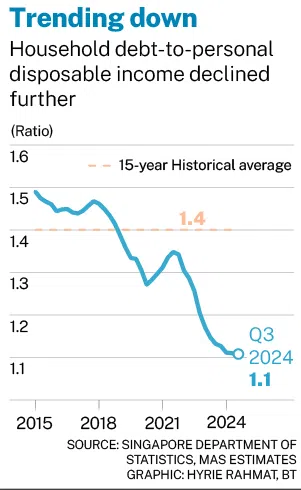
Household debt as a share of personal disposable income stabilised at a multiple of 1.1 as at Q3, indicated MAS.
Household debt includes loans backed by property collateral.
Outstanding home loans rose 1.6 per cent on the year in Q3, with new loans offset by borrowers paying down existing mortgages amid higher rates.
Stress tests done on borrowers showed that most could weather higher mortgage rates, even with rates rising to 5.5 per cent, with an income loss of 10 per cent.
Mortgage rates moderated over the past year as markets anticipated a peak in the global interest rate cycle in the first half of the year, along with policy easing by major central banks.
Fixed-rate mortgage packages peaked at 4.5 per cent in end-2022 and fell to below 3 per cent in H1 2024.
MAS also noted that some 90 per cent of borrowers now bear higher post-pandemic interest rates.
This includes those who refinanced or took out new loans since central banks started hiking rates in the second half of 2022.
As a result, the impact of higher rates has largely been absorbed by borrowers, reducing the risk of future financial strain from delayed rate adjustments, said the authority.
Property prices fell in Q3, down 0.7 per cent quarter on quarter – marking the first decline since the second quarter of 2023.
Overall, prices were up 1.6 per cent in the first nine months of 2024, “significantly slower” than the 3.9 per cent increase over the same period last year.
New private residential sales volume fell 43 per cent in the first three quarters.
This came as developers held back major project launches, partially offset by higher resale transactions in the same period.
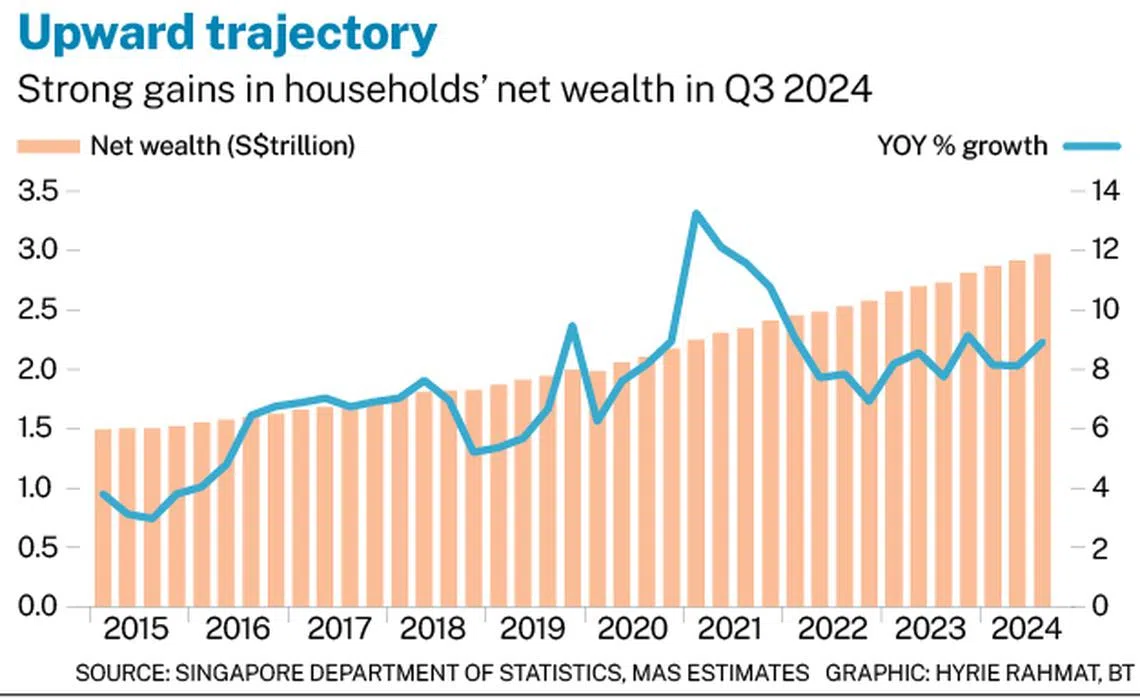
Meanwhile, net wealth among Singapore households grew 9 per cent on the year to nearly S$3 trillion as at Q3, largely driven by sustained growth in liquid assets, which continued to outstrip total liabilities.
Liquid assets, including cash and deposits, made up about 20 per cent of total assets as at Q3.
Although personal loans were up 5.1 per cent on the year in Q3, MAS noted that this growth rate remained below the historical average pace of 5.7 per cent.
Most borrowers have also been able to service their credit/charge card debt, despite rising balances – reflecting robust growth in resident outbound travel and domestic retail sales, MAS noted.
Meanwhile, credit quality of housing loans “remains strong”, with housing non-performing loans ratio staying low at 0.3 per cent.
The central bank expects risks to the household sector to remain contained, given strong financial buffers.
“Given the heightened geopolitical uncertainties and trade tensions in the macro-financial environment, households should continue to exercise prudence in their financial management,” it pointed out.
TRENDING NOW

LTA proposes combining car COE categories, adding rebate-surcharge system

StarHub to acquire MyRepublic’s mobile business amid ongoing telco consolidation

DBS, OCBC, UOB rout lops billions off STI as inflation, rate concerns spook investors

Grab CEO’s wife Chloe Tong on life with Anthony Tan and finding her purpose

