Instead of a separate COE category, make private-hire cars bid for open certificates
The open category already exists for COE flexibility. What better place for vehicles with both private and commercial functions?

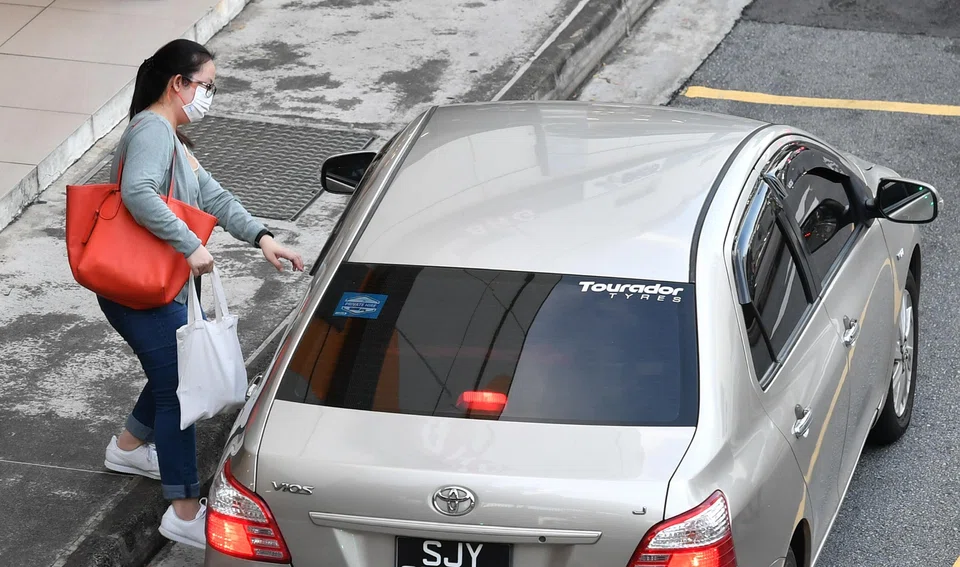
[SINGAPORE ] Industry players and disgruntled car owners have called for private-hire cars (PHCs) to get their own Certificate of Entitlement (COE) category, as a perceived way of hiving off demand.
But the Ministry of Transport (MOT) rejected this on Mar 5, after a long review.
As constantly changing PHC demand makes it hard to determine a suitable quota, their share of COEs is best left to the market to decide, said Senior Minister of State for Transport Amy Khor.
This means PHC fleets will continue to compete with private car buyers for certificates, possibly increasing demand and driving up premiums.
Perhaps one solution is to make PHCs bid for COEs in Category E, also known as the open category.
This would remove them from competition with most private passenger car buyers, while still leaving the premium to be decided by market forces.
Open season
Shifting PHCs to this category would address the difficulties raised by MOT, while addressing car buyers’ concerns about competition.
PHCs do not need their own category, said Dr Khor, because most of the demand for Category A and B COEs comes from local individuals – not PHCs or car-leasing companies.
In February 2025, business-owned PHCs made up 6 per cent and 8 per cent of successful Category A and B bids, respectively.
Volume, however, is only part of the picture. A bidder who does not obtain many COEs can still drive prices up through aggressive bidding.
Indeed, a common complaint is that companies have greater financial muscle to bid high for COEs, driving premiums up. Industry estimates put the company-owned share of PHCs at around 80 per cent.
Nor should the long-term context be ignored. The chauffeured PHC population has increased dramatically over the past decade to 59,371 in 2024, from 1,609 in 2014.
In 2012, taxis were removed from Category A precisely because they were driving COE prices up. Perhaps the same should be done now, this time for PHCs.
PHCs can go where taxis did: to Category E.
A Category E COE can be used to register any type of vehicle except motorcycles. Its stated purpose, according to the Land Transport Authority, is to provide the necessary flexibility to accommodate changes in demand for different categories of vehicles.
In practice, it is largely used by car dealers to register cars that would otherwise use Category B COEs – typically the most expensive COE type.
Since they have a three-month transfer period – unlike Category A and B COEs which cannot be transferred – they are also bought speculatively if the premium is expected to increase in the near future.
Market still decides
Another MOT concern is that creating a PHC COE category would require taking quota from categories A and B.
Taking too little could result in a shortage of PHCs and rides; taking too much would mean a shortage of Category A and B COEs, and a potential price spike.
It is best to let the market determine the balance of PHCs and passenger cars, said Dr Khor.
But, shifting PHCs to Category E would still allow for that. Currently, Category E’s quota is significant – almost 11 per cent of the combined Category A and B total – so it should be sufficient to absorb PHC demand.
Granted, some fine-tuning would be required.
Taxi COEs already come from the Category E quota, but taxi companies do not bid for certificates. Instead, they are allocated a certain amount after discussions with the government, and pay the three-month average price of Category A.
Since taxis offer the same services as PHCs, both should have to bid for Category E certificates.
If demand rises for taxis and PHCs, this could push up Category E premiums. But if that happens, the competition will be between commercial interest groups: car dealers, taxi and PHC companies. Private car buyers will be spared.