

JTC launches Singapore’s first district-level smart grid in Punggol
JTC teams up with Univers and PacificLight to create Singapore’s first integrated solar energy network in Punggol Digital District


JTC has tapped Univers and PacificLight to pioneer Singapore’s first district-level smart grid in Punggol Digital District (PDD), integrating solar panels with a battery-energy storage system to enhance energy resilience and reduce costs.
The smart grid for the business park will harness solar energy, store it in batteries, and distribute it within the district, or, in time to come, feed the power back to the national grid, said Nelson Liew, JTC’s group director of new estates, at a media briefing.
This on-site renewable energy generation is expected to lower electricity costs for JTC and PDD tenants, marking a significant step towards sustainable urban development.
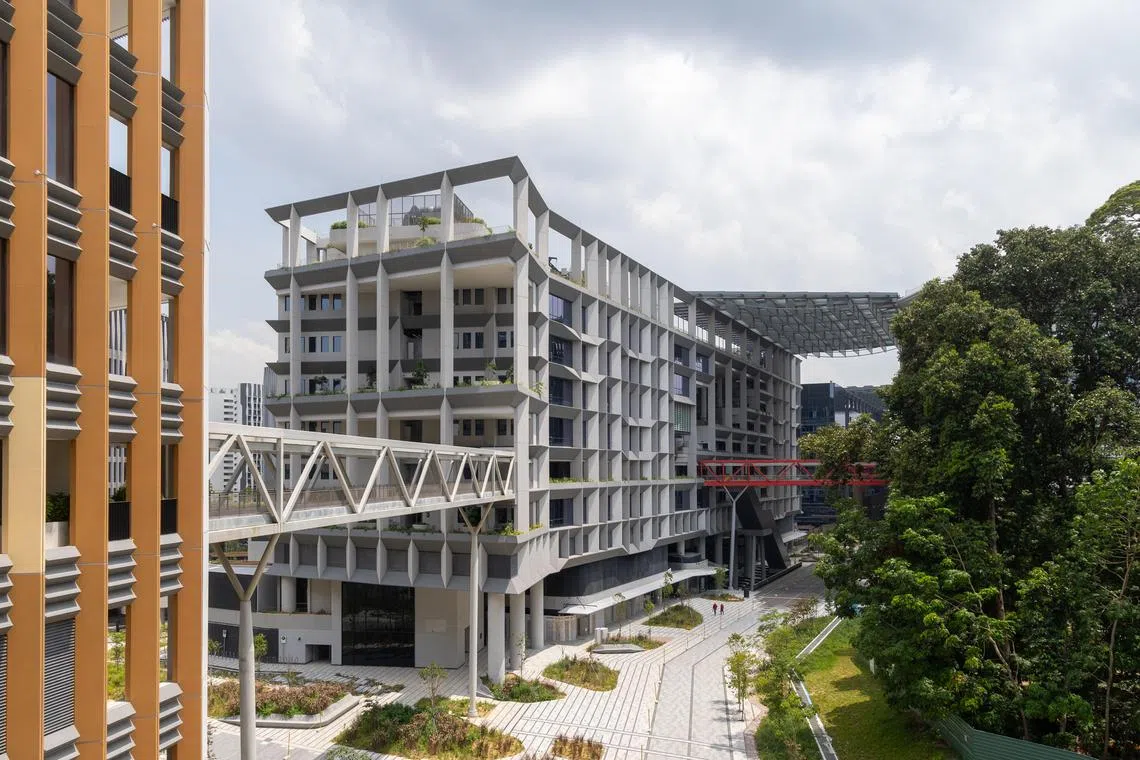
Under the partnership, Singapore-headquartered decarbonisation software firm Univers supplies the smart grid controller, and electricity retailer PacificLight installs the equipment, including the rooftop solar photovoltaic (PV) panels and the battery-energy storage system. PacificLight will operate and maintain the equipment for the next 20 years.
The district’s solar panels are expected to produce over 3,000 megawatt-hours of clean energy annually, just under 10 per cent of the demand in PDD.
Currently in the design phase, the smart grid is jointly developed by JTC, the Energy Market Authority (EMA), as well as the Public Sector Science & Technology Policy & Plans Office (S&TPPO) under the Prime Minister’s Office. It is expected to be completed by mid-2026.
Zahir Siddique, director of delivery lead at Univers, said the smart grid’s software will be designed to include features to handle future use cases. The interfaces between the smart grid and the Open Digital Platform will also be defined.
When completed, the smart grid will enable electricity consumers in PDD to take part in the demand response programme which the EMA launched in 2016; under this, consumers can choose to voluntarily time their electricity usage from peak to off-peak periods, and receive an incentive payment for doing so.
In future, the smart grid can also support Singapore’s national grid. Jonathan Tai, PacificLight’s senior manager of business development, said: “What we are going to test here (in PDD) is, when the smart grid controller detects (energy price spikes), it triggers the Auto Transfer Switch, such that, instead of supplying energy to the JTC loads, it goes directly to the national grid.”
Data is expected to be generated from the smart grid, such as the precise amount of energy being drawn from the grid and from solar PV panels, and the amount consumed by each tenant.
James Tan, JTC’s director of the smart district division, said that with this data, the team can explore the use of machine learning and artificial intelligence (AI), and eventually optimise the system through modelling simulations.
There is potential for further energy savings of up to 20 per cent, which can be achieved through AI and machine learning.
Asked how the smart grid’s success would be measured, JTC’s Liew listed three factors: The first is whether the smart grid can work seamlessly within the estate, including automatically switching between discharging to the estate and to the national grid at the right time, price and environment.
The second factor is whether the smart grid can achieve cost savings for the parties involved, and the amount of such savings; the third factor is the extent to which everyone in the estate can be brought onboard this sustainability journey.
Decoding Asia newsletter: your guide to navigating Asia in a new global order. Sign up here to get Decoding Asia newsletter. Delivered to your inbox. Free.
Copyright SPH Media. All rights reserved.
TRENDING NOW

Grab CEO’s wife Chloe Tong on life with Anthony Tan and finding her purpose

Hwa Seng Builder, two China companies win S$1.2 billion Tuas Road Viaduct phase two contracts

Deal between tycoon friends sparks scrutiny of Philippine power sector

Canada is upping oil flows to Asia, but South-east Asia’s refineries aren’t ready to handle them yet

